Comet Elenin: Preview of a coming attraction
May 5, 2011
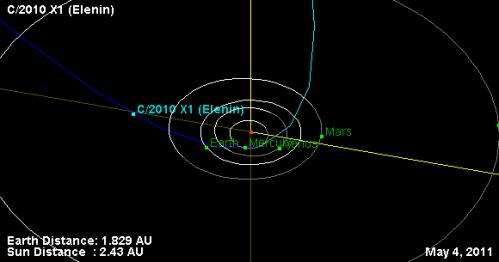
Trajectory of comet Elenin. Image credit: NASA/JPL-Caltech
(PhysOrg.com) -- You may have heard the news: Comet Elenin is coming to the inner-solar system this fall. Comet Elenin (also known by its astronomical name C/2010 X1), was first detected on Dec. 10, 2010 by Leonid Elenin, an observer in Lyubertsy, Russia, who made the discovery "remotely" using the ISON-NM observatory near Mayhill, New Mexico. At the time of the discovery, the comet was about 647 million kilometers (401 million miles) from Earth. Over the past four-and-a-half months, the comet has as comets do closed the distance to Earth's vicinity as it makes its way closer to perihelion (its closest point to the sun). As of May 4, Elenin's distance is about 274 million kilometers (170 million miles).
"That is what happens with these long-period comets that come in from way outside our planetary system," said Don Yeomans of NASA's Near-Earth Object Program Office at NASA's Jet Propulsion Laboratory in Pasadena, Calif. "They make these long, majestic, speedy arcs through our solar system, and sometimes they put on a great show. But not Elenin. Right now that comet looks kind of wimpy."
How does a NASA scientist define cometary wimpiness?
"We're talking about how a comet looks as it safely flies past us," said Yeomans. "Some cometary visitors arriving from beyond the planetary region like Hale-Bopp in 1997 -- have really lit up the night sky where you can see them easily with the naked eye as they safely transit the inner-solar system. But Elenin is trending toward the other end of the spectrum. You'll probably need a good pair of binoculars, clear skies, and a dark, secluded location to see it even on its brightest night."
Comet Elenin should be at its brightest shortly before the time of its closest approach to Earth on Oct. 16 of this year. At its closest point, it will be 35 million kilometers (22 million miles) from us. Can this icy interloper influence us from where it is, or where it will be in the future? What about this celestial object inspiring some shifting of the tides or even tectonic plates here on Earth? There have been some incorrect Internet speculations that external forces could cause comet Elenin to come closer.
"Comet Elenin will not encounter any dark bodies that could perturb its orbit, nor will it influence us in any way here on Earth," said Yeomans. "It will get no closer to Earth than 35 million kilometers [about 22 million miles]."
"Comet Elenin will not only be far away, it is also on the small side for comets," said Yeomans. "And comets are not the most densely-packed objects out there. They usually have the density of something akin to loosely packed icy dirt.
"So you've got a modest-sized icy dirtball that is getting no closer than 35 million kilometers," said Yeomans. "It will have an immeasurably miniscule influence on our planet. By comparison, my subcompact automobile exerts a greater influence on the ocean's tides than comet Elenin ever will."
Yeomans did have one final thought on comet Elenin.
"This comet may not put on a great show. Just as certainly, it will not cause any disruptions here on Earth. But there is a cause to marvel," said Yeomans. "This intrepid little traveler will offer astronomers a chance to study a relatively young comet that came here from well beyond our solar system's planetary region. After a short while, it will be headed back out again, and we will not see or hear from Elenin for thousands of years. That's pretty cool."
NASA detects, tracks and characterizes asteroids and comets passing relatively close to Earth using both ground- and space-based telescopes. The Near-Earth Object Observations Program, commonly called "Spaceguard," discovers these objects, characterizes a subset of them, and predicts their paths to determine if any could be potentially hazardous to our planet.
-
Image: Comet Hartley 2 approaches Earth
Sep 30, 2010 |
not rated yet |
0
-
Meteor shower is possible next week
May 17, 2006 |
not rated yet |
0
-
The comet cometh: Hartley 2 visible in night sky
Oct 19, 2010 |
not rated yet |
0
-
The great cometary show
Jan 19, 2007 |
not rated yet |
0
-
New Comet Discovered from Mauna Kea
Dec 05, 2005 |
not rated yet |
0
-
Stars containing dark matter should look different from other stars
Feb 20, 2012 |
4.5 / 5 (17) |
11
-
Physicists discover evidence of rare hypernucleus, a component of strange matter
Feb 17, 2012 |
4.7 / 5 (38) |
22
-
Fast photon control brings quantum photonic technologies closer
Feb 13, 2012 |
5 / 5 (8) |
1
-
Engineers build first sub-10-nm carbon nanotube transistor
Feb 01, 2012 |
4.9 / 5 (36) |
32
-
Something old, something new: Evolution and the structural divergence of duplicate genes
Jan 31, 2012 |
4.6 / 5 (7) |
1
-
Calculating the magnitude
2 hours ago
-
What is this spectrum I took?
12 hours ago
-
Orientation of Space
13 hours ago
-
Geologically Active Moon Now: NASA
20 hours ago
-
advice on building a science fair telescope
Feb 22, 2012
-
Rise of the Sun
Feb 22, 2012
- More from Physics Forums - General Astronomy
More news stories
Spitzer finds solid buckyballs in space
(PhysOrg.com) -- Astronomers using data from NASA's Spitzer Space Telescope have, for the first time, discovered buckyballs in a solid form in space. Prior to this discovery, the microscopic carbon spheres ...
14 hours ago |
4.7 / 5 (12) |
8
|
Going up: Japan builder eyes space elevator
A Japanese construction firm claimed Wednesday it could execute an out-of-this-world plan to put tourists in space within 40 years by building an elevator that stretches a quarter of the way to the moon.
Space & Earth / Space Exploration
21 hours ago |
3.5 / 5 (13) |
26
ENASA satellite finds Earth's clouds are getting lower
(PhysOrg.com) -- Earth's clouds got a little lower -- about one percent on average -- during the first decade of this century, finds a new NASA-funded university study based on NASA satellite data. The results ...
Space & Earth / Earth Sciences
18 hours ago |
5 / 5 (8) |
13
|
Fresh scandal embroils US climate science debate
A fresh scandal over climate change has erupted in the United States after leaked documents appeared to show a right-wing funded campaign to influence how climate science is taught in schools.
11 hours ago |
4.1 / 5 (9) |
8
World's oceans get an acid bath
Among the repercussions of global climate change, the effect of ocean acidification on marine life is one of the least-understood variables.
18 hours ago |
4.3 / 5 (6) |
4
|
Researchers build first physical 'metatronic' circuit
(PhysOrg.com) -- The technological world of the 21st century owes a tremendous amount to advances in electrical engineering, specifically, the ability to finely control the flow of electrical charges using ...
Faster than light neutrinos? More like faulty wiring
You can shelf your designs for a warp drive engine (for now) and put the DeLorean back in the garage; it turns out neutrinos may not have broken any cosmic speed limits after all.
Physicists surprised by disappearing and reappearing superconductivity in iron selenium chalcogenides
Superconductivity is a rare physical state in which matter is able to conduct electricity -- maintain a flow of electrons -- without any resistance. This phenomenon can only be found in certain materials at low temperatures, ...
Stanford research team cracks animated NuCaptcha
(PhysOrg.com) -- The research team from Stanford University, led by Elie Bursztein, that previously had cracked regular CAPTCHAs and then audio CAPTCHAs, now has also successfully cracked the animated version called NuCapt ...
Flesh-eating bacteria inspire superglue
(PhysOrg.com) -- A bio-inspired superglue has been developed by Oxford University researchers that cant be matched for sticking molecules together and not letting go.
Scientists create potent molecules aimed at treating muscular dystrophy
While RNA is an appealing drug target, small molecules that can actually affect its function have rarely been found. But now scientists from the Florida campus of The Scripps Research Institute have for the first time designed ...
May 05, 2011
Rank: 1.3 / 5 (14)
Raises some very tough questions:
1. Just where does the comet come from? There is no OORD cloud to supply it - that idea is just a myth. Nor can the Kuiper belt dish out such a body.
2. How come we can still see comets? Shouldn't these things have vanished long ago - after all they only last a few thousand years at most before disintegrating. So how would they have survived since the creation of the solar system supposedly 4.5 billion years ago? Or are we going to assume that comets suddenly appeared from somewhere in recent times, we just don't know where, i.e. we have no clue?
3. Is it reasonable to say that since comets are still around and they're not being replenished [ as all evidence currently seems to show], that perhaps the solar system is NOT 4.5 billion year old but is still relatively young?
May 05, 2011
Rank: 5 / 5 (8)
Uh... comets last a very long time indeed. You might want to read up or take an astronomy class.
And no, the solar system isn't very young at all. We have direct physical evidence in the form of billions of years old rocks from certain places on Earth, and even older rocks from the Moon.
May 05, 2011
Rank: 5 / 5 (6)
May 05, 2011
Rank: 5 / 5 (2)
Although I admit I did feel a bit of that vibe, to be fair, he never actually said that. I prefer to think he's just misinformed.
Innocent until proven guilty!
May 05, 2011
Rank: 1 / 5 (9)
Given observations made by some of the recent space probes with close encounters with comets and asteroids, what Kevin said is actually correct.
Based on extrapolation of erosion rates from actual recent observations and flyby of comets and asteroids, there is no way short period comets could possibly survive more than a few thousand years.
Long period comets may last an order of magnitude more or so...
May 05, 2011
Rank: 5 / 5 (4)
May 05, 2011
Rank: 5 / 5 (9)
@kevinrts
Please show some evidence supporting your claim that it's just a myth. Preferably from some individual or group that's actually qualified to make such statements.
While we're on the subject of evidence, I'm still waiting for you to produce something showing the existance of a magical sky fairy, or showing that said fairy had anything to do with producing your favorite book of fables.
You DO understand the concept of "credibility", don't you? As in, "you don't have any" ?
May 05, 2011
Rank: 1 / 5 (14)
We have particles 'emitted' from the sun right now - that make total mincemeat of any idea of carbon dating being accurate. Those 'particles' are changing what we thought was a stable decay rate.
To an interestingly large extent, the very idea of carbon dating was tossed out the window.
So no, you now have no accurate knowledge base from which to date those components.
Radioactive decay as a 'knowledge base' was scrapped, as 'systems' go.
May 05, 2011
Rank: 4.2 / 5 (5)
May 05, 2011
Rank: 5 / 5 (5)
Just where does your insanity come from?
KBK,
To an interestingly large extent, the very idea of your relevancy was tossed out the window.
Both,
Explain geologic layering, your great flood and actual recorded histories, or Hubble imagery. AND, provide ANY evidence that ANY religious book is in ANY WAY authoritative.
You won't because you can't. Next?
May 05, 2011
Rank: 5 / 5 (5)
Is this your knew "gap" "evidence?" I don't have the time to research and refute this, but I have little doubt that someone else does. Regardless, lack of information for a theory does not add evidence to a contrary hypothesis. You sure think it does, though, don't you?
May 05, 2011
Rank: 4.8 / 5 (6)
May 05, 2011
Rank: 5 / 5 (5)
Odd that no-one in the scientific community has heard about this. Must be secret work by all those highly-qualified creotard scientists.
Sarcasm aside, please provide references and/or credible scientific evidence/research to back up your wild and unsubstantiated claim. Until then, be prepared to be treated with all the respect and attention normally given to creotard lunacy.
May 06, 2011
Rank: 5 / 5 (3)
Images of the OORT Cloud are easily found with a google search, as are cometary erosion rates.
Most humans have difficulty grasping very large numbers (the diameter of the observable universe is 47 Billion light years. This does not mean that the Big Bang is wrong; space can, and does, expand faster than the speed of light. (This does not violate the laws of relativity.) The sun loses 4 tons per second. That might seem like a lot but the solar mass is on the order of 10^30 tons. If you know the math & science you can easily calculate that there will still be plenty of solar mass left in 15 billion years when it runs out of hydrogen and begins to fuse iron, the death knell for stars.
Take a few semesters of real math (calculus, differential equations) and science (physics, chemistry, and astronomy) before you start tossing out ridiculous assertions based on fairy tales.
May 06, 2011
Rank: 5 / 5 (4)
If you're not equipped to process the information then keep on believing the crap number that was calculated by the archbishop Ussher of Orange. It was he, in the 17th century (1633) that used a non-historical record to calculate that the earth had been created on Oct 23, 4004 BCE. Now that's a reliable source, right? Foolishness.
May 09, 2011
Rank: not rated yet