New explanation for Hawaiian hot spot
May 27, 2011 by Lin Edwards
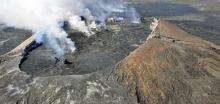
Hawaii Volcanoes National Park. Image: nps.gov
(PhysOrg.com) -- Scientists in the US have suggested that volcanic activity in Hawaii could be fed by a giant hot rock pool 1,000 kilometers west of the islands and in the Earths mantle, rather than being fed by a hot plume of magma as previously thought.
Hawaiis volcanoes have puzzled scientists for decades because the islands lie in the middle of a tectonic plate rather than at the edge, where volcanic activity would be expected. Until now the prevailing theory has been the mantle plume theory, which suggested the volcanism was fed by a hot plume rising from the Earths mantle, but so far efforts to detect a hot plume seismically have remained inconclusive.
The mantle plume theory was developed by US scientist Jason Morgan in 1971 and suggests the tectonic plate is sliding above a stationary plume of molten rock lying deep within the mantle, with upwellings of lava forming undersea volcanoes that eventually grew upwards to become islands. As the tectonic plate continued to move the volcanoes were extinguished and some of the islands eroded and dropped below sea level. The result was the Hawaiian-Emperor seamount chain, which stretches from the Aleutian Trench in the northwest to the present-day Hawaiian islands in the southeast.
The new research, by a team led by seismologist Dr Robert van der Hilst of the Massachusetts Institute of Technology (MIT) imaged the scattering of seismic waves from discontinuities in the mantle to try to identify plumes and other subterranean structures. Discontinuities are formed when the rocks in the mantle are squeezed together at such high pressures that they abruptly reorganize themselves. They included data from almost 170,000 reflected seismic signals along with seismic data from around 4,800 earthquakes in the Pacific region.
The next step in the research was to use computer models of the behavior of a variety of minerals at different temperatures and pressures to predict the temperature of the regions beneath the Earths surface that reflect the seismic waves.
The results suggested a shallow 800-to 2,000-kilometer-wide thermal anomaly exists near the top of the lower mantle around 720 kilometers beneath the surface to the west of Hawaii. This suggests that the mantle plume theory might be wrong, since the findings do not support hot material rising as a narrow vertical plume.
According to van der Hilst, the current volcanic activity might be fuelled instead by molten rocks bubbling upwards from the eastern edge of the pool of trapped materials like a lava lamp rather than a mantle plume.
Other scientists have some misgivings, with Thorne Lay of the University of California pointing out that some of the data selected for the analysis were not clean enough since 170,000 good quality waveforms do not exist, and using noisy data could have introduced errors.
Dr van der Hilst agreed the team used data other seismologists could discard as too noisy, but said they were able to exploit the noise reduction of very large data sets. He also said that carefully selecting data could produce bias in the results.
The paper was published in the journal Science on May 27.
More information: Seismic Imaging of Transition Zone Discontinuities Suggests Hot Mantle West of Hawaii, Science 27 May 2011: Vol. 332 no. 6033 pp. 1068-1071 DOI: 10.1126/science.1202731
ABSTRACT
The Hawaiian hotspot is often attributed to hot material rising from depth in the mantle, but efforts to detect a thermal plume seismically have been inconclusive. To investigate pertinent thermal anomalies, we imaged with inverse scattering of SS waves the depths to seismic discontinuities below the Central Pacific, which we explain with olivine and garnet transitions in a pyrolitic mantle. The presence of an 800- to 2000-kilometer-wide thermal anomaly (ΔTmax ~300 to 400 kelvin) deep in the transition zone west of Hawaii suggests that hot material does not rise from the lower mantle through a narrow vertical plume but accumulates near the base of the transition zone before being entrained in flow toward Hawaii and, perhaps, other islands. This implies that geochemical trends in Hawaiian lavas cannot constrain lower mantle domains directly.
© 2010 PhysOrg.com
-
New Technology Allows Geophysicist To Test Theory About Formation of Hawaii (w/ Podcast)
Dec 11, 2009 |
not rated yet |
0
-
Hawaiian hot spot has deep roots
Dec 03, 2009 |
not rated yet |
0
-
What lies beneath: new research looks deep into the centre of the Earth
Jan 20, 2006 |
not rated yet |
0
-
Looking deep in Earth, researchers see upwellings that could be root of volcanic islands
Jun 01, 2005 |
not rated yet |
0
-
Fledgling mantle plume may be cause of African volcano's unique lava
Mar 13, 2009 |
not rated yet |
0
-
Stars containing dark matter should look different from other stars
Feb 20, 2012 |
4.5 / 5 (17) |
11
-
Physicists discover evidence of rare hypernucleus, a component of strange matter
Feb 17, 2012 |
4.7 / 5 (38) |
22
-
Fast photon control brings quantum photonic technologies closer
Feb 13, 2012 |
5 / 5 (8) |
1
-
Engineers build first sub-10-nm carbon nanotube transistor
Feb 01, 2012 |
4.9 / 5 (36) |
32
-
Something old, something new: Evolution and the structural divergence of duplicate genes
Jan 31, 2012 |
4.6 / 5 (7) |
1
-
Is the Earth really going to die
13 hours ago
-
Do some geologists actually act a lot like Randy Marsh?
Feb 11, 2012
-
Discrepancy between oxygen and carbon-dioxide levels
Feb 09, 2012
-
where gems are found in the world
Feb 09, 2012
-
Wind Waves in Reservoir ~ Wind run-up and Wind set-up
Feb 08, 2012
-
Balance of oxygen in the atmosphere
Feb 01, 2012
- More from Physics Forums - Earth
More news stories
Spitzer finds solid buckyballs in space
(PhysOrg.com) -- Astronomers using data from NASA's Spitzer Space Telescope have, for the first time, discovered buckyballs in a solid form in space. Prior to this discovery, the microscopic carbon spheres ...
13 hours ago |
4.7 / 5 (12) |
8
|
Going up: Japan builder eyes space elevator
A Japanese construction firm claimed Wednesday it could execute an out-of-this-world plan to put tourists in space within 40 years by building an elevator that stretches a quarter of the way to the moon.
Space & Earth / Space Exploration
20 hours ago |
3.5 / 5 (13) |
26
ENASA satellite finds Earth's clouds are getting lower
(PhysOrg.com) -- Earth's clouds got a little lower -- about one percent on average -- during the first decade of this century, finds a new NASA-funded university study based on NASA satellite data. The results ...
Space & Earth / Earth Sciences
17 hours ago |
5 / 5 (8) |
12
|
Fresh scandal embroils US climate science debate
A fresh scandal over climate change has erupted in the United States after leaked documents appeared to show a right-wing funded campaign to influence how climate science is taught in schools.
10 hours ago |
4.1 / 5 (9) |
8
World's oceans get an acid bath
Among the repercussions of global climate change, the effect of ocean acidification on marine life is one of the least-understood variables.
17 hours ago |
4.3 / 5 (6) |
4
|
Researchers build first physical 'metatronic' circuit
(PhysOrg.com) -- The technological world of the 21st century owes a tremendous amount to advances in electrical engineering, specifically, the ability to finely control the flow of electrical charges using ...
Faster than light neutrinos? More like faulty wiring
You can shelf your designs for a warp drive engine (for now) and put the DeLorean back in the garage; it turns out neutrinos may not have broken any cosmic speed limits after all.
CT colonography shown to be comparable to standard colonoscopy
Computerized tomographic (CT) colonography (CTC), also known as virtual colonoscopy, is comparable to standard colonoscopy in its ability to accurately detect cancer and precancerous polyps in people ages 65 and older, according ...
Physicists surprised by disappearing and reappearing superconductivity in iron selenium chalcogenides
Superconductivity is a rare physical state in which matter is able to conduct electricity -- maintain a flow of electrons -- without any resistance. This phenomenon can only be found in certain materials at low temperatures, ...
Study: Virtual colonoscopy effective screening tool for adults over 65
Computed tomography (CT) colonography can be used as a primary screening tool for colorectal cancer in adults over the age of 65, according to a new study published online in the journal Radiology.
Stanford research team cracks animated NuCaptcha
(PhysOrg.com) -- The research team from Stanford University, led by Elie Bursztein, that previously had cracked regular CAPTCHAs and then audio CAPTCHAs, now has also successfully cracked the animated version called NuCapt ...
May 27, 2011
Rank: 1 / 5 (1)
I am sure many others had the idea before me. Just like the continental drift theory was proposed as early as the 17th century by a Catholic priest. In 1950 in the fourth grade another student and I also proposed and argued for a continental drift theory while standing in front of a globe.
But Morgan should get credit for publishing and getting others to respect his theory.
May 27, 2011
Rank: 4.2 / 5 (5)
See the difference?
May 28, 2011
Rank: not rated yet