Toward faster transistors: New physical phenomenon could lead to increases in computers' clock speed
May 13, 2011 by Larry Hardesty
Toward faster transistors

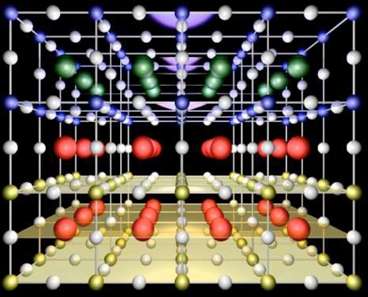
MIT researchers and colleagues at the University of Augsburg, in Germany, investigated the curious electrical properties of a material produced by stacking layers of lanthanum aluminate on layers of strontium titanate.

In the 1980s and ’90s, competition in the computer industry was all about "clock speed" — how many megahertz, and ultimately gigahertz, a chip could boast. But clock speeds stalled out almost 10 years ago: Chips that run faster also run hotter, and with existing technology, there seems to be no way to increase clock speed without causing chips to overheat.

In this week’s issue of the journal Science, MIT researchers and their colleagues at the University of Augsburg in Germany report the discovery of a new physical phenomenon that could yield with greatly enhanced capacitance — a measure of the voltage required to move a charge. And that, in turn, could lead to the revival of as the measure of a computer’s power.

In today’s computer chips, transistors are made from semiconductors, such as silicon. Each transistor includes an electrode called the gate; applying a voltage to the gate causes electrons to accumulate underneath it. The electrons constitute a channel through which an electrical current can pass, turning the semiconductor into a .

Capacitance measures how much charge accumulates below the gate for a given voltage. The power that a chip consumes, and the heat it gives off, are roughly proportional to the square of the gate’s operating voltage. So lowering the voltage could drastically reduce the heat, creating new room to crank up the clock.

Shoomp!

MIT Professor of Physics Raymond Ashoori and Lu Li, a postdoc and Pappalardo Fellow in his lab — together with Christoph Richter, Stefan Paetel, Thilo Kopp and Jochen Mannhart of the University of Augsburg — investigated the unusual physical system that results when lanthanum aluminate is grown on top of strontium titanate. Lanthanum aluminate consists of alternating layers of lanthanum oxide and aluminum oxide. The lanthanum-based layers have a slight positive charge; the aluminum-based layers, a slight negative charge. The result is a series of electric fields that all add up in the same direction, creating an electric potential between the top and bottom of the material.

Ordinarily, both lanthanum aluminate and strontium titanate are excellent insulators, meaning that they don’t conduct electrical current. But physicists had speculated that if the lanthanum aluminate gets thick enough, its electrical potential would increase to the point that some electrons would have to move from the top of the material to the bottom, to prevent what’s called a “polarization catastrophe.” The result is a conductive channel at the juncture with the strontium titanate — much like the one that forms when a transistor is switched on. So Ashoori and his collaborators decided to measure the capacitance between that channel and a gate electrode on top of the lanthanum aluminate.

They were amazed by what they found: Although their results were somewhat limited by their experimental apparatus, it may be that an infinitesimal change in voltage will cause a large amount of charge to enter the channel between the two materials. “The channel may suck in charge — shoomp! Like a vacuum,” Ashoori says. “And it operates at room temperature, which is the thing that really stunned us.”
Toward faster transistors

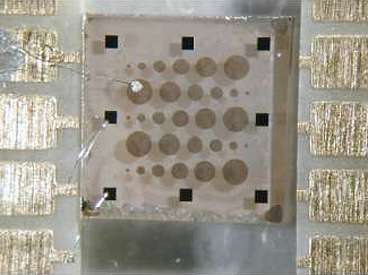
The researchers’ experimental setup consisted of a sample of the lanthanum aluminate-strontium titanate composite, which looks like a slab of thick glass, with thin electrodes deposited on top of it.

Indeed, the material’s capacitance is so high that the researchers don’t believe it can be explained by existing physics. “We’ve seen the same kind of thing in semiconductors,” Ashoori says, “but that was a very pure sample, and the effect was very small. This is a super-dirty sample and a super-big effect.” It’s still not clear, Ashoori says, just why the effect is so big: “It could be a new quantum-mechanical effect or some unknown physics of the material.”

“For capacitance, there is a formula that was assumed to be correct and was used in the computer industry and is in all the textbooks,” says Jean-Marc Triscone, a professor of physics at the University of Geneva whose group has published several papers on the juncture between lanthanum aluminate and strontium titanate. “What the MIT team and Mannhart showed is that to describe their system, this formula has to be modified.”

There is one drawback to the system that the researchers investigated: While a lot of charge will move into the channel between materials with a slight change in voltage, it moves slowly — much too slowly for the type of high-frequency switching that takes place in computer chips. That could be because the samples of the material are, as Ashoori says, “super dirty”; purer samples might exhibit less electrical resistance. But it’s also possible that, if researchers can understand the physical phenomena underlying the material’s remarkable capacitance, they may be able to reproduce them in more practical materials.

Triscone cautions that wholesale changes to the way computer chips are manufactured will inevitably face resistance. “So much money has been injected into the industry for decades that to do something new, you need a really disruptive technology,” he says.

“It’s not going to revolutionize electronics tomorrow,” Ashoori agrees. “But this mechanism exists, and once we know it exists, if we can understand what it is, we can try to engineer it.”


This story is republished courtesy of MIT News (http://web.mit.edu/newsoffice/), a popular site that covers news about MIT research, innovation and teaching.

Provided by Massachusetts Institute of Technology (news : web)

4.8 /5 (17 votes)  

Filter


Move the slider to adjust rank threshold, so that you can hide some of the comments.


Display comments: newest first

Vendicar_Decarian
May 13, 2011

Rank: 4.2 / 5 (11)
Big capacitance ay?

How big?

Bigger than an elephant?

Bigger than a Big Mac?

Bigger than the worlds biggest lump of cheese?

How many farads per unit volume? And how does it compare with existing super-capacitors?

I think it best to keep that information hidden. Don't you?
bluehigh
May 13, 2011

Rank: 5 / 5 (3)
Its getting boring here with the religious arguments and ad hominem attacks between various factions in the comments, so I may as well rate you 5 Vendi for valid sarcasm, especially as it seems you may have actually read the article!
Intensero
May 13, 2011

Rank: not rated yet
Yes please tell us your preliminary measurements before you publish this article.
boiseburns
May 13, 2011

Rank: not rated yet
Aren't the implications much greater than just the computer industry?
Burnerjack
May 13, 2011

Rank: not rated yet
Faster computers are cool! with all the %$#anti virus stuff I have to run,
My superduper laptop is almost as fast as my 80286 from back in the day.
Of course, for Cray's and the like it just might mean something.
Rank 4.8 /5 (17 votes)
Relevant PhysicsForums posts
  • which college offer Light and modern physics in summer?
    created59 minutes ago
  • linear wave equation vs. linear system
    created2 hours ago
  • adhesive force and surface tension
    created2 hours ago
  • Newbie here.
    created4 hours ago
  • Rainbows in space?
    created4 hours ago
  • taking mechanical physics next fall
    created5 hours ago
  • More from Physics Forums - General Physics

More news stories

Researchers build first physical 'metatronic' circuit

(PhysOrg.com) -- The technological world of the 21st century owes a tremendous amount to advances in electrical engineering, specifically, the ability to finely control the flow of electrical charges using ...

Physics / General Physics

created 10 hours ago | popularity 4.7 / 5 (17) | comments 5 | with audio podcast

Faster than light neutrinos? More like faulty wiring

You can shelf your designs for a warp drive engine (for now) and put the DeLorean back in the garage; it turns out neutrinos may not have broken any cosmic speed limits after all.

Physics / General Physics

created 9 hours ago | popularity 4.2 / 5 (22) | comments 23 | with audio podcast

Physicists surprised by disappearing and reappearing superconductivity in iron selenium chalcogenides

Superconductivity is a rare physical state in which matter is able to conduct electricity -- maintain a flow of electrons -- without any resistance. This phenomenon can only be found in certain materials at low temperatures, ...

Physics / Superconductivity

created 13 hours ago | popularity 5 / 5 (5) | comments 2 | with audio podcast

Less is more: Study of tiny droplets could have big impact on industrial applications

(PhysOrg.com) -- Under a microscope, a tiny droplet slides between two fine hairs like a roller coaster on a set of rails until — poof — it suddenly spreads along them, a droplet no more.

Physics / General Physics

created 10 hours ago | popularity 3.7 / 5 (3) | comments 0 | with audio podcast

Study reveals switching mechanism in promising computer memory device

(PhysOrg.com) -- Sometimes knowing that a new technology works is not enough. You also must know why it works to get marketplace acceptance. New information from the National Institute of Standards and Technology ...

Physics / General Physics

created 17 hours ago | popularity 4 / 5 (4) | comments 0 | with audio podcast


Spitzer finds solid buckyballs in space

(PhysOrg.com) -- Astronomers using data from NASA's Spitzer Space Telescope have, for the first time, discovered buckyballs in a solid form in space. Prior to this discovery, the microscopic carbon spheres ...

Stanford research team cracks animated NuCaptcha

(PhysOrg.com) -- The research team from Stanford University, led by Elie Bursztein, that previously had cracked regular CAPTCHAs and then audio CAPTCHAs, now has also successfully cracked the animated version called NuCapt ...

CT colonography shown to be comparable to standard colonoscopy

Computerized tomographic (CT) colonography (CTC), also known as virtual colonoscopy, is comparable to standard colonoscopy in its ability to accurately detect cancer and precancerous polyps in people ages 65 and older, according ...

Going up: Japan builder eyes space elevator

A Japanese construction firm claimed Wednesday it could execute an out-of-this-world plan to put tourists in space within 40 years by building an elevator that stretches a quarter of the way to the moon.

Scientists create potent molecules aimed at treating muscular dystrophy

While RNA is an appealing drug target, small molecules that can actually affect its function have rarely been found. But now scientists from the Florida campus of The Scripps Research Institute have for the first time designed ...

Flesh-eating bacteria inspire superglue

(PhysOrg.com) -- A bio-inspired superglue has been developed by Oxford University researchers that can’t be matched for sticking molecules together and not letting go.