Newly discovered plant fossil reveals more than age
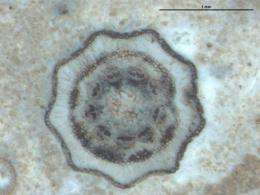
Over 100 million years ago, the understory of late Mesozoic forests was dominated by a diverse group of plants of the class Equisetopsida. Today, only one genus from this group, Equisetum (also known as horsetail or scouring rush), exists—and it is a prime candidate for being the oldest extant genus of land plant.
There is some debate as to the evolutionary beginnings of the genus Equisetum. Molecular dating places the divergence of the 15 extant species of the genus around 65 million years ago (mya), yet the fossil record suggests that it occurred earlier than that, perhaps around 136 mya. A discovery of a new fossil Equisetum species now places this genus at 150 mya, living in an environment where it still can be found today—hot springs.
Hot spring ecosystems and how they become fossilized are the main areas of research interest for Alan Channing, a geobiologist at Cardiff University, Wales. When he and colleagues from Wales and Argentina discovered the abundant fossilized remains of a species of Equisetum in southern Patagonia, they realized that not only could these fossils shed light on the phylogenetic age of this group of ancient plants, but they could also tell us something about how these plants lived, what types of environments they were adapted to, and their ecology and physiology. Moreover, they were intrigued to find out how closely these aspects might match extant species of Equisetum, especially those living in similar environments today. Their findings are published in the April issue of the American Journal of Botany (www.amjbot.org/cgi/reprint/98/4/680).
When Channing and his colleagues first began working in the remote Deseado Massif of Santa Cruz Province, Argentina—an area of ancient volcanic rocks—they did not know if they would find plant fossils. But the discovery of a near-intact and extremely well-exposed fossil hot spring deposit of Jurassic age at San Agustin Farm led them to some amazing discoveries—not the least of which was the hot spring itself. Hot spring deposits are extremely rare in the fossil record, and examples that are older than the Miocene are even rarer.
One of their interesting finds was the abundant fossilized remains of a species of Equisetum. Not only were dense stands of aerial stems discovered, but also a wide variety of organs—including leaf sheaths, roots and rhizomes, branches, apices, and strobili (reproductive parts)—were found intricately preserved in blocks of chert.
"Because these plants were located in a hot spring," notes Channing, "the normal preservation processes were replaced by a process of cellular permineralization—plant tissues and cells were permeated by water containing dissolved silica, which was precipitated prior to plant decay and resulted in magnificent three-dimensional preservation of complete plants."
By cutting, polishing, and thinly sectioning blocks of chert (layers of crystallized silica formed by the ancient hot springs) from the deposit and then examining the preserved fossils with high-powered microscopes, the authors were able to describe in intricate detail the anatomy and morphology of a Jurassic Equisetum for the first time.
The authors discovered that in many ways the morphology and anatomy of this fossilized Equisetum is indistinguishable from those of species living today in two subgenera, Equisetum and Hippochaete. For example, it was evergreen, grew upright in a single straight stem, and had a double endodermis. Yet, there were some features that did not fit with any extant or fossil species of Equisetum—thus justifying the erection of a new species: Equisetum thermale.
"Equisetum thermale appears to be the oldest record of the genus Equisetum and at the very least, records that anatomically, essentially modern Equisetum–like horsetails have a history extending back to the Late Jurassic," said Channing. Indeed, these findings support the idea that Equisetum is an extremely ancient genus that has undergone little evolutionary innovation over the last 150 million years.
Yet this species' distinguished phylogenetic placement is not the only exciting and unique aspect of this fossil discovery. Because E. thermale was preserved in life position where they grew in geothermally influenced habitats, Channing and his colleagues were also able to deduce many aspects about its habitat, the stresses it endured, and its potential mechanisms of stress tolerance. They could also compare its morphological features to extant species of Equisetum today—which can also be found in mineral- and geothermal-spring environments—and make inferences about the fossil species' ecology.
Indeed, the authors found that E. thermale had anatomy that suggests it was adapted for both wetland and dry settings. For example, E. thermale had an extensive network of air spaces in its stems and rhizomes that provided aeration for its water-flooded rooting system.
"Hot spring waters, of course, can cause heat stress," explains Channing. "But the water also has high pH and alkalinity and contains dissolved salt and heavy metals that may be toxic to plants. These stresses mean local plants suffer physiological drought—because taking up water also means an increase in the uptake of, for example, salt—and typically have anatomical features that help reduce water loss through evapotranspiration."
Channing points out that E. thermale also exhibited a number of features that would reduce water loss. Its epidermis had thick outer walls, a well-developed cuticle and silica deposits, and its stomata were situated well below the stem surface and were protected by cover-cells and silica deposits. "The silica deposits of E. thermale hint at a physiological mechanism of stress tolerance," adds Channing, "as silicon uptake has been demonstrated to ameliorate salt, heat, and heavy metal stresses in living crop plants."
"These adaptations exist in the horsetails to this day," Channing said, "illustrating that the genus developed a successful set of tools for life in extreme environments and has maintained them for millions of years."
More information: Channing, Alan, Alba Zamuner, Dianne Edwards, and Diego Guido (2011). Equisetum thermale sp. nov. (Equisetales) from the Jurassic San Agustín hot spring deposit, Patagonia: Anatomy, paleoecology, and inferred paleoecophysiology. American Journal of Botany 98(4): 680-697. DOI: 10.3732/ajb.1000211
Provided by American Journal of Botany


