Revolutionary new paper computer shows flexible future for smartphones, tablets (w/ video)
May 4, 2011
(PhysOrg.com) -- The world's first interactive paper computer is set to revolutionize the world of interactive computing.
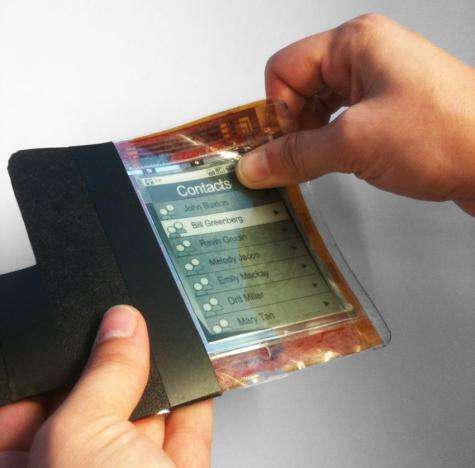
"This is the future. Everything is going to look and feel like this within five years," says creator Roel Vertegaal, the director of Queen's University Human Media Lab,. "This computer looks, feels and operates like a small sheet of interactive paper. You interact with it by bending it into a cell phone, flipping the corner to turn pages, or writing on it with a pen."
The smartphone prototype, called PaperPhone is best described as a flexible iPhone it does everything a smartphone does, like store books, play music or make phone calls. But its display consists of a 9.5 cm diagonal thin film flexible E Ink display. The flexible form of the display makes it much more portable that any current mobile computer: it will shape with your pocket.
This video is not supported by your browser at this time.
Dr. Vertegaal will unveil his paper computer on May 10 at 2 pm at the Association of Computing Machinery's CHI 2011 (Computer Human Interaction) conference in Vancouver the premier international conference of Human-Computer Interaction.Being able to store and interact with documents on larger versions of these light, flexible computers means offices will no longer require paper or printers.
This video is not supported by your browser at this time.
"The paperless office is here. Everything can be stored digitally and you can place these computers on top of each other just like a stack of paper, or throw them around the desk" says Dr. Vertegaal.The invention heralds a new generation of computers that are super lightweight, thin-film and flexible. They use no power when nobody is interacting with them. When users are reading, they don't feel like they're holding a sheet of glass or metal.
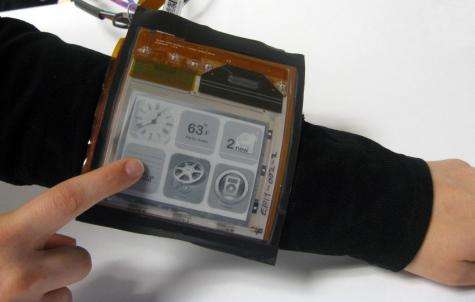
An article on a study of interactive use of bending with flexible thinfilm computers is to be published at the conference in Vancouver, where the group is also demonstrating a thinfilm wristband computer called Snaplet.
More information: paperphone acm chi 2011 scientific article PDF
-
Researchers make board games electronic (w/ Video)
Jan 22, 2010 |
not rated yet |
0
-
Flexible and transparent OLEDs from TDK (w/ Video)
Oct 06, 2010 |
not rated yet |
0
-
Toppan Demonstrates Flexible Electronic Paper Driven by Oxide Semiconductor TFT
Apr 24, 2006 |
not rated yet |
0
-
Flexible screens expected to inspire a host of new devices
Jan 19, 2011 |
not rated yet |
0
-
Human values key to the development of new technologies
Apr 04, 2008 |
not rated yet |
0
-
Stars containing dark matter should look different from other stars
Feb 20, 2012 |
4.5 / 5 (17) |
11
-
Physicists discover evidence of rare hypernucleus, a component of strange matter
Feb 17, 2012 |
4.7 / 5 (38) |
22
-
Fast photon control brings quantum photonic technologies closer
Feb 13, 2012 |
5 / 5 (8) |
1
-
Engineers build first sub-10-nm carbon nanotube transistor
Feb 01, 2012 |
4.9 / 5 (36) |
32
-
Something old, something new: Evolution and the structural divergence of duplicate genes
Jan 31, 2012 |
4.6 / 5 (7) |
1
-
Calculating forces involved in seesaw motion
4 hours ago
-
Writing shear and moment equations for a simple beam problem?
5 hours ago
-
Furnace Shell Spray Cooling Design
21 hours ago
-
Ways to measure the speed of a golf ball?
Feb 21, 2012
-
Water Skin Effect in Plastic Pipe
Feb 21, 2012
-
Undergraduate Engineering Physics To Graduate Aerospace Engineering
Feb 21, 2012
- More from Physics Forums - General Engineering
More news stories
Stanford research team cracks animated NuCaptcha
(PhysOrg.com) -- The research team from Stanford University, led by Elie Bursztein, that previously had cracked regular CAPTCHAs and then audio CAPTCHAs, now has also successfully cracked the animated version called NuCapt ...
Tiny, implantable medical device can propel itself through bloodstream
Someday, your doctor may turn to you and say, "Take two surgeons and call me in the morning." If that day arrives, you may just have Ada Poon to thank.
17 hours ago |
5 / 5 (9) |
8
|
Italian engineer invents floating solar panels
Rays of the winter sun bounce off gleaming mirrors on the tiny lake of Colignola in Italy, where engineers have built a cost-effective prototype for floating, rotating solar panels.
Technology / Energy & Green Tech
21 hours ago |
4.7 / 5 (6) |
5
Microsoft hits Motorola, Google with EU complaint
Microsoft on Wednesday lodged a formal complaint with the European Union's competition regulator against Motorola Mobility and its soon-to-be owner Google, saying Motorola's aggressive enforcement of patent ...
17 hours ago |
2 / 5 (1) |
2
Calif. pledges better mobile privacy disclosures
(AP) -- Mobile applications seeking to collect personal information will have to forewarn users as part of an agreement reached in California.
9 hours ago |
not rated yet |
0
Researchers build first physical 'metatronic' circuit
(PhysOrg.com) -- The technological world of the 21st century owes a tremendous amount to advances in electrical engineering, specifically, the ability to finely control the flow of electrical charges using ...
Spitzer finds solid buckyballs in space
(PhysOrg.com) -- Astronomers using data from NASA's Spitzer Space Telescope have, for the first time, discovered buckyballs in a solid form in space. Prior to this discovery, the microscopic carbon spheres ...
Faster than light neutrinos? More like faulty wiring
You can shelf your designs for a warp drive engine (for now) and put the DeLorean back in the garage; it turns out neutrinos may not have broken any cosmic speed limits after all.
Physicists surprised by disappearing and reappearing superconductivity in iron selenium chalcogenides
Superconductivity is a rare physical state in which matter is able to conduct electricity -- maintain a flow of electrons -- without any resistance. This phenomenon can only be found in certain materials at low temperatures, ...
Going up: Japan builder eyes space elevator
A Japanese construction firm claimed Wednesday it could execute an out-of-this-world plan to put tourists in space within 40 years by building an elevator that stretches a quarter of the way to the moon.
Flesh-eating bacteria inspire superglue
(PhysOrg.com) -- A bio-inspired superglue has been developed by Oxford University researchers that cant be matched for sticking molecules together and not letting go.

May 04, 2011
Rank: 5 / 5 (1)
May 04, 2011
Rank: not rated yet
May 04, 2011
Rank: 4 / 5 (2)
I can bend a piece of paper, without folding it, numerous times without placing undue stress on the material. Try it. Other materials are the same way. I don't think that engineering a durable surface for these kinds of gesture controls is beyond current materials technology.
Yes, eventually anything will wear out. As long as lifetime is comparable to current smartphones, which isn't really very long, then it will succeed.
May 04, 2011
Rank: 4.2 / 5 (5)
Unacceptable. We need devices to last a lot longer. It is wasteful for them to only last a few years. My old dial phones lasted 50 years and are still going strong. They were mechanical which should be more prone to wearing out yet they last longer than new electronic devices. I want real world rugged equipment that is built to last. The reason stuff doesn't lasts is that manufacturers want you to buy new over and over. Bad.
May 04, 2011
Rank: 5 / 5 (1)
Amen to that! Those cordless base phones at 5.8 ghz last about as long as the first dunk in water or even a humid room. They seem to me the worst products ever to come out of an electronics factory.
May 04, 2011
Rank: not rated yet
May 04, 2011
Rank: 5 / 5 (1)
May 04, 2011
Rank: 2.7 / 5 (3)
May 04, 2011
Rank: 2 / 5 (5)
I dislike the "designed to break" mentality of much of our existing technologies.
You realize they design products with a minum life expectancy so they can maximize sales?
Intel made around $11 Billion in profits last year alone, even after you count the ~$10 Billion they spent on building all-new facilities. Their profit margin is 25% in a $40 billion company.
They can afford to make products that last much longer, or else lower prices by 15% or so.
May 04, 2011
Rank: 3.7 / 5 (3)
Do you commonly let people insert slips of paper into your pants?
May 04, 2011
Rank: 5 / 5 (2)
May 04, 2011
Rank: 5 / 5 (2)
May 04, 2011
Rank: not rated yet
They just need to be as slim as a credit card and about as rigid, to maintain the integrity of the image you are looking at even when tapping on it.
And cheap and disposable and recyclable is fine. Everything stored in the cloud, you just carry the interface, easy to replace if lost, different sizes of the same thing for different uses, wall-sized to credit card-sized or smaller.
May 04, 2011
Rank: 5 / 5 (3)
That isn't to say flexible displays aren't going to find uses. With outboard power and electronics like the demo a transparent flexible display would be nice for a car. Window sized with voice recognition for your passenger window would give you a lot more flexibility than just flipping off the guy in the other lane.
May 04, 2011
Rank: 5 / 5 (2)
May 05, 2011
Rank: 5 / 5 (2)
Traditional touch screens snap when you try to bend them *once*. If flexibility is what someone wants, then this is better.
May 05, 2011
Rank: not rated yet
May 05, 2011
Rank: 5 / 5 (2)
I would prefer a much cheaper, more advanced, device that doesn't last as long, and is recyclable. As it stands technology gets outdated fast, and that trend will only continue to grow. As an added bonus, because I am continuously in the market, I increase the advance of technology/innovations.
May 05, 2011
Rank: 2 / 5 (1)
Not really. Eventually, the room for improvement in basic functionality of basic classes of devices will run out completely, or at least plateau, in at most a few decades. In around 10 to 12 years, top-down approaches to computer manufacturing will hit a limit, and then within about 8 to 10 more years, even bottom-up will run out of room for improvements.
True 3d/cubical architecture in computers will probably be achieved in about 10 years or so, and after a few years, that too will plateau. Though these computers will be many orders of magnitude greater than our existing computers, they will hit a wall and not be able to get any better no matter what. In the end, cubical architecture may prove to be a bigger leap than spintronics or even quantum computing in and of themselves.
May 06, 2011
Rank: not rated yet
May 06, 2011
Rank: not rated yet
FAA has recently approved the iPad to replace paper charts... (of course, I'm guessing someone will say, since when is the FAA responsible?)
So what is the "revolutionary" technology here? It appears there is still a lot of electronics that are remotely mounted. What is actually in the flexible portion? Are there actually processors, ram, etc. that would make it a "computer" ???
May 09, 2011
Rank: not rated yet
Actually, I think the new ?Motorola? keyboard/screen designed to accompany their telephone has a lot more possibilities.
Look out, Apple!