'I'm a tumor and I'm over here!' Nanovaults used to prod immune system to fight cancer (w/ video)
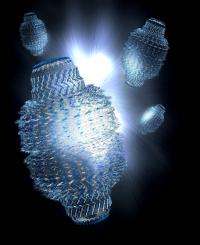
(PhysOrg.com) -- UCLA scientists have discovered a way to wake up the immune system to fight cancer by delivering an immune system-stimulating protein in a nanoscale container called a vault directly into lung cancer tumors, harnessing the body's natural defenses to fight disease growth.
The vaults, barrel-shaped nanoscale capsules found in the cytoplasm of all mammalian cells, were engineered to slowly release a protein, the chemokine CCL21, into the tumor. Pre-clinical studies in mice with lung cancer showed that the protein stimulated the immune system to recognize and attack the cancer cells, potently inhibiting cancer growth, said Leonard Rome, a researcher at UCLA's Jonsson Comprehensive Cancer Center, associate director of the California NanoSystems Institutes and co-senior author of the study.
"Researchers have been working for many years to develop effective immune therapies to treat cancer, with limited success," said Rome, who has been studying vaults for decades. "In lung tumors, the immune system is down-regulated and what we wanted to do was wake it up, find a way to have the cancer say to the immune system, 'Hey, I'm a tumor and I'm over here. Come get me.' "
The study appears in the May 3, 2011 issue of PLoS One, a peer-reviewed journal of the Public Library of Science.
The new vault delivery system, which Rome characterized as "just a dream" three years ago, is based on a 10-year, on-going research effort focusing on using a patient's white blood cells to create dendritic cells, cells of the immune system that process antigen material and present it on the surface to other immune system cells. A Phase I study that is part of the effort, led by ULCA's Dr. Steven Dubinett, used a replication-deficient adenovirus to infect the dendritic cells and prompt them to over-secrete CCL21, the first time the chemokine has been administered to humans. The engineered cells – 10 million at a time – were then injected directly into the patient's lung cancer to stimulate an immune response.
The early phase study has shown the dendritic cell method is safe, has no side effects and seems to boost the immune response – Dubinett and his team found T lymphocytes circulating in the blood stream with specific cytokine signatures, indicating that the lymphocytes were recognizing the cancer as a foreign invader.
However, the process to generate dendritic cells from the white blood cells and engineer them to over-secrete CCL21 is cumbersome, expensive and time-consuming. It also requires a Good Manufacturing Practice (GMP) suite, a specialized laboratory critical for the safe growth and manipulation of cells, which many research institutions do not have.
"It gets complicated," said Dubinett, director of the Lung Cancer Program at UCLA's Jonsson Comprehensive Cancer Center, a professor of pathology and laboratory medicine, member of the California NanoSystems Institute and a co-senior author of the paper. "You have to have a confluence of things happen - the patient has to be clinically eligible for the study and healthy enough to participate, we have to be able to grow the cells and then genetically modify them and give them back."
There also was the challenge of patient-to-patient variability, said Sherven Sharma, a researcher at both the Jonsson Cancer Center and the California NanoSystems Institute, professor of pulmonary and critical care medicine and co-senior author of the study. It was easier to isolate and grow the dendritic cells in some patients than in others, so results were not consistent.
"We wanted to create a simpler way to develop an environment that would stimulate the immune system," Sharma said.
In the Phase I study, it takes more than a week to differentiate the white blood cells into dendritic cells and let them grow to the millions required for the therapy. The dendritic cells are infected with a virus engineered to carry a gene that caused the cells to secrete CCL21 and then injected into the patient's tumor using guided imaging.
"We thought if we could replace the dendritic cells with a nano-vehicle to deliver the CCL21, we would have an easier and less expensive treatment that also could be used at institutions that don't have GMP," Dubinett said.
If successful, the vault delivery method would add a desperately needed weapon to the arsenal in the fight against lung cancer, which accounts for nearly one-third of all cancer deaths in the United States and kills one million people worldwide every year.
"It's crucial that we find new and more effective therapies to fight this deadly disease," Dubinett said. "Right now we don't have adequate options for therapies for advanced lung cancer."
The vault nanoparticles containing the CCL21 have been engineered to slowly release the protein into the tumor over time, producing an enduring immune response. Although the vaults protect the packed CCL21, they act like a time-release capsule, Rome said.
Rome, Dubinett and Sharma plan to test the vault delivery method in human studies within the next three years and hope the promising results found in the pre-clinical animal tumor models will be replicated. If such a study is approved, it would be the first time a vault nanoparticle is used in humans for a cancer immunotherapy.
The vault nanoparticle would require only a single injection into the tumor because of the slow-release design, and it eventually could be designed to be patient specific by adding the individual's tumor antigens into the vault, Dubinett said. The vaults may also be targeted by adding antibodies to their surface that recognize receptors on the tumor. The injection could then be delivered into the blood stream and the vault would navigate to the tumor, a less invasive process that would be easier on the patients. The vault could also seek out and target tumors and metastases too small to be detected with imaging.
Rome cautioned that the vault work is at a much earlier stage than Dubinett's dendritic cell research, but he is encouraged by the early results. The goal is to develop an "off-the-shelf" therapy using vaults.
"In animals, the vault nanoparticles have proven to be as effective, if not more effective, than the dendritic cell approach," he said. "Now we need to get the vault therapy approved by the FDA for use in humans."
Because a vault is naturally occurring particle, it causes no harm to the body and is potentially an ideal vehicle for use in delivery of personalized therapies, Rome said.
Provided by University of California - Los Angeles Health Sciences


