Solar power, with a side of hot running water
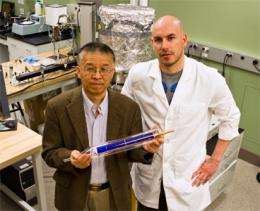
MIT researchers and their collaborators have come up with an unusual, highly efficient and possibly less expensive way of turning the sun’s heat into electricity.
Their system, described in a paper published online in the journal Nature Materials on May 1, produces power with an efficiency roughly eight times higher than ever previously reported for a solar thermoelectric device — one that produces electricity from solar heat. It does so by generating and harnessing a temperature difference of about 200 degrees Celsius between the interior of the device and the ambient air.
The concept “is very radical,” says Gang Chen, MIT’s Carl Richard Soderberg Professor in Power Engineering and director of the Pappalardo Micro and Nano Engineering Laboratories, who co-authored the new paper with MIT doctoral student Daniel Kraemer and collaborators from Boston College and GMZ Energy. The work is funded by the Solid-State Solar-Thermal Energy Conversion Center, an Energy Frontier Research Center at the U.S. Department of Energy.
While solar thermal electricity systems aren’t a new idea, they typically involve vast arrays of movable mirrors that track the sun and focus its rays on a small area. The new approach uses flat, stationary panels similar to traditional solar panels, eliminating the need for tracking systems.
Like the silicon photovoltaic cells that produce electricity when struck by sunlight, Chen’s system is a solid-state device with no moving parts. A thermoelectric generator, placed inside a vacuum chamber made of glass, is covered with a black plate of copper that absorbs sunlight but does not re-radiate it as heat. The other side of the generator is in contact with ambient temperatures. Placed in the sun, the entire unit heats up quickly, even without facing the sun directly.
The device requires much less material than conventional photovoltaic panels, and could therefore be much less expensive to produce. It can also be integrated into solar hot water systems, allowing the expenses of the structure and installation to serve two functions at once. Such solar water heaters are rarely seen in the United States, but are already a highly successful mass-market product in China and Europe, where they provide households with hot water and in some cases space heating as well.
The materials used to build such solar thermoelectric generators, made through a nanostructured process, were developed jointly a few years ago in Chen’s lab at MIT and in co-author Zhifeng Ren’s lab at Boston College. Their teams have continued to work on improving these materials and integrating them into complete systems.
Chen points out that the U.S. Department of Energy has programs to develop thermoelectric systems, mostly geared toward harnessing waste heat from car and truck engines. He says that solar applications for such devices also can “have an important role to play” in reducing carbon emissions. “Hopefully we can prove that,” he adds.
Li Shi, associate professor of mechanical engineering at the University of Texas at Austin, says this approach to solar power is “very novel, simple, and easy for low-cost implementation.” The efficiency level they have demonstrated so far, at 4.6 percent, is “already quite impressive,” he says.
“With the use of other or new thermoelectric materials that can operate at a higher temperature,” Shi adds, “the efficiency may be improved further to be competitive with that for state-of-the-art amorphous silicon solar cells. This can potentially provide a different approach to realizing the $1-per-watt goal for solar-electricity conversion.”
The new system wouldn’t be a substitute for solar photovoltaics, Chen says, but offers “another way” of tapping into the enormous amount of solar energy that bathes the Earth every day. And because it can be piggybacked onto the existing solar hot-water industry, the thermoelectric device could be a relatively inexpensive addition, with “no subsidies required,” Chen suggests. “It can be a game-changing thing,” he says.
More information: High-performance flat-panel solar thermoelectric generators with high thermal concentration, Nature Materials (2011) doi:10.1038/nmat3013
Abstract
The conversion of sunlight into electricity has been dominated by photovoltaic and solar thermal power generation. Photovoltaic cells are deployed widely, mostly as flat panels, whereas solar thermal electricity generation relying on optical concentrators and mechanical heat engines is only seen in large-scale power plants. Here we demonstrate a promising flat-panel solar thermal to electric power conversion technology based on the Seebeck effect and high thermal concentration, thus enabling wider applications. The developed solar thermoelectric generators (STEGs) achieved a peak efficiency of 4.6% under AM1.5G (1 kW m−2) conditions. The efficiency is 7–8 times higher than the previously reported best value for a flat-panel STEG, and is enabled by the use of high-performance nanostructured thermoelectric materials and spectrally-selective solar absorbers in an innovative design that exploits high thermal concentration in an evacuated environment. Our work opens up a promising new approach which has the potential to achieve cost-effective conversion of solar energy into electricity.
Provided by Massachusetts Institute of Technology


