Stinky feet could pave the way for better ways to stop mosquitoes
May 27, 2011 By Katharine Gammon
With Memorial Day weekend approaching and temperatures across the nation steadily increase to summertime highs, thoughts turn to picnics, ballgames -- and bug bites. Now, a new way of stopping mosquitoes could come from a precise method to interfere with their ability to hone in on people's blood.
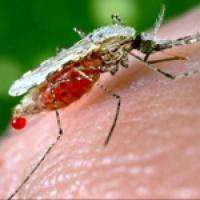
Before a mosquito comes in for a "fly-through" meal, it first has to feed on a sugary substance, usually from a flower. Then it uses carbon dioxide from a potential target's breath to locate a blood-filled host from up to 30 feet away. But as the hungry insect nears, malaria-bearing mosquitoes veer away from the face and move towards the feet, where they prefer to feed. Researchers have long believed that messing with the mosquitoes' sense of smell could hold the key to stopping their bloodlust.
Remco Suer started by experimenting on the African malaria mosquito, Anopheles gambiae. He knew that prior research had found that human foot bacteria produce about ten separate odors, some more attractive to mosquitoes than others. Suer, who did the study as part of his doctorate in entomology at Wageningen University in the Netherlands, showed that these foot odors are detected by neurons that control smell, which are present underneath hair-like structures on the mouthparts of the malaria mosquito.
Suer tested their sense of smell in the labratory by pumping additional CO2 into a container to simulate human breath, then added a high concentration of five different foot odors and found that the mosquitoes were unable to react to the CO2 for several seconds. The sole-ful odors actually stopped mosquitoes from sensing CO2 from breathing -- which could be a reason why malarial mosquitoes divert when honing in on a person and move instead to the feet at close ranges.
But Suer pointed out that this doesn't mean people with especially funky feet are more likely to get nibbled on.
"It is not the amount of odors produced, but which particular odors and ratio between them that makes a difference. Finding these odors and their respective ratio's brings us one step closer to manipulating the mosquito's behavior."
It is this short-range orientation shift that may be used against the mosquito's sensitive nose.
Suer thinks that better traps could be built luring mosquitoes into places that smell like feet -- and away from transmitting disease to human targets -- and started In2Care, a company he hopes will take the research and transform it into a low-tech product to help people in places where malaria is a danger.
Of course, not all mosquitoes do the same thing, making it difficult to use a small array of odors to interfere with all species, said Daniel Kline, an entomologist with the Agricultural Research Service in Gainesville, Fla.
Kline, who called the new work exciting, said that where he lives there are 71 different species of mosquitoes -- each with its own habits. Some will choose the face or neck to bite, while others will attack cows over humans.
"One size definitely doesn't fit all," Kline said.
Kline's research has taken him to do similar experiments with dirty socks -- including a pair he wore for 12 hours per day, for three days in a row.
"We actually got the female mosquitoes to respond to the socks," he said.
Using the olfactory prowess of the malaria-bearing mosquito against it is a useful trick.
Maybe gym-shoe odors could possibly do the trick.
-
Malaria mosquitoes accurately find their way to smelly feet
May 09, 2011 |
not rated yet |
0
-
Malaria mosquitoes guided by bacteria
Dec 08, 2010 |
not rated yet |
0
-
Entomologists seek fungus to blunt mosquitoes' sense of smell
May 07, 2009 |
not rated yet |
0
-
Wolbachia bacteria reduce parasite levels and kill the mosquito that spreads malaria
May 19, 2011 |
not rated yet |
0
-
Jumping spiders that love smelly socks could help fight malaria
Feb 17, 2011 |
not rated yet |
0
-
Stars containing dark matter should look different from other stars
Feb 20, 2012 |
4.5 / 5 (17) |
11
-
Physicists discover evidence of rare hypernucleus, a component of strange matter
Feb 17, 2012 |
4.7 / 5 (38) |
22
-
Fast photon control brings quantum photonic technologies closer
Feb 13, 2012 |
5 / 5 (8) |
1
-
Engineers build first sub-10-nm carbon nanotube transistor
Feb 01, 2012 |
4.9 / 5 (36) |
32
-
Something old, something new: Evolution and the structural divergence of duplicate genes
Jan 31, 2012 |
4.6 / 5 (7) |
1
-
Eye biology videos
4 hours ago
-
Flowering Plant Revived After 30,000 Years in Permafrost
Feb 21, 2012
-
Toba volcano eruptions - 1.000 - 10,000 breeding pairsunb
Feb 20, 2012
-
How is a specific gene removed from DNA
Feb 20, 2012
-
Reproduction and Human evolution
Feb 19, 2012
-
Viruses: Living or Non-living organisms
Feb 19, 2012
- More from Physics Forums - Biology
More news stories
Surprising diversity at a synapse hints at complex diversity of neural circuitry
A new study reveals a dazzling degree of biological diversity in an unexpected place a single neural connection in the body wall of flies.
11 hours ago |
5 / 5 (4) |
0
|
Men might not 'become extinct' after all: Theory of the 'rotting' Y chromosome dealt a fatal blow
If you were to discover that a fundamental component of human biology has survived virtually intact for the past 25 million years, you'd be quite confident in saying that it is here to stay.
14 hours ago |
5 / 5 (6) |
1
|
New family of legless amphibians found in India
Since before the age of dinosaurs it has burrowed unbothered beneath the monsoon-soaked soils of remote northeast India - unknown to science and mistaken by villagers as a deadly, miniature snake.
21 hours ago |
5 / 5 (9) |
3
Climate change affects bird migration timing in North America
Bird migration timing across North America has been affected by climate change, according to a study published Feb. 22 in the open access journal PLoS ONE.
10 hours ago |
4.5 / 5 (2) |
2
New iridescent lizard species found in Cambodia
A new species of lizard with striking iridescent rainbow skin, a long tail and very short legs has been discovered in the rainforest in northeast Cambodia, conservationists announced Wednesday.
10 hours ago |
not rated yet |
0
Researchers build first physical 'metatronic' circuit
(PhysOrg.com) -- The technological world of the 21st century owes a tremendous amount to advances in electrical engineering, specifically, the ability to finely control the flow of electrical charges using ...
Spitzer finds solid buckyballs in space
(PhysOrg.com) -- Astronomers using data from NASA's Spitzer Space Telescope have, for the first time, discovered buckyballs in a solid form in space. Prior to this discovery, the microscopic carbon spheres ...
Faster than light neutrinos? More like faulty wiring
You can shelf your designs for a warp drive engine (for now) and put the DeLorean back in the garage; it turns out neutrinos may not have broken any cosmic speed limits after all.
Physicists surprised by disappearing and reappearing superconductivity in iron selenium chalcogenides
Superconductivity is a rare physical state in which matter is able to conduct electricity -- maintain a flow of electrons -- without any resistance. This phenomenon can only be found in certain materials at low temperatures, ...
Stanford research team cracks animated NuCaptcha
(PhysOrg.com) -- The research team from Stanford University, led by Elie Bursztein, that previously had cracked regular CAPTCHAs and then audio CAPTCHAs, now has also successfully cracked the animated version called NuCapt ...
Going up: Japan builder eyes space elevator
A Japanese construction firm claimed Wednesday it could execute an out-of-this-world plan to put tourists in space within 40 years by building an elevator that stretches a quarter of the way to the moon.
May 27, 2011
Rank: 1 / 5 (3)
home in: to direct onto a point or target
Please use "dictionary-check" as well as spell-check.
May 27, 2011
Rank: 1 / 5 (1)