Astronomers find evidence for a strange new planetary system
June 21, 2011
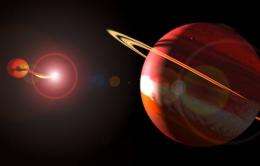
An artist’s impression of the binary UZ For and planet
(PhysOrg.com) -- A team of astronomers, including Dr Gavin Ramsay of the Armagh Observatory, has found evidence that suggests the existence of an extraordinary planetary system. Two giant planets appear to be revolving at some distance around a compact, interacting stellar binary known as UZ For, which comprises two small stars orbiting very closely one about the other.
If confirmed, this would be an example of a very strange new planetary system, given the nature of the stellar pair. The two stars, one a white dwarf and the other a red dwarf, are each smaller than our Sun and are orbiting in such close proximity that they take only a couple of hours to complete one revolution. The stellar pair would actually fit comfortably inside our Sun! By chance, the system is oriented in such a way that the stars pass in front of one another every orbit as seen from Earth, producing mutual eclipses that allow the properties of the system to be very well determined.
But the researchers noticed that the eclipses were not occurring precisely on time. Instead, they were sometimes too early and sometimes too late. This led them to suggest the presence of two giant planets, whose gravitational tugs would cause the orbits of the stars to "wobble" in space and so slightly change the measured time between eclipses. According to their calculations, the masses of the two planets would have to be at least eight and six times that of Jupiter, and they would have to take respectively five and sixteen years to orbit the two central stars. The system is too far away for these planets to be directly imaged.
The interacting system, which is called UZ For because of its location in the southern constellation of Fornax, produces an extremely inhospitable environment for planets. Due to their close proximity, the gravity of the more massive, but much more compact white dwarf star is constantly "stealing" material from the surface of the red dwarf in a continuous stream. This stream of material collides with the surface of the white dwarf, where it is heated to millions of degrees Kelvin, flooding the entire planetary system with enormous amounts of deadly X-rays.
The discovery was made using new observations from the Southern African Large Telescope (SALT) together with archival data spanning 27 years gathered from multiple observatories and Earth-orbiting satellites. The Armagh Observatory has access to SALT through its membership of the UK SALT Consortium. Astronomy at Armagh is supported by core funding from the Northern Ireland Department of Culture, Arts and Leisure.
More information: The research has been accepted for publication in the journal Monthly Notices of the Royal Astronomical Society, under the title "Possible detection of two giant extrasolar planets orbiting the eclipsing polar UZ Fornacis". The authors are: Steve Potter, Encarni Romero Colmenero (South African Astronomical Observatory), Gavin Ramsay (Armagh Observatory) and a number of others. A pre-print can be seen here.
Provided by Armagh Observatory
-
New planetary system has South African astronomers doing a double take
Jun 15, 2011 |
not rated yet |
0
-
Astronomers find 'snooker star system'
Nov 09, 2010 |
not rated yet |
0
-
A sub-stellar Jonah: Brown dwarf survives being swallowed
Aug 02, 2006 |
not rated yet |
0
-
Planets orbiting a binary system help astrobiologists search for habitable worlds
Oct 26, 2010 |
not rated yet |
0
-
South African Clone of Penn State Telescope Makes First Scientific Discovery
Aug 22, 2006 |
not rated yet |
0
-
Stars containing dark matter should look different from other stars
Feb 20, 2012 |
4.5 / 5 (17) |
11
-
Physicists discover evidence of rare hypernucleus, a component of strange matter
Feb 17, 2012 |
4.7 / 5 (38) |
22
-
Fast photon control brings quantum photonic technologies closer
Feb 13, 2012 |
5 / 5 (8) |
1
-
Engineers build first sub-10-nm carbon nanotube transistor
Feb 01, 2012 |
4.9 / 5 (36) |
32
-
Something old, something new: Evolution and the structural divergence of duplicate genes
Jan 31, 2012 |
4.6 / 5 (7) |
1
-
Calculating the magnitude
2 hours ago
-
What is this spectrum I took?
13 hours ago
-
Orientation of Space
13 hours ago
-
Geologically Active Moon Now: NASA
20 hours ago
-
advice on building a science fair telescope
Feb 22, 2012
-
Rise of the Sun
Feb 22, 2012
- More from Physics Forums - General Astronomy
More news stories
Spitzer finds solid buckyballs in space
(PhysOrg.com) -- Astronomers using data from NASA's Spitzer Space Telescope have, for the first time, discovered buckyballs in a solid form in space. Prior to this discovery, the microscopic carbon spheres ...
15 hours ago |
4.7 / 5 (12) |
8
|
Going up: Japan builder eyes space elevator
A Japanese construction firm claimed Wednesday it could execute an out-of-this-world plan to put tourists in space within 40 years by building an elevator that stretches a quarter of the way to the moon.
Space & Earth / Space Exploration
22 hours ago |
3.5 / 5 (13) |
26
ENASA satellite finds Earth's clouds are getting lower
(PhysOrg.com) -- Earth's clouds got a little lower -- about one percent on average -- during the first decade of this century, finds a new NASA-funded university study based on NASA satellite data. The results ...
Space & Earth / Earth Sciences
19 hours ago |
5 / 5 (8) |
13
|
Fresh scandal embroils US climate science debate
A fresh scandal over climate change has erupted in the United States after leaked documents appeared to show a right-wing funded campaign to influence how climate science is taught in schools.
11 hours ago |
4.1 / 5 (9) |
8
World's oceans get an acid bath
Among the repercussions of global climate change, the effect of ocean acidification on marine life is one of the least-understood variables.
18 hours ago |
4.3 / 5 (6) |
4
|
Researchers build first physical 'metatronic' circuit
(PhysOrg.com) -- The technological world of the 21st century owes a tremendous amount to advances in electrical engineering, specifically, the ability to finely control the flow of electrical charges using ...
Faster than light neutrinos? More like faulty wiring
You can shelf your designs for a warp drive engine (for now) and put the DeLorean back in the garage; it turns out neutrinos may not have broken any cosmic speed limits after all.
Physicists surprised by disappearing and reappearing superconductivity in iron selenium chalcogenides
Superconductivity is a rare physical state in which matter is able to conduct electricity -- maintain a flow of electrons -- without any resistance. This phenomenon can only be found in certain materials at low temperatures, ...
Stanford research team cracks animated NuCaptcha
(PhysOrg.com) -- The research team from Stanford University, led by Elie Bursztein, that previously had cracked regular CAPTCHAs and then audio CAPTCHAs, now has also successfully cracked the animated version called NuCapt ...
Flesh-eating bacteria inspire superglue
(PhysOrg.com) -- A bio-inspired superglue has been developed by Oxford University researchers that cant be matched for sticking molecules together and not letting go.
Scientists create potent molecules aimed at treating muscular dystrophy
While RNA is an appealing drug target, small molecules that can actually affect its function have rarely been found. But now scientists from the Florida campus of The Scripps Research Institute have for the first time designed ...
Jun 21, 2011
Rank: 2.1 / 5 (15)
It should be noted that Kelvins are a unit of measurement. You don't go around writing, "the Sun is millions of kilometers miles from the Earth..."
Come on, Physorg!
Jun 21, 2011
Rank: 2.5 / 5 (8)
Millions of Kilo-metres, Giga-metres
:o*
Jun 21, 2011
Rank: 2.3 / 5 (6)
Jun 21, 2011
Rank: 5 / 5 (5)
"Unlike the degree Fahrenheit and degree Celsius, the kelvin is not referred to or typeset as a degree."
from Kelvin to Kelvin
Celsius [°C] = [K] 273.15 [K] = [°C] + 273.15
Fahrenheit [°F] = [K] × 95 459.67 [K] = ([°F] + 459.67) × 59
Rankine [°R] = [K] × 95 [K] = [°R] × 59
For temperature intervals rather than specific temperatures,
1 K = 1 °C = 1.8 °F = 1.8 °R
Comparisons among various temperature scales
Jun 21, 2011
Rank: 4 / 5 (5)
Jun 21, 2011
Rank: 3.8 / 5 (4)
Because the unit of temperature on the absolute scale in the SI system is "Kelvin", not "degrees Kelvin". That's what it's called. And "degrees" was probably dropped because it's unnecessary and nobody likes to have to add special characters such as the degree symbol when writing about science.
Jun 21, 2011
Rank: 3 / 5 (2)
Anyways, it seems that this strange or extraordinary system is doomed to die soon in a type 1a supernova.
Jun 21, 2011
Rank: 5 / 5 (1)
Jun 21, 2011
Rank: not rated yet
Jun 21, 2011
Rank: 5 / 5 (2)
Jun 22, 2011
Rank: 1 / 5 (4)
The inference of an external gravitational distortion from rotating planets is possibly unnecessary within this other view.
It may turn out that the reason the eclipses aren't perfectly timed is due to some sort of slow-motion separation of the two bodies. Or, there may be a sudden change in the entire system's stability due to the fact that the number of bodies has changed.
I'm surprised that there is no observable energetic event which preceded the separation. I wonder what led the researchers to observe it, to begin with ...
Jun 22, 2011
Rank: not rated yet
Jun 30, 2011
Rank: not rated yet