'Kill a camel' to cut pollution concept in Australia
June 9, 2011
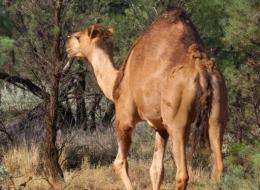
This file photo shows a feral camel searching for food near the dry Ross River, west of Alice Springs. Considered a pest due to the damage they do to vegetation, a camel produces, on average, a methane equivalent to one tonne of carbon dioxide a year, making them collectively one of Australia's major emitters of greenhouse gases.
Australia is considering awarding carbon credits for killing feral camels as a way to tackle climate change.
The suggestion is included in Canberra's "Carbon Farming Initiative", a consultation paper by the Department of Climate Change and Energy Efficiency, seen Thursday.
Adelaide-based Northwest Carbon, a commercial company, proposed culling some 1.2 million wild camels that roam the Outback, the legacy of herds introduced to help early settlers in the 19th century.
Considered a pest due to the damage they do to vegetation, a camel produces, on average, a methane equivalent to one tonne of carbon dioxide a year, making them collectively one of Australia's major emitters of greenhouse gases.
In its plan, Northwest said it would shoot them from helicopters or muster them and send them to an abattoir for either human or pet consumption.
"We're a nation of innovators and we find innovative solutions to our challenges -- this is just a classic example," Northwest Carbon managing director Tim Moore told Australian Associated Press.
The idea was among those accepted for discussion by the government, which is seeking to "provide new economic opportunities for farmers, forest growers and landholders" if they come up with ways to cut emissions, according to the document.
Heavily reliant on coal-fired power and mining exports, Australia is one of the world's worst per capita polluters and the government is looking at ways to clean up its act.
Legislation for the "Carbon Farming Initiative" is set to go before parliament next week.
(c) 2011 AFP
-
Australia targets 20 pct renewable energy by 2020
Aug 18, 2009 |
not rated yet |
0
-
Australia blames mining for greenhouse gas rise
Feb 09, 2011 |
not rated yet |
0
-
Australia overtakes US as biggest polluter: report
Sep 11, 2009 |
not rated yet |
0
-
U.S. greenhouse emissions up 1.7 percent
Feb 28, 2006 |
not rated yet |
0
-
China says 2010 pollution goal met
Dec 01, 2010 |
not rated yet |
0
-
Stars containing dark matter should look different from other stars
Feb 20, 2012 |
4.5 / 5 (17) |
11
-
Physicists discover evidence of rare hypernucleus, a component of strange matter
Feb 17, 2012 |
4.7 / 5 (38) |
22
-
Fast photon control brings quantum photonic technologies closer
Feb 13, 2012 |
5 / 5 (8) |
1
-
Engineers build first sub-10-nm carbon nanotube transistor
Feb 01, 2012 |
4.9 / 5 (36) |
32
-
Something old, something new: Evolution and the structural divergence of duplicate genes
Jan 31, 2012 |
4.6 / 5 (7) |
1
-
Is the Earth really going to die
14 hours ago
-
Do some geologists actually act a lot like Randy Marsh?
Feb 11, 2012
-
Discrepancy between oxygen and carbon-dioxide levels
Feb 09, 2012
-
where gems are found in the world
Feb 09, 2012
-
Wind Waves in Reservoir ~ Wind run-up and Wind set-up
Feb 08, 2012
-
Balance of oxygen in the atmosphere
Feb 01, 2012
- More from Physics Forums - Earth
More news stories
Spitzer finds solid buckyballs in space
(PhysOrg.com) -- Astronomers using data from NASA's Spitzer Space Telescope have, for the first time, discovered buckyballs in a solid form in space. Prior to this discovery, the microscopic carbon spheres ...
14 hours ago |
4.7 / 5 (12) |
8
|
Going up: Japan builder eyes space elevator
A Japanese construction firm claimed Wednesday it could execute an out-of-this-world plan to put tourists in space within 40 years by building an elevator that stretches a quarter of the way to the moon.
Space & Earth / Space Exploration
21 hours ago |
3.5 / 5 (13) |
26
ENASA satellite finds Earth's clouds are getting lower
(PhysOrg.com) -- Earth's clouds got a little lower -- about one percent on average -- during the first decade of this century, finds a new NASA-funded university study based on NASA satellite data. The results ...
Space & Earth / Earth Sciences
18 hours ago |
5 / 5 (8) |
13
|
Fresh scandal embroils US climate science debate
A fresh scandal over climate change has erupted in the United States after leaked documents appeared to show a right-wing funded campaign to influence how climate science is taught in schools.
11 hours ago |
4.1 / 5 (9) |
8
World's oceans get an acid bath
Among the repercussions of global climate change, the effect of ocean acidification on marine life is one of the least-understood variables.
18 hours ago |
4.3 / 5 (6) |
4
|
Researchers build first physical 'metatronic' circuit
(PhysOrg.com) -- The technological world of the 21st century owes a tremendous amount to advances in electrical engineering, specifically, the ability to finely control the flow of electrical charges using ...
Faster than light neutrinos? More like faulty wiring
You can shelf your designs for a warp drive engine (for now) and put the DeLorean back in the garage; it turns out neutrinos may not have broken any cosmic speed limits after all.
Physicists surprised by disappearing and reappearing superconductivity in iron selenium chalcogenides
Superconductivity is a rare physical state in which matter is able to conduct electricity -- maintain a flow of electrons -- without any resistance. This phenomenon can only be found in certain materials at low temperatures, ...
Stanford research team cracks animated NuCaptcha
(PhysOrg.com) -- The research team from Stanford University, led by Elie Bursztein, that previously had cracked regular CAPTCHAs and then audio CAPTCHAs, now has also successfully cracked the animated version called NuCapt ...
Flesh-eating bacteria inspire superglue
(PhysOrg.com) -- A bio-inspired superglue has been developed by Oxford University researchers that cant be matched for sticking molecules together and not letting go.
Scientists create potent molecules aimed at treating muscular dystrophy
While RNA is an appealing drug target, small molecules that can actually affect its function have rarely been found. But now scientists from the Florida campus of The Scripps Research Institute have for the first time designed ...
Jun 09, 2011
Rank: 3.6 / 5 (11)
Jun 09, 2011
Rank: 2.7 / 5 (10)
So, in effect, by removing (culling) these animals you are giving endangered indigenous floras and flora half a chance as well as eliminating a source of greenhouse gas emission. Where, pray tell, is the problem?
Jun 09, 2011
Rank: 4.2 / 5 (10)
Feral = Wild
So Australia is going to fight global warming by killing wild camels. How about something more humane like neutering them ?
Keep in mind this is a mentality that starts with animals , and then works its way up to humans.
As of 2007 , 1 Australian = 17.9 tonnes/year . In the year 2051 , will they start killing Australians to "fight" Global Warming ?
Jun 09, 2011
Rank: 3.1 / 5 (9)
Jun 09, 2011
Rank: 3.4 / 5 (5)
Jun 09, 2011
Rank: 3.7 / 5 (12)
So who is going to go into the uninhabited inhospitable inaccessible Australian desert outback and neuter hundreds of thousands of FERAL Camels, you numbat?! They need to be culled chiefly to stop them WRECKING the environment in a direct physical sense and destroying native habitat. And guess what? Scientists measure animal flatulence and can easily work out their total emissions. It is almost as easy as READING and COMPREHENDING at the SAME TIME......
Jun 09, 2011
Rank: 2.3 / 5 (6)
Jun 09, 2011
Rank: 3.2 / 5 (9)
Jun 09, 2011
Rank: 4.2 / 5 (9)
Jun 09, 2011
Rank: 2 / 5 (1)
Jun 09, 2011
Rank: not rated yet
Oops, meant to say propane not butane for LPG.
Jun 09, 2011
Rank: 4.2 / 5 (6)
Jun 09, 2011
Rank: 3.5 / 5 (6)
How many camels will they kill - saving how much CO2 emissions, emissions that we don't know are harmful, or helpful , to the environment.
Now let's compare all those killed camels to one forest fire. The latter would put far, far, far more CO2 into the environment.
So a reasonable alternative might be to build a few lightning towers in a forest in North America to eliminate one forest fire. In fact, with the cost of fighting a single forest fire, you can probably afford to build multiple and elminiate even more forest fires.
Jun 09, 2011
Rank: 2.5 / 5 (8)
When it comes to camels and idiots , i don't see much of a difference between "Domesticated gone wild" and wild. Considering most of them were born wild they are by definition "wild".
I Imagine inoculating and then neutering animals takes the same or actually less effort as killing them and then disposing the body. Or do you propose to just shoot them and then leave the bodies to rot ? My how hygienic. Its just stupid converting an ecological problem into an disease causing epidimic by mass killing of animals.
If you want to really fight global warming , then build nuclear plants . You can reduce you carbon emmision very soon to 10% . Hypocritical aussies export coal all over the world and then talk abt "global warming".
Jun 09, 2011
Rank: 2 / 5 (4)
Bog Mire, your tone is condescending, violent, insulting, bigoted and extreme, just like the methods you support. I sincerely put it to you that you are angry (you're probable feeling angry at me right now for suggesting it) and this extends into your outlook on and approach to the world and those around you. Life doesn't have to be painful.
Jun 09, 2011
Rank: not rated yet
Jun 09, 2011
Rank: 3 / 5 (2)
All my camel-related memories are happy ones (e.g Camel Toe etc.)
Regards
Jun 09, 2011
Rank: 4.5 / 5 (2)
They don't even have a carbon credit law yet though, do they? This seems a bit presumptuous with so many people opposed to the carbon credit scheme in AU in the first place. Even if it passes, it seems likly that it would be repealed after the next election there. So talking about killing camels for carbon credits is a moot point. Kill them for being a pest and be done with it.
I smoke Camels sometimes but I think those are made from imitation camel.
Jun 09, 2011
Rank: 5 / 5 (1)
Jun 09, 2011
Rank: 5 / 5 (1)
There's a pest animal here in the US, I think it's down in the swamps in Louisiana, but i don't remember the animal's name. The extermination program is working quite well. The government pays for the furrs. They have tried to find ways to use the furrs but they just destroy them for the most part. There's been a few novelty auctions where famous designers made fur coats for the first time in ages, but other than that they just toss them. The program has been very successful at removing the pests that are destroying the swamp/wetland environment there.
Jun 09, 2011
Rank: 5 / 5 (1)
I don't know about Australia, but here in the US, you could use the meat in animal feed products, especially hog feed. You can use any kind of animal bones for glue base, so that's most of the carcass there, between the meat and bones. They do use camel skin for boots and stuff, by the way. You can google it.
Jun 09, 2011
Rank: 2.6 / 5 (5)
Jun 10, 2011
Rank: 2 / 5 (4)
TONIGHT AT 11 ON ALL THREE CHANNELS!!!! BE THERE!!! RAAAWWWWW!
Jun 10, 2011
Rank: 3.3 / 5 (3)
All-in-all though - considering the enormous fossil fuel carbon footprint of Australians, which is being tackled so very poorly by Aussie politicians, it's really just a political ruse to cull camels in the name of carbon credits.
Jun 10, 2011
Rank: 2.7 / 5 (3)
Never have been a big fan of Australian laws expressly censorship now people that kill camels may be able to sell there carbon credits to corporations I wonder what provision will get passed along side this one.
Jun 10, 2011
Rank: 3 / 5 (2)
Jun 11, 2011
Rank: 1 / 5 (1)
If animals can talk, they would conside human a pest too. Would that give them any right to kill human?
To the camel and many other species, warming is not a bad thing, but being killed by human (because human wants to stay nature's natural climate cycle and variability) is.
Jun 11, 2011
Rank: 4.5 / 5 (2)
Jun 12, 2011
Rank: 1 / 5 (1)
Human is not indigenous to America, Europe and Asia. We migrated along with our herd and crops. Ever think of killing cattle, sheep and crops to restore native life? I don't think so.
The invading animals and plants are not to blame, human is. So we kill off dogs, cats, rabits, camels, toads, etc en mass, whose only crime are their success in surviving human's meddling. But what did we do to the human perpetrator?
It is nature's way that species would spread and one might replace another, its natural selection. In the end that too will be replaced. You want to protect native species? Kill human, the animals would say.
I, for one, would not speak lightly of killing.
Respect life, for one day we will be judged.
Jun 12, 2011
Rank: 1 / 5 (1)
Jun 13, 2011
Rank: 1 / 5 (1)
Jun 14, 2011
Rank: not rated yet
Farmers have to make a living, they have to work the land so that the city may live. So that I can have food. Native species is only collateral damage, my sincere apology. Nevertheless, when it comes to killing camel, rabits and kangaroos, it is business talking. Just don't sound so righteous.
But bear in mind that after the camel is removed, another animal will take its place. What's next, wallabee and kangeroos? And after that, cattles and sheeps?
Jun 14, 2011
Rank: not rated yet
1) Feral camels in Australia are the tallest animal and strip vegetation from trees/shrubs that natives AND cows/sheep can not reach. This results in mass dieback of trees/shrubs, increased desertification and reduced feed for natives and reduced habitat for native flora and fauna.
2) Cattle and sheep are *farmed*in huge acreage stations admittedly yet they are still *farmed* and not allowed to roam/breed/forage unchecked. They are *farmed* in a *controlled* manner.
3) Money has nil to do with this re/live stock competition. Feral camels ingress into areas untouched by man or cattle/sheep stations and there they thrive unhindered and unchecked by man or his flocks. In fact kangaroos are a much more significant threat to station managers as they directly compete for resources (GRASS) and ruin fences and infrastructure. Tell me, do you live in the real world?
Jun 14, 2011
Rank: not rated yet
Jun 14, 2011
Rank: not rated yet
You can dislike the existance of this animal but it only wants to survive. Is there a better solution than killing them, may be not? But still killing does not make it moral.
I have the previlage to visit Australia several times many years back. The people I met left me with the impression that they are both friendly, simple but honourable and very concious of their environment, leaving me ashamed of how wasteful my habit was. I stand corrected, there can be exception, of course.
I am no farmer that I admit. But as for your manner and grasp of morality, I have come to realise that we live on different planets. Goodday mate.