High-precision robots available in kit form
June 17, 2011 By Emmanuel Barraud
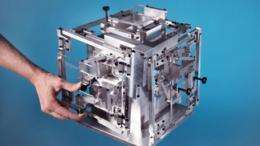
The "Legolas 5" mock-up shows the range of its capacities. Credit: Alain Herzog / EPFL
(PhysOrg.com) -- A doctoral student from EPFL's Laboratory of Robotics Systems has developed a concept for modular industrial robots, based on the technology of parallel robots, whose precision is expressed in nanometers.
Its name is Legolas. Its as precise as the elf of the same name from The Lord of the Rings, and as modular as Lego bricks. This surprising association has been achieved by Murielle Richard in the context of her thesis, conducted in the Laboratory of Robotics Systems (LSRO) at EPFL. Her goal was to create an industrial robot that would be capable of a variable number of degrees of freedom, according to the needs of its users. Normally, the development time required for a high-precision robot is long around two to three years and expensive. For industry, for example in watchmaking, this is too long, explains Ms. Richard.
To shorten the time required, Murielle Richard has conceived a modular system that has a very limited number of bricks active or passive whose combinations enable the creation of a large number of robots of different types. My approach consisted of reducing a three-dimensional complex problem to a combination of problems in two dimensions, she continues. In practice, plates equipped with motors that give them from one to three degrees of freedom are mounted on a cube 10 cm wide. According to their type and disposition, they can allow up to six degrees of freedom (three translational and three for rotation) to a point situated at one of the angles of the cube, on which a tool can be fitted. Ms. Richards concept was described in a recent edition of the journal Mechanical Sciences.
The legacy of the Delta robot
The technological basis of Murielle Richards project is in fact a speciality of EPFL. The assembly of these different plates results in a parallel-type robot. This principle has already been used by the Director of the laboratory, Reymond Clavel, in the invention of the well-known Delta robot, which is used mainly in the packaging industry. The fact that several arms link the output (or end-effector, the part that moves and holds a tool) of the robot to its fixed part gives this type of device greater precision, just like when we use both our arms to move an object, instead of just one. Moreover, these structures allow for very high acceleration.
For this new application, Murielle Richard uses the mechanical properties of flexible parallel structures. Each of the plates of the robot is composed of parallel elements linked together by very fine metal bands. These plates are made from one piece, carved in a block of metal using a high-precision method of electrical discharge machining. Thus, they are able to generate, in each direction, movements that can be combined and controlled with extremely high precision.
Industry is expected to show a high level of interest in this technology. Precision of the order of five nanometers (millionths of millimeters) in a modular device that is quickly adaptable to specific needs constitutes a record and holds the promise of exciting economic perspectives for those sectors requiring very high precision; for example, fine watchmaking, optics or microtechnology.
Provided by Ecole Polytechnique Federale de Lausanne
-
When robots learn from our mistakes
May 26, 2011 |
not rated yet |
0
-
A robot with finger-tip sensitivity
Dec 01, 2010 |
not rated yet |
0
-
University of Ulster celebrates acquisition of PR2 robot by having it solve Rubik's cube
May 11, 2011 |
not rated yet |
0
-
As long as original version still available, tweaking Twain is OK, professor says
Jan 12, 2011 |
not rated yet |
0
-
Key to Robonaut 2's dexterity is human-like hands
Dec 09, 2010 |
not rated yet |
0
-
Stars containing dark matter should look different from other stars
Feb 20, 2012 |
4.5 / 5 (17) |
11
-
Physicists discover evidence of rare hypernucleus, a component of strange matter
Feb 17, 2012 |
4.7 / 5 (38) |
22
-
Fast photon control brings quantum photonic technologies closer
Feb 13, 2012 |
5 / 5 (8) |
1
-
Engineers build first sub-10-nm carbon nanotube transistor
Feb 01, 2012 |
4.9 / 5 (36) |
32
-
Something old, something new: Evolution and the structural divergence of duplicate genes
Jan 31, 2012 |
4.6 / 5 (7) |
1
-
Calculating forces involved in seesaw motion
3 hours ago
-
Writing shear and moment equations for a simple beam problem?
4 hours ago
-
Furnace Shell Spray Cooling Design
20 hours ago
-
Ways to measure the speed of a golf ball?
Feb 21, 2012
-
Water Skin Effect in Plastic Pipe
Feb 21, 2012
-
Undergraduate Engineering Physics To Graduate Aerospace Engineering
Feb 21, 2012
- More from Physics Forums - General Engineering
More news stories
PlayStation Vita game gadgets debut outside Asia
Sony's slick PlayStation Vita handheld videogame gadget hit major markets around the world on Wednesday as the Japanese entertainment titan bucked a trend towards play on smartphones.
Electronics / Consumer & Gadgets
10 hours ago |
not rated yet |
0
Energy-recycling computer technology from UM goes global through AMD
An energy-recycling computer circuit born at the University of Michigan will enable a new generation of power efficient laptop PCs and servers.
17 hours ago |
5 / 5 (1) |
0
Review: Vita sets new standard for portable games
(AP) -- The PlayStation Vita won't replace your smartphone. For starters, it isn't a telephone (although it will eventually let you use Skype). And it's too big to fit in your pants pocket, unless you're wearing ...
Electronics / Consumer & Gadgets
Feb 21, 2012 |
3.7 / 5 (3) |
2
Engineering research brings seven adult-sized humanoid robots together for first time in US
Seven adult-sized humanoid robots took the stage during Drexel University's celebration of National Engineers Week, in a first-of-its-kind assembly of robotic technology. A showcase event on Feb. 20 introduced all seven of ...
Feb 21, 2012 |
not rated yet |
2
British firm develops 'cheapest wireless tablet'
A British technology company claims to have developed the world's least expensive computer tablet for wireless Internet access.
Electronics / Consumer & Gadgets
Feb 19, 2012 |
4.6 / 5 (10) |
2
Researchers build first physical 'metatronic' circuit
(PhysOrg.com) -- The technological world of the 21st century owes a tremendous amount to advances in electrical engineering, specifically, the ability to finely control the flow of electrical charges using ...
Spitzer finds solid buckyballs in space
(PhysOrg.com) -- Astronomers using data from NASA's Spitzer Space Telescope have, for the first time, discovered buckyballs in a solid form in space. Prior to this discovery, the microscopic carbon spheres ...
Faster than light neutrinos? More like faulty wiring
You can shelf your designs for a warp drive engine (for now) and put the DeLorean back in the garage; it turns out neutrinos may not have broken any cosmic speed limits after all.
CT colonography shown to be comparable to standard colonoscopy
Computerized tomographic (CT) colonography (CTC), also known as virtual colonoscopy, is comparable to standard colonoscopy in its ability to accurately detect cancer and precancerous polyps in people ages 65 and older, according ...
Physicists surprised by disappearing and reappearing superconductivity in iron selenium chalcogenides
Superconductivity is a rare physical state in which matter is able to conduct electricity -- maintain a flow of electrons -- without any resistance. This phenomenon can only be found in certain materials at low temperatures, ...
Study: Virtual colonoscopy effective screening tool for adults over 65
Computed tomography (CT) colonography can be used as a primary screening tool for colorectal cancer in adults over the age of 65, according to a new study published online in the journal Radiology.