Lab-grown meat would 'cut emissions and save energy'
June 21, 2011
Lab-grown meat would 'cut emissions and save energy'

An alternative to conventionally-reared meat could cut emissions

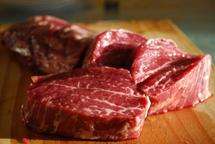
(PhysOrg.com) -- Meat grown using tissue engineering techniques, so-called ‘cultured meat’, would generate up to 96% lower greenhouse gas emissions than conventionally produced meat, according to a new study.

The analysis, carried out by scientists from Oxford University and the University of Amsterdam, also estimates that cultured meat would require 7-45% less energy to produce than the same volume of pork, sheep or beef. It would require more energy to produce than poultry but only a fraction of the land area and water needed to rear chickens.

A report of the team’s research is published in the journal Environmental Science & Technology.

‘What our study found was that the environmental impacts of cultured meat could be substantially lower than those of meat produced in the conventional way,’ said Hanna Tuomisto of Oxford University’s Wildlife Conservation Research Unit, who led the research. ‘Cultured meat could potentially be produced with up to 96% lower greenhouse gas emissions, 45% less energy, 99% lower land use, and 96% lower water use than conventional meat.’

The researchers based their calculations on a process, using Cyanobacteria hydrolysate as a nutrient and energy source for growing muscle cells, that is being developed by co-author Dr Joost Teixeira de Mattos at the University of Amsterdam. At the moment this sort of tissue engineering technology is confined to the laboratory, but the researchers estimated what the various costs would be for producing 1000kg of cultured meat using a scaled-up version of the technology compared to the costs associated with livestock reared conventionally.

In comparison to conventionally-produced European meat, the team estimate cultured meat would involve approximately 7-45% lower energy use, 78-96% lower greenhouse gas emissions, 99% lower land use, and 82-96% lower water use depending on the type of meat.  

‘We are not saying that we could, or would necessarily want to, replace conventional meat with its cultured counterpart right now,’ said Ms Tuomisto, ‘however, our research shows that cultured meat could be part of the solution to feeding the world’s growing population and at the same time cutting emissions and saving both energy and water. Simply put, cultured meat is, potentially, a much more efficient and environmentally-friendly way of putting meat on the table.’

The team point out that their calculations do not currently take into account additional savings from, for instance, the lower energy costs of transport and refrigeration of cultured meat compared to the conventional variety. They also suggest that land freed up from farming could be reforested or used for other carbon sequestration purposes, further lowering the carbon footprint of cultured meat.

Ms Tuomisto said: ‘There are obviously many obstacles to overcome before we can say whether cultured meat will become part of our diet, not least of which is whether people would be prepared to eat it! But we hope our research will add to the debate about whether we could, or should, develop a less wasteful alternative to from animals.’

More information: A report of the research, ‘Environmental impacts of cultured meat production’, is published online in Environmental Science & Technology.

Provided by Oxford University (news : web)

4.3 /5 (28 votes)  

Filter


Move the slider to adjust rank threshold, so that you can hide some of the comments.


Display comments: newest first

lengould100
Jun 21, 2011

Rank: 4.7 / 5 (14)
Terrific! Do it, now.
danlgarmstrong
Jun 21, 2011

Rank: 5 / 5 (15)
If the flavor and texture is good, I'd eat it. Food comes to us plastic wrapped as it is, with a bit of good marketing this stuff could take off. I really don't understand why there are so many 'reservations' about cultured meat.
MentalHealthNut
Jun 21, 2011

Rank: 4.6 / 5 (15)
Soylent green is people!!!!
Ramael
Jun 21, 2011

Rank: 4.7 / 5 (15)
I'm prepared to eat it! gimme gimme gimme!
Frankly I'm amazed at the progress so far and have a feeling that there's going to be a market regardless. Just make it cheaper than normal meat and your golden.
Egnite
Jun 21, 2011

Rank: 4.6 / 5 (5)
Quick get it on the market to start the live long-term side effect testing so we'll know the dangers for future generations.
PaulRC
Jun 21, 2011

Rank: 1.2 / 5 (21)
morons! so, what? we kill off all the animals to do this? it only works if we drive species to near extinction, and keep their numbers low.....
"dang it sheriff! i just killed farmer bob's cows to save the planet! dont arrest me!"
it will work great in space perhaps, though.
SmartK8
Jun 21, 2011

Rank: 1.8 / 5 (11)
We can grow already marinated steak, yum. But wouldn't synthetic meat make some animals go extinct ? Like pigs for example.
jscroft
Jun 21, 2011

Rank: 1.3 / 5 (23)
Two points:

1. You want a species to survive, find a market for it. There's a REASON why there are more pigs running around than, say, white tigers. If this takes off, fifty years from now pinko environmentalists will be wondering why porkers are going extinct.

2. We already have HIGHLY efficient beef factories. They're called cows. I'm just sayin'.
zevkirsh
Jun 21, 2011

Rank: 5 / 5 (9)
monsanto is going to love this.
Scientist_Steve
Jun 21, 2011

Rank: 4.6 / 5 (10)
@jscroft
How would you define "HIGHLY efficient". Take a drive through Bakersfield sometime. Its like driving through a giant cloud of methane gas. This technology has been on the back burner for awhile now. I am not super thrilled about "Lab meat" either. But all ways you spin it, this is probably a step in the right direction.
antialias_physorg
Jun 21, 2011

Rank: 4.7 / 5 (12)
What I'd like to know is whether the process is so simple that you can make this stuff at home.

From what I read elsewhere texture is still a problem. (Though one paper reports that they keep artificialy stressing/stretching the growing lumps to produce the right kind of texture and not just generate an undifferentiated lump of meat cells)

We already have HIGHLY efficient beef factories. They're called cows..

If you'd read the article you'd have noticd that cows are not nearly as efficient as the described process.

synthetic meat make some animals go extinct ? Like pigs for example.

The pigs we have now are already a specifically bred form that is a long way from what pigs once were in the wild. The pigs (and cows and chickens and whatnot) we have on farms today are not really any kind of 'natural' animal. They are 'meat on legs'. So what if they die out?

CapitalismPrevails
Jun 21, 2011

Rank: 5 / 5 (3)
Why would it make animals go extinct? I am a rancher so would this put me out of business? Sounds like it...
Scientist_Steve
Jun 21, 2011

Rank: 4.8 / 5 (8)
@CapitalismPrevails
Probably not. Even if we manage to replicate the appearance of a typical steak with Lab meat and drive the market cost way way down, someone will always want the "real" thing. I would see something like this probably reducing the demand for so much beef, but not replacing it completely.
FrankHerbert
Jun 21, 2011

Rank: 3.6 / 5 (19)
Why would it make animals go extinct? I am a rancher so would this put me out of business? Sounds like it...


Wouldn't this be capitalism prevailing?
CapitalismPrevails
Jun 21, 2011

Rank: 4.8 / 5 (9)
Lol Frank. Yes you are correct.
omatumr
Jun 21, 2011

Rank: 1.4 / 5 (20)
Today the entire AGW scam is crumbling faster than any cookie!

See todays Skeptical Swedish Scientists report, Sun, Sun, Sun.

http://skepticals...sun-sun/

With kind regards,
Oliver K. Manuel
Jonathan_Q
Jun 21, 2011

Rank: 4.6 / 5 (10)
Lab manufactured meat / protein substitute is much better than synthesizing some meat like product from poop.

Oscar_D
Jun 21, 2011

Rank: 5 / 5 (9)
How texture and taste are integral for our appreciation have been explored by star chefs as Heston Blumenthal and Ferrān Adria and as one that has himself been working in Michelin rated restaurants I know that texture and taste of perfect quality is really hard to come by in "naturally farmed meat".

The quality control of the lab-grown meat, I'm confident, would soon surpass most of what we are offered now.

I also believe that in many senses this new meat could be made more naturally without the need for steroids and antibiotics (e.g. better for human consumption).

I also need to add that much of the meat offered in the supermarket today has an artificial textures as small pieces of low grade meat are tendered and then glued together with meat glue (transglutaminase). The food industry will very quickly pick on this.
Oscar_D
Jun 21, 2011

Rank: not rated yet
dbl.
wealthychef
Jun 21, 2011

Rank: 4.7 / 5 (7)
I love this technology's promise. Another advantage: you don't have to kill animals for this. Ethical win! Another advantage: you save labor, because you can create the meat in the right shape and size, you don't have to butcher a carcass. Another win: smaller waste stream, because it doesn't create e.g., hair, bones, etc. It will probably be cheaper. And flavor will come. The only missing piece is complete nutrition, but honestly, the idea of "natural foods" is probably overhyped, as evolution has not "designed" a perfect food any more than it has "designed" a perfect esophagus. We are getting close to besting nature at her game of creating life. (rubs hands together in glee)
jscroft
Jun 21, 2011

Rank: 2.6 / 5 (5)
How would you define "HIGHLY efficient".


Try raising a human for under $3 a pound live weight.
Scientist_Steve
Jun 21, 2011

Rank: 5 / 5 (2)
@jscroft
OK??? Thats a joke right? Did you even read the article?
Javinator
Jun 21, 2011

Rank: 4.6 / 5 (5)
How would you define "HIGHLY efficient". Take a drive through Bakersfield sometime. Its like driving through a giant cloud of methane gas.


Methane is odorless.

The smell you smell when there's a natural gas leak is an additive. You're smelling sulphur containing compounds in the dung, not methane.
Scientist_Steve
Jun 21, 2011

Rank: 3 / 5 (2)
@Javinator
I was making a joke. Not trying to accurately describe the composition of a cow fart (which contains methane). Don't be a jerk.
Isaacsname
Jun 21, 2011

Rank: 2.3 / 5 (8)
Yeah, that's nice and all, but until they can grow me Lamb shanks for Osso,I'm not too excited about this. And where will I get my bones for making Veal Demi ? I think this has great promise for certain applications, like fast food, but it has no place in a chef's hands aside from a possible flash-in-the-pan fad.

On the other hand, the positive thing about this is that meat will not be flooded with adrenaline from the frightened animals, most of you probably don't know how much that contributes to not only flavor, but shelf-life of product as well.

If you have never tasted side-by-side, 2 pieces of meat, 1 from an animal that was slaughtered humanly, and 1 that was killed in fear, you wouldn't understand.

idk,..if they could flawlessly recreate various cuts, bone-in, I might be interested in trying it, otherwise, yech.
jscroft
Jun 21, 2011

Rank: 3 / 5 (4)
OK??? Thats a joke right? Did you even read the article?


Of course I did. I never said cows were MORE efficient than this lab process... only that they are HIGHLY efficient.

Which they are. Most beef averages well under $3/pound live weight at market. Forget people... try raising a DOG for that amount!
Scientist_Steve
Jun 21, 2011

Rank: 4 / 5 (3)
@jscroft
My bad on the misconfusion there. I thought you were implying cows are or would be more efficient then the lab process.
I do agree with you that cows are more efficient from a livestock standpoint, compared to other species. For the record, I really like steak the way it is now too!
that_guy
Jun 21, 2011

Rank: 3.5 / 5 (2)
I've read other articles on lab raised meat...For the average person, there is quite a difference between this and the 'real' thing. To get lab raised meat that would be indistinguishable from real meat would substantially raise costs and emissions.

There is a substantial difference between a lab dish of unstressed muscle cells, and a big slab of shoulder meat, complete with fibrous tissue, blood cells, differentation, fat and marbling, capillaries, blood vessels...

And those who have tasted lab meat report that it's disgusting.

If they get the lab meat to a marketable quality, there will still be plenty of demand for natural meat as well. I don't think the ranchers have much to worry about.

The arguments you guys are giving essentially amount to the risk that veggie dogs and morningstar grillers will take over the burger and hot dog markets.
jscroft
Jun 21, 2011

Rank: 3.7 / 5 (3)
@SciSteve: Haha me too. I'm sure lab-grown steaks will be tastier than soyaburger on those long space flights, but I seriously doubt they'll eclipse the real thing anytime soon down here on Earth.
NeptuneAD
Jun 21, 2011

Rank: 5 / 5 (1)
All through the ages people have made stands against change, we humans like to be comfortable and protect what we have.

I really like my meat and any change will be difficult for me, however 10 years later I may find that what I had was good but this is better, only time will tell and in the end I probably wont get a choice either way.
that_guy
Jun 21, 2011

Rank: 4.5 / 5 (2)
@SciSteve: Haha me too. I'm sure lab-grown steaks will be tastier than soyaburger on those long space flights, but I seriously doubt they'll eclipse the real thing anytime soon down here on Earth.

Don't knock my reconstituted soy protien burgers!!!!
Norezar
Jun 21, 2011

Rank: 4.5 / 5 (4)
Two points:

1. You want a species to survive, find a market for it. There's a REASON why there are more pigs running around than, say, white tigers. If this takes off, fifty years from now pinko environmentalists will be wondering why porkers are going extinct.

2. We already have HIGHLY efficient beef factories. They're called cows. I'm just sayin'.


True on the cow front, and I bet tigerburgers are DELICIOUS.
thewhitebear
Jun 21, 2011

Rank: 3.7 / 5 (3)
I don't understand where they are getting the raw nutrients to build this muscle tissue. cows eat grass, which is awesome because we can't eat grass. where do the inputs come from for this lab-meat? gen-mod soy? corn? there's still a land footprint somewhere. bottom line, you can't make energy.
Moebius
Jun 21, 2011

Rank: 5 / 5 (7)
Sounds great for other reasons like not killing so many animals, no hormones, no E Coli or Salmonella.

They forgot the fat. I don't want just protein, grow some fat in there too (trans-fat free, polyunsaturated, yada yada)

This technology should be applicable to other things like artificial fur and leather.
KillerKopy
Jun 21, 2011

Rank: 4.7 / 5 (3)
If they can get the texture right then it will take off. Texture is just as important as flavor when you are talking about any kind of meat. It better also grill the same ;)
Caliban
Jun 21, 2011

Rank: 5 / 5 (6)
The whole idea seems to be lacking in imagination. They are thinking too small.
Why stop at culturing a single type of food? Why not a balanced, nutritionally-complete, non toxic food stuff that satisfies all the requirements all at once? Call it "Panacaea" or something, and end the goddam shortage, already? Why not eliminate all the strife and pollution caused by the current, entirely profit-driven, food production model?

Oh, right --I forgot. Sorry.

PhotonX
Jun 21, 2011

Rank: 5 / 5 (1)
Um, yummy!(?) "Waiter, I'll have the vat-grown Slab-o-Beef with 5% pseudofat, and a side of fried mockorella sticks please."

I wonder: is it better to live for a while and then be eaten, or to never live at all?
Recovering_Human
Jun 21, 2011

Rank: 4.9 / 5 (9)

I wonder: is it better to live for a while and then be eaten, or to never live at all?


You don't get eaten until after you're already dead. But it's most definitely better not to live at all than to spend your life in a factory farm.
ekim
Jun 22, 2011

Rank: 5 / 5 (6)
3d printer capable of creating an extra cellular matrix stem cells from animal of choice = perfect steak every time.
And perhaps a new heart/liver/lungs for myself.
pokerdice1
Jun 22, 2011

Rank: 3 / 5 (7)
The sooner the better! Stop funding studies that for instance relate the symmetry of spider genitals to mating preferences in humans and lavish (I mean it!) money on things that matter such as artificial meat, tower farms, nuclear fusion power and anti-aging medicine!
Sinister1811
Jun 22, 2011

Rank: 3.3 / 5 (3)
As long as they can get rid of most of the fat, bone, and gristle - I'm all for it. For me, there's nothing worse than biting into a steak that has copious amounts of fat and cartilage.
jnjnjnjn
Jun 22, 2011

Rank: 4 / 5 (4)
This could end the animal holocaust.
But if its used to increase the number of people on the planet it will destroy almost all animals and the nature they live in.

J.
blengi
Jun 22, 2011

Rank: 4.5 / 5 (4)
just give me something like an animal protein goo that I can sqirt out of a bottle into a frying pan and fry up like an egg into a semi-chewey ham/bacon/chicken flavour meat pancake and I'll be satisfied....
jscroft
Jun 22, 2011

Rank: 3 / 5 (2)
gross
Jumanji
Jun 22, 2011

Rank: 5 / 5 (1)
Most beef averages well under $3/pound live weight at market.

True, but I feel that this has more to do with government subsidies on the corn and beef industry rather than the efficiency of the cow.
jscroft
Jun 23, 2011

Rank: 5 / 5 (1)
So the true cost is... what, $4/pound? How would affect my point? It's still cheaper than tin by weight.
Jumanji
Jun 23, 2011

Rank: 1 / 5 (1)
If the subsidies were lifted as mentioned before, the true economic price of a hamburger is $10 at a minimum. Other estimates are in the hundreds. Not so efficient huh?

I find it curious why you are so dismissive of anything other than the cow as a means of producing beef. The fact is we can't claim that cows are the pinnacle of efficiency compared to other methods because we haven't even begun to explore the alternatives in depth, and from what this article suggests, the economic and environmental potential behind cultured meats is well worth exploring.

kaasinees
Jun 23, 2011

Rank: 1 / 5 (1)
cows and pigs are one of the biggest sources of methane release.
cows are not efficient at all. But there is more to a cow than just meat though. everything of a cow is used. they are working on reducing methane release by using different food and modded/breed cows. proteine goo is a very good idea especially if it can be made from waste, good for space travel.
I sure wouldnt mind eating some proteine cake or pancake 5 times a day and fruit shakes with it.
jscroft
Jun 24, 2011

Rank: 5 / 5 (1)
If the subsidies were lifted as mentioned before, the true economic price of a hamburger is $10 at a minimum. Other estimates are in the hundreds. Not so efficient huh?


HUNDREDS??? Grab an envelope, scribble on the back for a minute or two, and I think you'll convince yourself that this statement is ridiculous.

But let's say $10. No... let's say TWENTY!!! My dog weighs about 50 lbs and eats $2 worth of food per day. That's 4 cents per pound per day... so he'll hit $20/pound (live weight) in 500 days, or less than 17 months. That's LESS than the two years it takes to produce prime beef.

So, even assuming that subsidies account for 85% (!!!) of the cost of raising prime beef--AND assuming that live weight costs the same as hamburger (!!!!!)--it's still WAY more efficient than raising my dog. The zenith of performance? Maybe not... but not exactly its nadir, either.
Jumanji
Jun 24, 2011

Rank: 2.3 / 5 (3)
If your dog takes 500 days, and a cow takes two years under identical circumstances, then isn't it more efficient to raise your dog? Hundreds is not ridiculous btw. It merely accounts for things that are not usually included, such as deforestation in favor of more pastureland and environmental impacts of methane release, both major factors that go against the claim that a cow is "efficient".

BrusierTDS
Jun 25, 2011

Rank: 1 / 5 (1)
@jscroft
How would you define "HIGHLY efficient". Take a drive through Bakersfield sometime. Its like driving through a giant cloud of methane gas. This technology has been on the back burner for awhile now. I am not super thrilled about "Lab meat" either. But all ways you spin it, this is probably a step in the right direction.


Ohh my god that is so funny you mention Bakersfield. I guess I just wish I was not from there. The great smell north of Delano from the factory mmm... ok it is not good.
Skepticus
Jun 25, 2011

Rank: 5 / 5 (1)
My guts doesn't give a fcuk if the "beef" is grown with all the correct bovine DNA, nutrients, hormones, textures and so on in the original. Chemistry is chemistry. You get what you put in. But I guess, somebody will miss the pleasure, the estasy of knowing they get their kosher and halal meats from concious animals' throats being slit and slowly bleeded to death. If God decreed such a way of killing was good for the souls and bodies of His followers, who dares to go against Him??? The terrorists who slit thoats and chopped heads off concious infidel captives must have whole heartedly agree.
TheGhostofOtto1923
Jun 25, 2011

Rank: 3.7 / 5 (3)
Farm animals are not natural. They are the result of countless gens of husbandry aimed at producing more quantity at the inevitable expense of quality. We can engineer foods to be much better. I suggest starting with venison as a model or other wild foods we evolved on.

As to texture and such, ever have fake crab?
http://en.wikiped...i/Surimi

-Food scientists can make anything taste like anything. Here is an example (not for the squeemish)
http://www.mnn.co...ste-test

-This kind of shortcuts the fertilizer-to-food cycle.
that_guy
Jun 25, 2011

Rank: 1 / 5 (1)
@Otto
You forgot mcdonalds chicken nuggets!
They used ground up chicken leftovers that turn into a pink goo. Then they fry them, flavor them, and color them - because the chicken 'base' that they use doesn't taste or look very good.

Ironically, the only reason mcdonalds chicken nuggets actually have chicken in them is so they can say they have chicken in them.

Along those lines, chicken was listed as using less energy than cultured meat, so why don't we just use chicken protien? But then, if you had mcdonalds chicken nuggets 15 years ago, you weren't complaining that it was mostly soy protien at that time...
Blather
Jun 25, 2011

Rank: 2.6 / 5 (5)
I have long advocated growing meat in factories. Giant slabs of meat can be grown to taste with all the nutrients and fat content regulated to perfection.

This would also free up considerable pasture land.

Also, growing meat tissues in factories will unveil many vegetarians' and "vegans'" REAL intent as they will protect vociferously.

They will show that they are NOT concerned with the lives of animals that will no longer be killed and eaten but they will show that they really harbor a hatred for humanity and only use their phony concern for animals as a mask.
ShotmanMaslo
Jun 25, 2011

Rank: 4.5 / 5 (2)
This could help to save many animals from suffering. Heck, I am not a vegetarian, but I would definately buy this over ordinary meat just for this reason. It could also be more efficient. Sounds very promising, IMHO.
TheGhostofOtto1923
Jun 25, 2011

Rank: 4 / 5 (2)
They used ground up chicken leftovers that turn into a pink goo. Then they fry them, flavor them, and color them - because the chicken 'base' that they use doesn't taste or look very good.
And they are very tasty even without the sauce. Yum.
I have long advocated growing meat in factories. Giant slabs of meat can be grown to taste with all the nutrients and fat content regulated to perfection.
And also protect us from prion disease, bovine growth hormone, e coli, salmonella, etc etc.
TheRedComet
Jun 25, 2011

Rank: 1.3 / 5 (3)
I love vegan and vegetarian food I find myself eating vegetarian not because of my views on factory farming it just that it taste so good. But its also makes me feel good knowing that I have helped the current food shortage. Ecology professor David Pimentel has claimed, "If all the grain currently fed to livestock in the United States were consumed directly by people, the number of people who could be fed would be nearly 800 million."
socean
Jun 26, 2011

Rank: 4.7 / 5 (3)
Why stop with beef? Why not grow every kind of food under laboratory conditions? No pesticides, steroids, hormones, etc. needed. No crop losses, no contaminants, no shipping, no waste.

Could be grown to order to meet individual preferences and requirements.

Organic, all natural foods will be grown for pleasure instead of profit.

In a world where a child dies of malnutrition about every 2 seconds, is there really any other ethical choice?
Tenche
Jun 26, 2011

Rank: 3 / 5 (2)
@jscroft
How would you define "HIGHLY efficient". Take a drive through Bakersfield sometime. Its like driving through a giant cloud of methane gas. This technology has been on the back burner for awhile now. I am not super thrilled about "Lab meat" either. But all ways you spin it, this is probably a step in the right direction.


Wouldn't the problem then be with the large scale farming. Last time I checked, the small local farms who produce beef have 0 emissions.

I think people are missing the point of all of this. We shouldn't even be considering LAB MEAT... The problem is the giant corporate farms who pump hormones, steroids, and antibiotics into their cows.

I urge everyone to talk to their local organic farmers and get setup with a CSA or something. Stop fueling the large corporations and they won't emit anything anymore.
Jonathan_Q
Jun 26, 2011

Rank: not rated yet
Seriously; before making predictions of how much in terms of natural resources it will save manufacturing such a meat product, actually produce the product then let us know if saves anything all.

When you or anyone else start producing a meat substitute and consumers(us) start consuming it then we find out if it is successful or not in terms of cost to the environment.
TheGhostofOtto1923
Jun 26, 2011

Rank: 1 / 5 (1)
I love vegan and vegetarian food I find myself eating vegetarian not because of my views on factory farming it just that it taste so good. But its also makes me feel good knowing that I have helped the current food shortage. Ecology professor David Pimentel has claimed, "If all the grain currently fed to livestock in the United States were consumed directly by people, the number of people who could be fed would be nearly 800 million."
Yeah except that livestock food is not very good for people. Grasses are some of the last things pleistoceners would want to eat - too much work collecting and processing for a limited nutritional benefit.

Eating grass is a sign of overpopulation, of people forced to consume whatever they could in order to survive. Grain-fed pops were chronically undernourished. Domesticated grains were preferable, again, because they offered quantity over quality and long storage life. This is not to say we couldn't grow something else on the land though.
David_Wishengrad
Jun 26, 2011

Rank: 2 / 5 (6)
Man is not built to eat raw flesh. Real science anyone? There are how may posts here from people that are totally brain washed?
TheEyeofTheBeholder
Jun 26, 2011

Rank: 5 / 5 (1)
Obviously, this is a program that should be taken up on the Space Lab, to see how well in near zero weight if and how this would grow. Astronauts need protein and eat meat, too.
TheGhostofOtto1923
Jun 26, 2011

Rank: 1 / 5 (1)
Man is not built to eat raw flesh. Real science anyone? There are how may posts here from people that are totally brain washed?
Indeed because of chronic overpopulation throughout our recent evolutionary past, humans ate LOTS of meat - including quite frequently each other. For why leave all that good protein to rot on the battleground when your family was starving back home? We have developed immunity to certain prion infections as a result.

Chimps are hunters and marauders and cannibals. You are naive.
Wulfgar
Jun 26, 2011

Rank: 1 / 5 (1)
There seems to be some confusion out there. The people studying this lab meat or their business partners fully intend on one day mimicking the taste and texture of real meat. You aren't going to be eating custard consistency cow meat, unless a market for that arises. They are first talking about being able to deliver real consistency ground meat followed by steaks at some point (which is more complicated than ground meat).

I am worried about them accidentally growing some potent virus into the meat or some such thing. I would imagine that contamination will be an issue. Other than that I also wonder whether this will displace factory farming or just supplement the industry as it already is. Either way, its great to be able to feed a lot of people while using less land to do so.
Humpty
Jun 27, 2011

Rank: 1 / 5 (1)
Ahhh but when is the fun, the joy, the pleasure and the excitement in killing it, to eat it?

The blood - the knives.... the stabbing, and carving up the carcass.

There is a thrill in being the No. 1 predator that this planet has ever produced.

(not including everything else that eats us alive)
chthonic
Jun 27, 2011

Rank: 3 / 5 (2)
Tleilaxu slig meat! (slurp slurp slurp) :-)
braindead
Jun 27, 2011

Rank: 1 / 5 (1)
You aren't going to be eating custard consistency cow meat, unless a market for that arises.

It's called "beef gravy".
jscroft
Jun 27, 2011

Rank: 5 / 5 (1)
If your dog takes 500 days, and a cow takes two years under identical circumstances, then isn't it more efficient to raise your dog?


Depends on the efficiency under consideration. I was talking about "price efficiency." My dog accumulates dollars/lb live weight faster than a cow, so raising him is less efficient.
FrankHerbert
Jun 27, 2011

Rank: 1 / 5 (6)
Tleilaxu slig meat! (slurp slurp slurp) :-)


Quoting for posterity ;-)
diego
Jul 17, 2011

Rank: 5 / 5 (1)

I am worried about them accidentally growing some potent virus into the meat or some such thing. I would imagine that contamination will be an issue.


Why on earth would you think that contamination is an issue? Do you realize that the average pound of hamburger has bits of flesh from hundreds of different cows. Forgive, I cannot give you a source, I learned that fact by watching a documentary about the evils of the modern food industry,
Rank 4.3 /5 (28 votes)
Tags

Related Stories
Relevant PhysicsForums posts
  • Is the Earth really going to die
    created14 hours ago
  • Do some geologists actually act a lot like Randy Marsh?
    createdFeb 11, 2012
  • Discrepancy between oxygen and carbon-dioxide levels
    createdFeb 09, 2012
  • where gems are found in the world
    createdFeb 09, 2012
  • Wind Waves in Reservoir ~ Wind run-up and Wind set-up
    createdFeb 08, 2012
  • Balance of oxygen in the atmosphere
    createdFeb 01, 2012
  • More from Physics Forums - Earth

More news stories

Spitzer finds solid buckyballs in space

(PhysOrg.com) -- Astronomers using data from NASA's Spitzer Space Telescope have, for the first time, discovered buckyballs in a solid form in space. Prior to this discovery, the microscopic carbon spheres ...

Space & Earth / Astronomy

created 14 hours ago | popularity 4.7 / 5 (12) | comments 8 | with audio podcast

Going up: Japan builder eyes space elevator

A Japanese construction firm claimed Wednesday it could execute an out-of-this-world plan to put tourists in space within 40 years by building an elevator that stretches a quarter of the way to the moon.

Space & Earth / Space Exploration

created 21 hours ago | popularity 3.5 / 5 (13) | comments 26

ENASA satellite finds Earth's clouds are getting lower

(PhysOrg.com) -- Earth's clouds got a little lower -- about one percent on average -- during the first decade of this century, finds a new NASA-funded university study based on NASA satellite data. The results ...

Space & Earth / Earth Sciences

created 18 hours ago | popularity 5 / 5 (8) | comments 13 | with audio podcast

Fresh scandal embroils US climate science debate

A fresh scandal over climate change has erupted in the United States after leaked documents appeared to show a right-wing funded campaign to influence how climate science is taught in schools.

Space & Earth / Environment

created 10 hours ago | popularity 4.1 / 5 (9) | comments 8

World's oceans get an acid bath

Among the repercussions of global climate change, the effect of ocean acidification on marine life is one of the least-understood variables.

Space & Earth / Environment

created 17 hours ago | popularity 4.3 / 5 (6) | comments 4 | with audio podcast


Researchers build first physical 'metatronic' circuit

(PhysOrg.com) -- The technological world of the 21st century owes a tremendous amount to advances in electrical engineering, specifically, the ability to finely control the flow of electrical charges using ...

Faster than light neutrinos? More like faulty wiring

You can shelf your designs for a warp drive engine (for now) and put the DeLorean back in the garage; it turns out neutrinos may not have broken any cosmic speed limits after all.

Physicists surprised by disappearing and reappearing superconductivity in iron selenium chalcogenides

Superconductivity is a rare physical state in which matter is able to conduct electricity -- maintain a flow of electrons -- without any resistance. This phenomenon can only be found in certain materials at low temperatures, ...

CT colonography shown to be comparable to standard colonoscopy

Computerized tomographic (CT) colonography (CTC), also known as virtual colonoscopy, is comparable to standard colonoscopy in its ability to accurately detect cancer and precancerous polyps in people ages 65 and older, according ...

Stanford research team cracks animated NuCaptcha

(PhysOrg.com) -- The research team from Stanford University, led by Elie Bursztein, that previously had cracked regular CAPTCHAs and then audio CAPTCHAs, now has also successfully cracked the animated version called NuCapt ...

Study: Virtual colonoscopy effective screening tool for adults over 65

Computed tomography (CT) colonography can be used as a primary screening tool for colorectal cancer in adults over the age of 65, according to a new study published online in the journal Radiology.