Touch-screen steering wheel keeps drivers focused on the road
June 6, 2011 by Deborah Braconnier
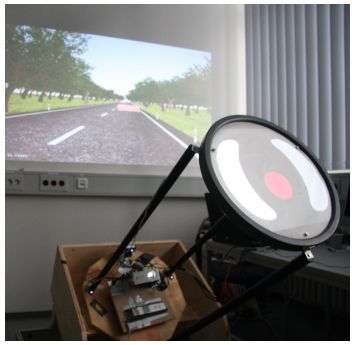
The multi-touch steering wheel hardware. Image: Tanja Döring et al.
(PhysOrg.com) -- A team of researchers from the University of Stuttgart, University of Duisburg-Essen and the German Research Center for Artificial Intelligence have created a prototype automotive steering wheel that uses a touch screen to enable the driver to control things such as the radio or navigate a map without having to take their eyes off the road.
With the numerous technological advances such as mobile phones and texting, the need to keep drivers focused on the road is the idea behind the development of this touch-screen steering wheel. With standard vehicle controls being behind the steering wheel or in the center console, making changes requires the driver to look away from the road. Albrecht Schmidt, a computer science professor who worked on the project believes by creating gesture-enabled steering wheel, drivers will be able to spend more time focused on the road.
The steering wheel is made out of 11 millimeter thick acrylic that is ringed with infrared LEDs. There is an infrared camera that is attached to the bottom that detects reflections when the screen is touched. Gestures can be made on the screen without the driver ever having to take their hands off the steering wheel.
To create the prototype, researchers asked participants what movements and gestures they currently used on technological devices in order to create the gestures for some 20 commands. Gestures such as pinching two fingers in order to zoom or tracing out the first letter of a command are some that have been included.
Once they had established all the different general commands and gestures, the researchers then had participants test the steering wheel in a simulator. The data from the study shows that the new prototype was able to substantially reduce the amount of time a driver needed to take his eyes off the road.
Down the road, they believe the technology could include things such as the ability to project information directly onto the windshield as well as a sensor system designed to check road conditions and traffic and alert a driver to stay focused on the road.
The prototype was presented at the Conference on Human Factors in Computing Systems and the researchers are currently speaking with automotive companies to look at the possibility of getting this technology into vehicles in the near future.
More information: Research papers are available here and here.
© 2010 PhysOrg.com
-
Lane departure warning systems help drowsy drivers avoid crashes
Oct 17, 2006 |
not rated yet |
0
-
Sleep deprivation affects eye-steering coordination when driving
Jun 11, 2007 |
not rated yet |
0
-
New way to guide a car: With your eyes, not hands
Apr 23, 2010 |
not rated yet |
0
-
Without driver or map, vans go from Italy to China
Oct 28, 2010 |
not rated yet |
0
-
Eye movements and sight distance reveal how drivers negotiate winding roads
Jul 06, 2010 |
not rated yet |
0
-
Stars containing dark matter should look different from other stars
Feb 20, 2012 |
4.5 / 5 (17) |
11
-
Physicists discover evidence of rare hypernucleus, a component of strange matter
Feb 17, 2012 |
4.7 / 5 (38) |
22
-
Fast photon control brings quantum photonic technologies closer
Feb 13, 2012 |
5 / 5 (8) |
1
-
Engineers build first sub-10-nm carbon nanotube transistor
Feb 01, 2012 |
4.9 / 5 (36) |
32
-
Something old, something new: Evolution and the structural divergence of duplicate genes
Jan 31, 2012 |
4.6 / 5 (7) |
1
-
Calculating forces involved in seesaw motion
4 hours ago
-
Writing shear and moment equations for a simple beam problem?
5 hours ago
-
Furnace Shell Spray Cooling Design
21 hours ago
-
Ways to measure the speed of a golf ball?
Feb 21, 2012
-
Water Skin Effect in Plastic Pipe
Feb 21, 2012
-
Undergraduate Engineering Physics To Graduate Aerospace Engineering
Feb 21, 2012
- More from Physics Forums - General Engineering
More news stories
Stanford research team cracks animated NuCaptcha
(PhysOrg.com) -- The research team from Stanford University, led by Elie Bursztein, that previously had cracked regular CAPTCHAs and then audio CAPTCHAs, now has also successfully cracked the animated version called NuCapt ...
Tiny, implantable medical device can propel itself through bloodstream
Someday, your doctor may turn to you and say, "Take two surgeons and call me in the morning." If that day arrives, you may just have Ada Poon to thank.
18 hours ago |
5 / 5 (9) |
8
|
Italian engineer invents floating solar panels
Rays of the winter sun bounce off gleaming mirrors on the tiny lake of Colignola in Italy, where engineers have built a cost-effective prototype for floating, rotating solar panels.
Technology / Energy & Green Tech
22 hours ago |
4.7 / 5 (6) |
5
Microsoft hits Motorola, Google with EU complaint
Microsoft on Wednesday lodged a formal complaint with the European Union's competition regulator against Motorola Mobility and its soon-to-be owner Google, saying Motorola's aggressive enforcement of patent ...
17 hours ago |
2 / 5 (1) |
2
Calif. pledges better mobile privacy disclosures
(AP) -- Mobile applications seeking to collect personal information will have to forewarn users as part of an agreement reached in California.
10 hours ago |
not rated yet |
0
Researchers build first physical 'metatronic' circuit
(PhysOrg.com) -- The technological world of the 21st century owes a tremendous amount to advances in electrical engineering, specifically, the ability to finely control the flow of electrical charges using ...
Spitzer finds solid buckyballs in space
(PhysOrg.com) -- Astronomers using data from NASA's Spitzer Space Telescope have, for the first time, discovered buckyballs in a solid form in space. Prior to this discovery, the microscopic carbon spheres ...
Faster than light neutrinos? More like faulty wiring
You can shelf your designs for a warp drive engine (for now) and put the DeLorean back in the garage; it turns out neutrinos may not have broken any cosmic speed limits after all.
Physicists surprised by disappearing and reappearing superconductivity in iron selenium chalcogenides
Superconductivity is a rare physical state in which matter is able to conduct electricity -- maintain a flow of electrons -- without any resistance. This phenomenon can only be found in certain materials at low temperatures, ...
Going up: Japan builder eyes space elevator
A Japanese construction firm claimed Wednesday it could execute an out-of-this-world plan to put tourists in space within 40 years by building an elevator that stretches a quarter of the way to the moon.
Flesh-eating bacteria inspire superglue
(PhysOrg.com) -- A bio-inspired superglue has been developed by Oxford University researchers that cant be matched for sticking molecules together and not letting go.
Jun 06, 2011
Rank: 5 / 5 (1)
Jun 06, 2011
Rank: not rated yet
I known, cost too much but sooner or later it will be cheap enough.
Jun 06, 2011
Rank: 4.5 / 5 (2)
Jun 06, 2011
Rank: 5 / 5 (2)
Robotic cars are already operational, just ask Google how well they work. When oh when will we realize that people just stink as drivers?
Jun 06, 2011
Rank: not rated yet
That's a little extreme Dave. Staring at the road suggests tunnel vision. Glancing at surroundings, checking mirrors, and performing shoulder checks are necessary actions that require you to take your eyes off the road. Just staring at the road is much more dangerous. It's dangerous not to be aware of your surroundings.
There's a difference between focusing on driving and staring at the road.
Jun 06, 2011
Rank: not rated yet
It will be a LONG LONG time. Not until we do something about the corrupt Insurance system we have in place here in the USA.
Insurance companies will never allow for driver less vehicles due to the "Fault" issue. Who pays for the damage in the inevitable accidents between automated and human drivers. Who will pay for the costs of an accident between two automated drivers?
'Crashes will never happen' is not a possibility; even Linux crashes once in awhile.
Jun 06, 2011
Rank: not rated yet
Jun 06, 2011
Rank: not rated yet
Jun 07, 2011
Rank: not rated yet
Jun 08, 2011
Rank: 5 / 5 (1)
Fault would be easy, just sign a form that says you take full responsibility for the malfunctions of your car. If these systems are safe enough for people to entrust their lives to them, I'm sure they'd feel alright about accepting responsibility. Engineered redundancy and failsafes can be orders of magnitude safer than the best human driver.
Accidents will almost always happen when human error is involved (dumbass running stop sign etc...)and in that case it's not your fault anyway.
I think the biggest problem is for people to think rationally instead of emotionally and accept that they are the safer option in the first place.
Jun 12, 2011
Rank: not rated yet
Well, it doubles the cost and in so doing increases the ability of the auto manufacturer to increase it's profits.
That is good... Isn't it?