Big rips and little rips
July 4, 2011 By Steve Nerlich, Universe Today
The concept of accelerating expansion does get you wondering just how fast the universe can end up expanding by. Theorists think that the rate of expansion might become so extreme as to produce a Big Rip. Or, after fiddling with the math a bit, maybe just a Little Rip? Credit: NASA.
One of a number of seemingly implausible features of dark energy is that its density is assumed to be constant over time. So, even though the universe expands over time, dark energy does not become diluted, unlike the rest of the contents of the universe.
As the universe expands, it seems that more dark energy appears out of nowhere to sustain the constant dark energy density of the universe. So, as times goes by, dark energy will become an increasingly dominant proportion of the observable universe remembering that it is already estimated as being 73% of it.
An easy solution to this is to say that dark energy is a feature inherent in the fabric of space-time, so that as the universe expands and the expanse of space-time increases, so dark energy increases and its density remains constant. And this is fine, as long as we then acknowledge that it isnt really energy since our otherwise highly reliable three laws of thermodynamics dont obviously permit energy to behave in such ways.
An easy solution to explain the uniform acceleration of the universes expansion is to propose that dark energy has the feature of negative pressure where negative pressure is a feature inherent in expansion.
Applying this arcane logic to observation, the observed apparent flatness of the universes geometry suggests that the ratio of dark energy pressure to dark energy density is approximately 1, or more correctly -1, since we are dealing with a negative pressure. This relationship is known as the equation of state for dark energy.
In speculating about what might happen in the universes future, an easy solution is to assume that dark energy is just whatever it is and that this ratio of pressure to density will be sustained at -1 indefinitely, whatever the heck that means.
But cosmologists are rarely happy to just leave things there and have speculated on what might happen if the equation of state does not stay at -1.
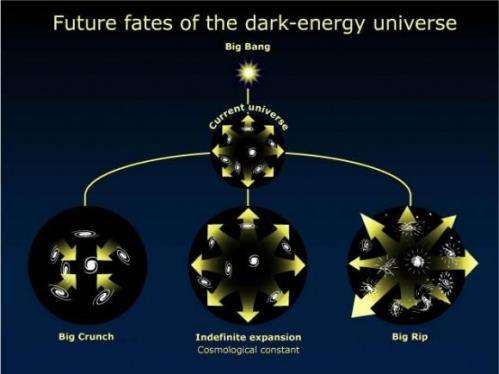
Three scenarios for a future driven by dark energy - its density declines over time, it stays the same or its density increases, tearing the contents of the universe to bits. If you are of the view that dark energy is just a mathematical artifact that grows as the expanse of space-time increases - then the cosmological constant option is for you.
If dark energy density decreased over time, the acceleration rate of universal expansion would decline and potentially cease if the pressure/density ratio reached -1/3. On the other hand, if dark energy density increased and the pressure/density ratio dropped below -1 (that is, towards -2, or -3 etc), then you get phantom energy scenarios. Phantom energy is a dark energy which has its density increasing over time. And lets pause here to remember that the Phantom (ghost who walks) is a fictional character.
Anyhow, as the universe expands and we allow phantom energy density to increase, it potentially approaches infinite within a finite period of time, causing a Big Rip, as the universe becomes infinite in scale and all bound structures, all the way down to subatomic particles, are torn apart. At a pressure/density ratio of just -1.5, this scenario could unfold over a mere 22 billion years.
Frampton et al propose an alternative Little Rip scenario, where the pressure/density ratio is variable over time so that bound structures are still torn apart but the universe does not become infinite in scale.
This might support a cyclic universe model since it gets you around problems with entropy. A hypothetical Big Bang Big Crunch cyclic universe has an entropy problem since free energy is lost as everything becomes gravitationally bound so that you just end up with one huge black hole at the end of the Crunch.
A Little Rip potentially gives you an entropy reboot, since everything is split apart and so can progress from scratch through the long process of being gravitationally bound all over again generating new stars and galaxies in the process.
Anyhow, Sunday morning time for a Big Brunch.
More information: Frampton et al. The Little Rip: http://arxiv.org/p … /1106.4996v1
Source: Universe Today
-
Holographic dark information energy
May 30, 2011 |
not rated yet |
0
-
Throwing light on the dark side of the Universe
Oct 21, 2008 |
not rated yet |
0
-
Statistical modeling could help us understand cosmic acceleration
Dec 24, 2010 |
not rated yet |
0
-
Penn astrophysicist outlines a multi-pronged approach in the hunt for dark energy
Feb 18, 2005 |
not rated yet |
0
-
U-M physics researchers chosen to study space mission
Aug 24, 2006 |
not rated yet |
0
-
Stars containing dark matter should look different from other stars
Feb 20, 2012 |
4.5 / 5 (17) |
11
-
Physicists discover evidence of rare hypernucleus, a component of strange matter
Feb 17, 2012 |
4.7 / 5 (38) |
22
-
Fast photon control brings quantum photonic technologies closer
Feb 13, 2012 |
5 / 5 (8) |
1
-
Engineers build first sub-10-nm carbon nanotube transistor
Feb 01, 2012 |
4.9 / 5 (36) |
32
-
Something old, something new: Evolution and the structural divergence of duplicate genes
Jan 31, 2012 |
4.6 / 5 (7) |
1
-
Calculating the magnitude
2 hours ago
-
What is this spectrum I took?
13 hours ago
-
Orientation of Space
13 hours ago
-
Geologically Active Moon Now: NASA
20 hours ago
-
advice on building a science fair telescope
Feb 22, 2012
-
Rise of the Sun
Feb 22, 2012
- More from Physics Forums - General Astronomy
More news stories
Spitzer finds solid buckyballs in space
(PhysOrg.com) -- Astronomers using data from NASA's Spitzer Space Telescope have, for the first time, discovered buckyballs in a solid form in space. Prior to this discovery, the microscopic carbon spheres ...
14 hours ago |
4.7 / 5 (12) |
8
|
Going up: Japan builder eyes space elevator
A Japanese construction firm claimed Wednesday it could execute an out-of-this-world plan to put tourists in space within 40 years by building an elevator that stretches a quarter of the way to the moon.
Space & Earth / Space Exploration
21 hours ago |
3.5 / 5 (13) |
26
ENASA satellite finds Earth's clouds are getting lower
(PhysOrg.com) -- Earth's clouds got a little lower -- about one percent on average -- during the first decade of this century, finds a new NASA-funded university study based on NASA satellite data. The results ...
Space & Earth / Earth Sciences
18 hours ago |
5 / 5 (8) |
13
|
Fresh scandal embroils US climate science debate
A fresh scandal over climate change has erupted in the United States after leaked documents appeared to show a right-wing funded campaign to influence how climate science is taught in schools.
11 hours ago |
4.1 / 5 (9) |
8
World's oceans get an acid bath
Among the repercussions of global climate change, the effect of ocean acidification on marine life is one of the least-understood variables.
18 hours ago |
4.3 / 5 (6) |
4
|
Researchers build first physical 'metatronic' circuit
(PhysOrg.com) -- The technological world of the 21st century owes a tremendous amount to advances in electrical engineering, specifically, the ability to finely control the flow of electrical charges using ...
Faster than light neutrinos? More like faulty wiring
You can shelf your designs for a warp drive engine (for now) and put the DeLorean back in the garage; it turns out neutrinos may not have broken any cosmic speed limits after all.
Physicists surprised by disappearing and reappearing superconductivity in iron selenium chalcogenides
Superconductivity is a rare physical state in which matter is able to conduct electricity -- maintain a flow of electrons -- without any resistance. This phenomenon can only be found in certain materials at low temperatures, ...
Stanford research team cracks animated NuCaptcha
(PhysOrg.com) -- The research team from Stanford University, led by Elie Bursztein, that previously had cracked regular CAPTCHAs and then audio CAPTCHAs, now has also successfully cracked the animated version called NuCapt ...
Flesh-eating bacteria inspire superglue
(PhysOrg.com) -- A bio-inspired superglue has been developed by Oxford University researchers that cant be matched for sticking molecules together and not letting go.
Scientists create potent molecules aimed at treating muscular dystrophy
While RNA is an appealing drug target, small molecules that can actually affect its function have rarely been found. But now scientists from the Florida campus of The Scripps Research Institute have for the first time designed ...

Jul 04, 2011
Rank: 1 / 5 (10)
Yes, of course.
The force of expansion is the same force that causes fragmentation of heavy nuclei of
a.) Atoms
b.) Stars and
c.) Galaxies
Neutron Repulsion.
That force is recorded as rest mass in every nucleus with two or more neutrons.
That is the force that powers the Cosmos, the Sun and sustains Life itself.
That is the force that world leaders and politicians cannot control.
With kind regards,
Oliver K. Manuel
Former NASA Principal
Investigator for Apollo
Jul 04, 2011
Rank: 1 / 5 (9)
1. "Super-fluidity in the solar interior:
Implications for solar eruptions and climate",
Journal of Fusion Energy 21, 193-198 (2002)
http://arxiv.org/.../0501441
2. "Earth's Heat Source - The Sun",
Energy and Environment 20, 131-144 (2009)
http://arxiv.org/pdf/0905.0704
3. "Neutron Repulsion", The
APEIRON Journal, in press, 19 pages (2011)
http://arxiv.org/...2.1499v1
4. "Is the Universe Expanding?"
The Journal of Cosmology 13, 4187-4190 (2011)
http://journalofc...102.html
Jul 04, 2011
Rank: 4.6 / 5 (8)
Yes. Of course, Oliver.
And your neutron-repulsion acts over billions of lightyears of space-the vast majority of which is hard, interstellar/galactic vacuum with nary an atomic nucleus to be found, much less to repel itself from anything else. And all the while still more space is being created, placing that much more distance between your neutron-repulsive atomic nuclei.
So, unless you are willing to go so far as to say that your neutron-repulsion force is contant AND infinite in range, then you need to go back to the drawing board, because your neutron-repulsion bucket has a hole in it, and it just keeps getting bigger, and bigger, and bigger, and...
Jul 04, 2011
Rank: 1 / 5 (1)
Jul 04, 2011
Rank: 1 / 5 (8)
Can a rapid chemical drive the bullet that kills a deer a mile away?
Could nuclear forces vaporize the entire city of Hiroshima in 1945?
May I suggest that you read the paper?
"Is the Universe Expanding?"
The Journal of Cosmology 13, 4187-4190 (2011)
http://journalofc...102.html
With kind regards,
Oliver K. Manuel
Jul 04, 2011
Rank: 5 / 5 (7)
Jul 04, 2011
Rank: 1 / 5 (1)
http://www.physor...ion.html
http://www.physor...042.html
http://www.physor...176.html
Jul 05, 2011
Rank: 1 / 5 (2)
Jul 05, 2011
Rank: not rated yet
Jul 05, 2011
Rank: not rated yet
Jul 05, 2011
Rank: 1 / 5 (5)
Thanks for the question, Golden.
I am seriously suggesting that the causes of dark energy (explosions of the nuclei of atoms, stars and galaxies) and expansion on large scales are neutron repulsion.
By the way, I personally knew many leading astrophysicists and cosmologists - Willie Fowler, A. G. W. Cameron, Fred Hoyle, Geoffrey and Margaret Burbidge, Hannes Alfven, David Schramm, Don Clayton, etc.
Here is a photo Oliver sitting behind Willie Fowler at the 1976 Gregynog Workshop on Isotopic Anomalies
www.omatumr.com/P...shop.pdf
Jul 05, 2011
Rank: 1.5 / 5 (4)
Basically, Dark Energy comes from all the light that has ever been emitted in 14 billion years of the history of the universe. As all this light escapes out beyond the reaches of all normal matter, it drags the rest of the universe with it. Think about the quantity of light this represents as well as however much excess light came from the initial explosion. Now imagine the mass of this light and it's possible magnetic pull on the light following it, perhaps in a giant chain of magnetism and gravity.
Essentially this mass of light, forever beyond the horizon and continually added upon, is what drags our universe apart.
In that scenario, as the size of the universe increases and the light mass added decreases, we eventually end in a big crunch.
Jul 05, 2011
Rank: 1 / 5 (3)
Jul 05, 2011
Rank: not rated yet
Jul 05, 2011
Rank: 1 / 5 (3)
But that is only if inflation and dark energy are even true.
I kind of have a conceptual problem with the big bang, inflation, dark matter, etc.
It seems like a series of contrived circumstances based upon one key observation(redshift) that seems to be self-fulfilling.
Jul 05, 2011
Rank: 1 / 5 (2)
How much stronger will the James Webb be, assuming it ever reaches orbit? Will it be able to see 15 billion years back, 20? At which point do all our standard theories get thrown completely on their head?
Jul 05, 2011
Rank: not rated yet
I'm fairly sure the "inflation period" ended only micro-seconds after the big bang itself ?? and shouldn't explain the current universality of the background radiation. No doubt there exists a lot of abstract mathematics beyond my understanding which can logically clear up my confusion, but unfortunately I haven't had it explained to me, and any intuitive solution excapes me.
Jul 05, 2011
Rank: 5 / 5 (3)
Whut? This makes no sense whatsoever.
Consider this: Space expands (which seems pretty well documented). This means that between far enough points the space in between can expand faster than light could travel between them. Such points are effectively beyond our visibility horizon.
Now consider points that currently NEARLY expand away from us at the speed of light. The light that was emitted there at the big bang (or at the 400k year mark to be more precise) would just now be reaching us. This is what we see when we record cosmic background radiation.
The big bang is not an 'explosion that happened far away'. It is an expansion of all space. Every point in it is the 'center'.
Jul 05, 2011
Rank: not rated yet
http://www.space....fog.html
'Earliest Galaxies Helped Lift Universe's Cosmic Fog' clarifies the parameters somewhat for me. The issue (as far as peering back into the big bang) is not excessive ionization but insufficient ionization, for a period up to perhaps 800 million yrs after the big bang (not the 400 thousand I'd recalled).
antialias_physorg : Thanks, that helps. HOWEVER, I still fail to make a coherent relationship between the universally coherent CMB, apparently emitted 800 million years after the big bang during the re-ionization period, and the neatly time-sequenced light arriving to us from galaxies 12.6 million light-years away (eg. which left them 800 million years after the big bang.
Jul 05, 2011
Rank: 1 / 5 (1)
Antialias, I am just saying that 10-13 billion lightyears of photons all traveling "out" from the universe could have some of the effects of dragging the universe apart as a dark energy mechanic.
Also, the amount of photons and other such particles that actually came out of the big bang could outweigh all other matter in the universe by who knows how much.
Thus, with possibly multi-universe-weights of photonic matter rushing outward at C, it could be enough to drag the universe apart as a dark energy mechanic.
Jul 05, 2011
Rank: not rated yet
I think current equations of gravity provide for the curving of spacetime too much to allow such travelling (so what does happen to that light?). Perhaps current equations of gravity are the problem?
Jul 05, 2011
Rank: not rated yet
Also, without doing the detailed calculation, I suspect that there is insufficient total mass in all photons emitted to implement the effect.
Jul 05, 2011
Rank: not rated yet
So what happened to the energy=mass which it lost? (I'm guessing someone will raise the word Relativity. How sure are you? In what way does it make sense to you?)
Jul 05, 2011
Rank: not rated yet
I'll bet John Moffat could do an answer.
Jul 05, 2011
Rank: 1 / 5 (1)
We may not have reached that point. Right now we calculate that dark energy is ~73% of the universe' mass with normal matter being somewhere near 3-5%? Perhaps that ratio began at something like thousands to one, with the dark energy being 99% and as it gets further away and redshifts the ratio lowers. However, after a certain point, the energy rate that the baryonic matter adds to this mass outweighs the rate of loss that the photonic mass experiences. Hence expansion.
Jul 05, 2011
Rank: 1 / 5 (1)
At some point, the material closest to the big bang epicenter, yet far enough away from the photonic shockwave, ends inflation. However, due to the shockwave's continuing outward trajectory, the universe continues to be stretched as everything is pulled in the direction of the shockwave.
Our big bang timeline could merely be the point at which we "fell off" the shockwave. Galaxies closer to the shockwave are being pulled away from us. Galaxies further from the shockwave are not being pulled as much as we are and are therefore receding at a relative rate away from us.
Jul 05, 2011
Rank: 1 / 5 (1)
I agree that your final question is rather interesting. It seems that this gravitational drop off point would be the most important aspect of the expansion of the universe. However, at current rates, I do not see this happening before we are forever separated from all galaxies in the visible universe apart from our local cluster.
If there ever is a big crunch, it could be trillions of years from now and invlove nothing more than dormant blackholes and neutron stars.
Jul 05, 2011
Rank: 1 / 5 (1)
Basically you have the same giant mass of photons outrushing from the big bang.
Instead of relying primarily on gravity for expansion, the shockwave would literally push at a pre-existing "membrane" you might say. Essentially the photons hit this wall with enough force to push it outward in all directions. As there is a finite amount of space, and spacetime has a fabric that is connected thoroughly, all space in the universe experiences inflation.
The rate of expansion accelerates as a result of space being less tightly woven the more you stretch it; essentially becoming easier to stretch the further you pull it apart, similar to rubber.
A question might be whether space would have a breaking point or rebound point where it either can no longer stretch, or slows down expansion until it can contract under it's own force.
Jul 05, 2011
Rank: 5 / 5 (1)
Jul 05, 2011
Rank: not rated yet
Jul 05, 2011
Rank: 1 / 5 (1)
There should be testable points. Obviously(or most probably) we will never see the shockwave itself as it has likely inflated itself far beyond detection range.
However, there should be certain features left behind that could point to this theory.
Actually, the remnants of this shockwave would not be that different from the remnants of the current theory, it is only the cause that has changed. Replace "dark energy" with the shockwave. Both inflate the universe and can potentially have accelerating expansion.
Jul 05, 2011
Rank: 1 / 5 (1)
Jul 05, 2011
Rank: 1 / 5 (2)
Jul 05, 2011
Rank: not rated yet
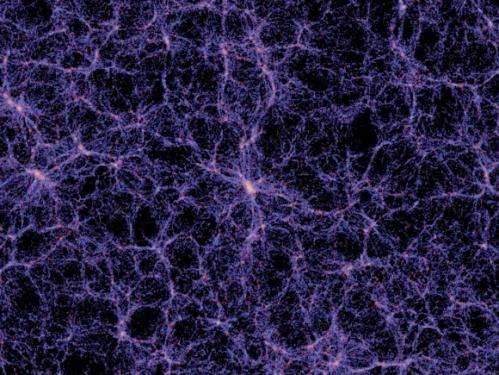
But all that spatial expansion which you suppose to be spiking the guns of his "neutron-repulsive atomic nuclei" ain't doing much of a better job busting up all those endless root and branch like traceries of physical filaments connecting all the galaxies together like they're all part of one gigantic organism.
If it can't stop them forming across supposedly vast empty expanses of endlessly expanding space, then why the hell d'you suppose it'll put a stop to his particular doings?
...not particularly having a go, just wondering how you square the two things, especially since it seems to me when you stop looking at this stuff as so many bits and start trying to Rubik's Cube them together, the more you begin to realise it only works so long as you keep all the contradictory data sets apart.
Jul 05, 2011
Rank: not rated yet
I don't have an answer to that.
But applying the same question to Oliver's neutron-repulsion principle, wouldn't we be seeing an even greater expansion/flying apart of all the structures contained in the universe?
If the principle is actually real, then there wouldn't be any fine structure, and not much gross structure, either, in the universe, unless the neutron-repusion force is centered in, and radiates from, the very low-density, hard vacuum vesicles of empty space that are interstitial to the structures in the universe. And hence my question- in these void spaces, where are the atomic nuclei in sufficient numbers to generate that magnitude of repulsive force?
Jul 06, 2011
Rank: not rated yet
omatumr, go fetch; let us know if you can sniff out any Cherenkov radiation from the residual nebula.
Also, hope you don't find the neutron odour in it too "repulsive".
Jul 09, 2011
Rank: not rated yet
I think the reason why the expansion of the universe (or anything else that happens in our universe) has no effect on the density of dark energy is that the source of dark energy is somewhere in the four dimensional space and everything that happens in our 3D world is trapped in this 3D world.
Let's make a mental exercise:
We go one dimension lower and think of our (3D) world as a 2D plane and we replace gravity with let's say "air currents". In the 2D world there are things that produce "air currents" but we also have an inexplicable background "air current" that doesn't change no matter what happens in the 2D world. That background "air current" is produced by a "fan" that exists in the 3D world and nothing from the 2D world can ever reach it.
Sounds like "evidence" for 4D space :)