MIT Lincoln Lab spinout unveils new more powerful direct-diode laser
July 8, 2011 by Bob Yirka
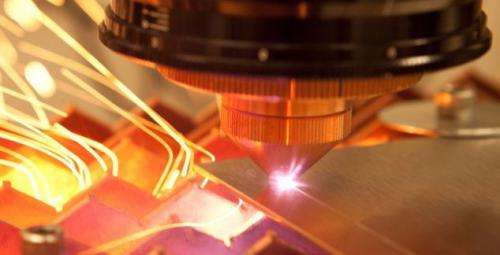
(PhysOrg.com) -- TeraDiode, a spinout company from MIT Lincoln Lab and located nearby in Littleton, MA, has unveiled, a new powerful direct-diode laser capable of cutting all the way through steel up to half an inch thick at various speeds. The laser is based on technology developed by company co-founders Dr. Bien Chann and Dr. Robin Huang while still at MIT.
The new laser system is based on semiconductor technology, which means it uses electricity, rather than chemicals, and employs an optical system that directs multiple individual beams into one single stronger one, and, according to the company website, the laser has "revolutionary TeraDrive technology" that has "coupled 1000 watts into a 200 um, 0.18 NA fiber." Which means, it is assumed, that they believe they have succeeded in creating the most powerful direct-diode laser ever; one that is also brighter and more focused than those that came before it.
The bottom line here appears to be that the company has put together laser technology that when deployed, will be smaller than others that have similar strength, and will be both more compact, and more efficient; making it perhaps, at last, suitable for creating laser guns like weve been seeing in science-fiction movies for years.
This video is not supported by your browser at this time.
TeraDiode Laser Cutting and Welding demo.
Company CEO David Sossen says that the new laser breaks through the limiting factors that have held back the use of truly powerful lasers in all but manufacturing pursuits; namely, the inefficiencies and huge power appetites normally associated with powerful lasers, and can output between several hundred and several thousand watts, and in principle up to 100 kilowatts, all in a package that is smaller than other laser systems currently available.The company makes clear it sees its new technology as not just a new tool for manufacturing, but as a future weapon that could be placed aboard a tank or ship in perhaps as few as five years. In the meantime, the company says it will be focusing on testing the new technology to see if it might be used in missile defense, such as connecting it to the back of a fighter plane to stymie the technology in heat-seeking weapons currently used in anti-aircraft missiles, or better yet, to simply destroy them.
More information: http://teradiode.com/
© 2010 PhysOrg.com
-
World's most powerful diode pumped solid state laser
Jul 05, 2005 |
not rated yet |
0
-
DARPA's compact high-power laser program completes key milestone
Jul 04, 2011 |
not rated yet |
0
-
Laser sets records in power and energy efficiency
Jul 24, 2007 |
not rated yet |
0
-
Laser shoots down drones at sea (w/ Video)
Jul 21, 2010 |
not rated yet |
0
-
Smaller, cheaper, 300 times more intense: Scientists prove theory which could revolutionise lasers
Oct 11, 2010 |
not rated yet |
0
-
Stars containing dark matter should look different from other stars
Feb 20, 2012 |
4.5 / 5 (17) |
11
-
Physicists discover evidence of rare hypernucleus, a component of strange matter
Feb 17, 2012 |
4.7 / 5 (38) |
22
-
Fast photon control brings quantum photonic technologies closer
Feb 13, 2012 |
5 / 5 (8) |
1
-
Engineers build first sub-10-nm carbon nanotube transistor
Feb 01, 2012 |
4.9 / 5 (36) |
32
-
Something old, something new: Evolution and the structural divergence of duplicate genes
Jan 31, 2012 |
4.6 / 5 (7) |
1
-
Calculating forces involved in seesaw motion
4 hours ago
-
Writing shear and moment equations for a simple beam problem?
5 hours ago
-
Furnace Shell Spray Cooling Design
21 hours ago
-
Ways to measure the speed of a golf ball?
Feb 21, 2012
-
Water Skin Effect in Plastic Pipe
Feb 21, 2012
-
Undergraduate Engineering Physics To Graduate Aerospace Engineering
Feb 21, 2012
- More from Physics Forums - General Engineering
More news stories
Stanford research team cracks animated NuCaptcha
(PhysOrg.com) -- The research team from Stanford University, led by Elie Bursztein, that previously had cracked regular CAPTCHAs and then audio CAPTCHAs, now has also successfully cracked the animated version called NuCapt ...
Tiny, implantable medical device can propel itself through bloodstream
Someday, your doctor may turn to you and say, "Take two surgeons and call me in the morning." If that day arrives, you may just have Ada Poon to thank.
18 hours ago |
5 / 5 (9) |
8
|
Italian engineer invents floating solar panels
Rays of the winter sun bounce off gleaming mirrors on the tiny lake of Colignola in Italy, where engineers have built a cost-effective prototype for floating, rotating solar panels.
Technology / Energy & Green Tech
22 hours ago |
4.7 / 5 (6) |
5
Microsoft hits Motorola, Google with EU complaint
Microsoft on Wednesday lodged a formal complaint with the European Union's competition regulator against Motorola Mobility and its soon-to-be owner Google, saying Motorola's aggressive enforcement of patent ...
17 hours ago |
2 / 5 (1) |
2
Calif. pledges better mobile privacy disclosures
(AP) -- Mobile applications seeking to collect personal information will have to forewarn users as part of an agreement reached in California.
10 hours ago |
not rated yet |
0
Researchers build first physical 'metatronic' circuit
(PhysOrg.com) -- The technological world of the 21st century owes a tremendous amount to advances in electrical engineering, specifically, the ability to finely control the flow of electrical charges using ...
Spitzer finds solid buckyballs in space
(PhysOrg.com) -- Astronomers using data from NASA's Spitzer Space Telescope have, for the first time, discovered buckyballs in a solid form in space. Prior to this discovery, the microscopic carbon spheres ...
Faster than light neutrinos? More like faulty wiring
You can shelf your designs for a warp drive engine (for now) and put the DeLorean back in the garage; it turns out neutrinos may not have broken any cosmic speed limits after all.
Physicists surprised by disappearing and reappearing superconductivity in iron selenium chalcogenides
Superconductivity is a rare physical state in which matter is able to conduct electricity -- maintain a flow of electrons -- without any resistance. This phenomenon can only be found in certain materials at low temperatures, ...
Going up: Japan builder eyes space elevator
A Japanese construction firm claimed Wednesday it could execute an out-of-this-world plan to put tourists in space within 40 years by building an elevator that stretches a quarter of the way to the moon.
Flesh-eating bacteria inspire superglue
(PhysOrg.com) -- A bio-inspired superglue has been developed by Oxford University researchers that cant be matched for sticking molecules together and not letting go.
Jul 08, 2011
Rank: 1 / 5 (1)
Jul 08, 2011
Rank: 1 / 5 (1)
Jul 08, 2011
Rank: 1 / 5 (1)
Jul 08, 2011
Rank: 4.3 / 5 (6)
Jul 08, 2011
Rank: 4 / 5 (2)
Jul 08, 2011
Rank: 3.7 / 5 (3)
Jul 08, 2011
Rank: 3.5 / 5 (4)
Jul 08, 2011
Rank: 2.3 / 5 (3)
Jul 08, 2011
Rank: 4.5 / 5 (2)
Jul 08, 2011
Rank: 4 / 5 (1)
How light could a 1000-watt-capable power supply be? Probably too heavy for a non-exoskeleton-assisted soldier to carry in battle. Maybe mounted onto a robot. Wow! "lasers in the jungle" James Coburn was right :)
Jul 08, 2011
Rank: 4.7 / 5 (3)
Hardly. Once others start tearing these apart, it won't be long until some kind of albedo armor is produced to counter it. Supply and demand; we wanted this and we got it. The pendulum will now swing the other way. I'll guarantee you won't get one of our Marines or Armored Cavalry officers to say this won't be countered, because they know better.
Jul 08, 2011
Rank: 3 / 5 (1)
Jul 09, 2011
Rank: 4.8 / 5 (5)
Jul 09, 2011
Rank: 4 / 5 (1)
Anything that you see in the civilian arena of such strong potential use, is already well far advanced in the context of weapons systems.
Jul 09, 2011
Rank: 4 / 5 (1)
Jul 09, 2011
Rank: not rated yet
Jul 09, 2011
Rank: not rated yet
Jul 09, 2011
Rank: 5 / 5 (1)
Jul 09, 2011
Rank: not rated yet
Jul 09, 2011
Rank: 3.7 / 5 (3)
How about use in hydrogen fusion? Multiple low energy consuming lasers with high outputs could perhaps deliver an energy gain from fusion systems.
Jul 09, 2011
Rank: 1 / 5 (2)
Jul 10, 2011
Rank: 1 / 5 (1)
Jul 10, 2011
Rank: 3 / 5 (1)
Jul 10, 2011
Rank: not rated yet
I wonder if that would be equivalent to power transfer via microwaves,which has been proposed as the means to deliver power from solar satellites to the ground.There would be inevitable losses with both systems.
Jul 10, 2011
Rank: not rated yet
Are you referring to implosion fusion? Yes,perhaps this new laser would reduce the size of such a system..
Jul 10, 2011
Rank: 3 / 5 (2)
Jul 10, 2011
Rank: not rated yet
And inertial confinement is probably going to produce a practical reactor sooner than a Tokamak type reactor.I recall a physicist describing the process of plasma confinement as being more difficult than confining Jello in a cage of rubber bands.
Jul 11, 2011
Rank: not rated yet
Jul 11, 2011
Rank: not rated yet
That's a LOT of waste heat!
Jul 16, 2011
Rank: not rated yet
hey, look at that, a relevant comment from dogbert.
Been a while since I've seen one of those.
Jul 16, 2011
Rank: 1 / 5 (1)
Now girls,be nice,no fighting!
Jul 16, 2011
Rank: not rated yet