Overturning 250 years of scientific theory: Age, repeated injury do not affect newt regeneration
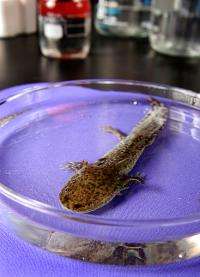
(PhysOrg.com) -- Scientists have been wrong for 250 years about a fundamental aspect of tissue regeneration, according to a University of Dayton biologist who says his recent discovery is good news for humans.
In research published in Nature Communications this month, Panagiotis Tsonis concludes repeated regeneration, even at old age, does not alter the capacity of newts to regenerate tissue. His findings overturn long-accepted theories proposed by regeneration scientists that age and repeated amputation negatively affect regeneration.
Tsonis, director of the University of Dayton's Center for Tissue Regeneration and Engineering at Dayton (TREND), said his discovery will benefit the entire field of regeneration research and brings science one step closer to a complete understanding of how newts regenerate, which Tsonis believes will one day enable humans to replicate the process.
"We are still a long way from relating this to humans, but what this shows is that the newt is an excellent source for finding answers to regeneration, particularly as it relates to old age," he said. "The newt not only has good regeneration properties, but it has the ability to protect and preserve regeneration."
The discovery lays the groundwork for further research on aging and regeneration, including investigations into differences in the regeneration processes of older and younger newts, such as changes in how cells participate in regeneration or in which cells are used. Another study could investigate what happens with newts' telomeres, the ends of DNA strands that degenerate as cells multiply, which many scientists believe accounts for the negative effects of aging.
"When would a person benefit from regeneration most? It's when they are older," Tsonis said. "Even if we knew exactly how newts do it, if their capabilities weaken over time, it would not be very useful to us."
The paper, "Regenerative capacity in newts is not altered by repeated regeneration and aging," is co-authored by Tsonis, Goro Eguchi and Yukiko Eguchi from Japan, Manisha Yadav and José Luis Millán from the Sanford-Burnham Medical Research Institute in La Jolla, Calif., and Kenta Nakamura from the University of Dayton. The study spanned 16 years and involved removing lenses from the same animals a total of 18 times. Goro Eguchi, Tsonis' mentor and the paper's first author, initiated the study in 1994 on several Japanese newts, believed to be at least 30 years old by the end of the study in 2010.
Newts are among the few vertebrates to have a spectacular capacity to regenerate tissues, organs or body parts, such as limbs, tails and eyes. Tsonis has focused his research on the newt's lens, which is unique in that it can be removed entirely and regenerates in a completely enclosed environment after the incision in the cornea heals within a day.
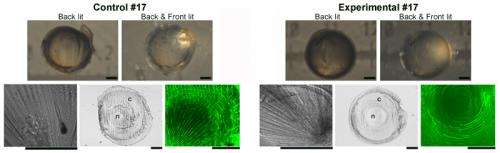
The 17th and 18th regenerated lenses of each animal were virtually identical to intact lenses removed from full-grown newts, which had never undergone lens regeneration. Tsonis and his team analyzed appearance and key gene expression and found no significant differences in the rate of differentiation and growth of the regenerating lens.
"I expected to see regeneration in the final trials, but this good? Even I was surprised a little. It was a perfect lens," Tsonis said. "As a biologist, I can say this is the biggest discovery in regeneration research involving newts in 250 years."
The article's reviewers concurred, suggesting the research was destined to become "an instant classic" for the findings, the attention to detail and the length of the study.
Tsonis has studied tissue regeneration in the newt for more than 30 years and is currently working with a five-year, $1.8 million grant to continue his study of lens regeneration in the newt and its connection to stem cell research. The grant, awarded in 2009, is the sixth and largest grant Tsonis has received from the National Institutes of Health, which has funded his research continuously since 1995. In all, he's received nearly $7 million in research funding from the NIH, the Arthritis Foundation and others.
He has become a leading voice in regeneration research. Six years ago, he and his wife succeeded in causing tissue to regenerate where it never had before. In a newt’s eye, the upper iris can regenerate a lens after injury, but the lower iris cannot. Both have the same type of cells and both show similar activity after the lens is removed, but the lower iris naturally stops before it can begin regeneration.
By adding the right mix of certain growth factors – sort of like a recipe – Tsonis was finally able to induce the ventral iris to grow a new lens. Nature published the couple's findings in 2005.
Tsonis also had a paper published in the June 2009 issue of Developmental Dynamics, in which he made a step in bridging the gap between regeneration in newts and regeneration in mammals.
He found that the process of lens regeneration in a newt is similar to how scientists have reprogrammed adult cells in humans to become induced pluripotent stem cells (iPS), reverse-engineered cells that are able to differentiate into any number of new types of tissue. The reprogramming is induced by expressing – or activating – four factors naturally dormant in cells. In newts, one of those four factors is not expressed, and their differentiated cells lack pluripotency — the ability to become any other type of cell. This difference might hold the key to pluripotency.
This has led Tsonis to begin a comprehensive project to identify all the genes expressed in regeneration. This genetic map — called the transcriptome — could provide significant insight into the regeneration process and how it might be applied to humans.
More information: Eguchi, G., Eguchi, Y., Nakamura, K., Yadav, M., Millán, J., & Tsonis, P. (2011). Regenerative capacity in newts is not altered by repeated regeneration and ageing Nature Communications, 2 DOI: 10.1038/ncomms1389
Provided by University of Dayton


