Double solar world record
July 7, 2011
Double solar world record

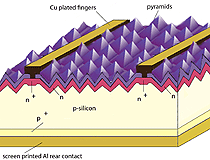
diagram of an LDSE cell

(PhysOrg.com) -- A world record double by UNSW solar cell researchers promises to make solar power more affordable, with world-beating new technology delivering substantial efficiency gains at minimal extra cost.

Using a patented laser process, researchers from UNSW’s Photovoltaics Technology Transfer Team, working with solar technology firm Centrotherm, achieved a new world benchmark of 19.3 percent efficiency in May for a mass-produced, crystalline silicon solar cell. They improved that result in June to advance the record to 19.4 per cent.

The previous record for cells created with this process was 18.9 per cent.

The new cells compare favourably with the 18 per cent-efficient cells commonly used in rooftop solar panels.

Dr Matt Edwards, Program Manager of the Photovoltaics Technology Transfer Team in the UNSW School of Photovoltaic and Renewable Energy Engineering, said the records were achieved without exotic materials or equipment.

"The exciting aspect of these records is that we achieved these results in a short time, using an industry-standard silicon wafer and modified industry-standard equipment," he said.

"It’s another step closer to costing the same as coal-fired electricity."

Dr Edwards said the gains, achieved on a standard p-type CZ silicon wafer, had produced a low-cost cell which delivered "the best bang for your buck" of any mass-produced cell in the world.

The record-breaking cells were produced using UNSW’s patented Laser Doped Selective Emitter (LDSE) process, which uses a high-powered laser and a light-induced plating process to create ultra-fine metal contacts on the cell surface, leaving more area exposed to light to create more power.

One of the advantages of LDSE technology is its ability to boost cell efficiency with simple modifications to existing screen-printed solar cell production lines – the most common mass-production systems in use today. The process is already in pilot production at some facilities.

Dr Edwards said the group was now working on a , double-sided LDSE (D-LDSE), which optimises both the front and rear surfaces of a solar cell to deliver efficiencies of up to 22 per cent.

The new 19.4 per cent efficiency record was verified by the Fraunhofer ISE Solar Cell Calibration Laboratory and a paper detailing the work will be published in the inaugural edition of the Journal of Photovoltaics.

Provided by University of New South Wales (news : web)

4.2 /5 (15 votes)  

Filter


Move the slider to adjust rank threshold, so that you can hide some of the comments.


Display comments: newest first

gwrede
Jul 07, 2011

Rank: 4 / 5 (4)
Counting the average rate of absolutely astounding solar-cell development news published here per month, one would think we will hit 110% efficiency in a year.

(And yes, I know my math, and still wrote 110% here.)
hyongx
Jul 07, 2011

Rank: not rated yet
Haven't silicon-based PVD in the lab seen ~40% efficiency? and haven't some CNT-based PVs from MIT seen like 100% quantum (capture) efficiency (does not imply that efficient electron transport)?
maybe i just made that up. I guess the key here is "mass produced"
Moebius
Jul 07, 2011

Rank: 4 / 5 (4)
...promises to make solar power more affordable, with world-beating new technology delivering substantial efficiency gains at minimal extra cost.

How many times have we heard this?
ForFreeMinds
Jul 07, 2011

Rank: 4.3 / 5 (6)
A change in efficiency from 18.9% to 19.4% is only an improvement of 2.6%. They've got a long way to go to make solar competitive with fossil fuels or even nuclear. But at least there's a place for solar cells (away from the grid) and I welcome future improvements. They've a long way to go.
Isaacsname
Jul 07, 2011

Rank: not rated yet
I brought up this idea to my 9th grade science teacher, over 20 years ago, was told it was a ridiculous idea.
david_42
Jul 07, 2011

Rank: 1 / 5 (2)
Whatever. You'll still need huge amounts of space and backup generators or massive amounts of power storage. It's great in certain applications, but not useful for base generation.
dirk_bruere
Jul 07, 2011

Rank: 4 / 5 (1)
Solar PV is already competitive with domestic mains prices in S Europe *without* subsidies.
ricarguy
Jul 07, 2011

Rank: 3.7 / 5 (3)
Solar PV is already competitive with domestic mains prices in S Europe *without* subsidies.


They must be paying a hell of a lot more than we do in most of the U.S.
Subsidies => artificially cheaper for the "chosen" technology,
Taxes => artificially more expensive for the "anti-chosen" technology.
Gov't manipulation is still gov't manipulation for either side.
braindead
Jul 07, 2011

Rank: 3.5 / 5 (6)
"They must be paying a hell of a lot more than we do in most of the U.S. " - that's because you pay far too little for your power with the consequence of contributing to messing up the planet way beyond your borders.
ScienceLust
Jul 07, 2011

Rank: 1.5 / 5 (8)
Cover your roof with them and you still won't have enough power to power your toaster.Am I right? It seems solar power
sounds great enough that it can make science news without makeing signifagant inprovement.
Vendicar_Decarian
Jul 08, 2011

Rank: 4.2 / 5 (5)
"How many times have we heard this?" - Mobeius

Weekly at least.

And solar cell prices continue to fall, in part, due to the developments you read about here.

Vendicar_Decarian
Jul 08, 2011

Rank: 4.6 / 5 (9)
"Cover your roof with them and you still won't have enough power to power your toaster.Am I right?" - ScienceTard

Depends on the size and orientation of your roof. But lets take a 10 meter by 5 meter roof as a typical size.

Total roof area 50 square meters, total solar energy available comes in at about 70000 Watts.

At 15% conversion efficiency you get 10,500 Watts.

A toaster uses around 2,000 watts.

You should really learn how to add, subtract, multiply and divide. It comes in handy some times.
Vendicar_Decarian
Jul 08, 2011

Rank: 2.6 / 5 (5)
"It's great in certain applications, but not useful for base generation." - Tard of Tards

Actually solar and wind are best for base load with gas turbines in the gaps.

ricarguy
Jul 08, 2011

Rank: 1 / 5 (5)
Mr. "Braindead",
Your "holier than thou" stance makes me smile, if not laugh. You can pay all you want. In fact you should be even better yet and give extra.
I believe society is best served by paying for what things actually cost, not what some central planner says it should. You or I eating or breathing has impact beyond our borders.
I am sorry to say, you are brain-washed.

Mr. Vendicar:
If you would like your "electricity rates to necessarily sky-rocket", then go for it. Please leave mine alone. When I see a charity or cause worthy of my money, I give it at my discretion, not someone else's.
ricarguy
Jul 08, 2011

Rank: 1.1 / 5 (7)
It is ironic regarding those that tout evolution and survival of the fittest and reject the concept or possibility of God or intelligent design. Those are the same people who tend to reject free markets and capitalism (which is merely economic evolution and survival of the fittest) in favor of central planning. Your favored philosophy/theory is rejected when applied to your own lives.

Back to topic:
Solar and wind have a place but as a general rule should not be favored to take over until the overall cost, including time and event independent implementation, is reduced. Progress is being made, but not ready for prime time yet. Until then, keep up the good work.
lovenugget
Jul 08, 2011

Rank: 5 / 5 (2)
"Those are the same people who tend to reject free markets and capitalism (which is merely economic evolution and survival of the fittest) in favor of central planning. Your favored philosophy/theory is rejected when applied to your own lives."

You're naively trying to compare two very different things. Biological evolution is based on hard science and the effect of physical law on life over time. Capitalism is an invention based on inflating currency and infinite growth. Infinite growth is not possible without a serious impact on the enviornment- not to mention the price of food in third world countries where there is a serious risk of starvation... The ultimate goal should be survival for all, not just the wealthiest. Your attempt to force a square block into a circular hole is apparent. Please try again.
ScienceLust
Jul 08, 2011

Rank: not rated yet
Vendicar Decarian, aka: Scott Nudds, Thanks for the 4th grade math help.I feel enlightend. My solar panels stop working every night.Could you talk to them at night,That is I mean enlighten them when it is dark out. I am on your side about not useing coal for our energy needs.I just tried photovolatic before you.
tarheelchief
Jul 08, 2011

Rank: not rated yet
Scotland has created a new solar system which connects large solar panels and salt storage batteries.Since sunlight is precious during the winter months,this option of solar battery power proves to be a solution.
It might be helpful if solar power is connected to a nearby industrial plant or better,a desal plant like San Diego.This way both parties are closely tied to long term financing.
Husky
Jul 09, 2011

Rank: not rated yet
they need to come up with stronger interlocking solar tiles providing structural support so that you dont place solar cells on the roof, but that the solar cells ARE the roof, this way you could offset costs from putting a roof on newly build homes, especially with the more expensive fancy roofs, like geodesic domes, the more expensive solar roofing tiles * might * (big if here) beat the price of roofing puttting seperate solarcells on it integral solution looking more estethic for sure
Isaacsname
Jul 09, 2011

Rank: not rated yet
they need to come up with stronger interlocking solar tiles providing structural support so that you dont place solar cells on the roof, but that the solar cells ARE the roof, this way you could offset costs from putting a roof on newly build homes, especially with the more expensive fancy roofs, like geodesic domes, the more expensive solar roofing tiles * might * (big if here) beat the price of roofing puttting seperate solarcells on it integral solution looking more estethic for sure

Well put. Modern design should be moderated by the need for improved efficiency, not just pure profit. I don't think we need to " get more " energy as much as we need to rethink how much we do need, and why we waste so much of what we already produce.
wwqq
Jul 09, 2011

Rank: 3 / 5 (1)
A change in efficiency from 18.9% to 19.4% is only an improvement of 2.6%. They've got a long way to go to make solar competitive with fossil fuels or even nuclear.


Solar doesn't compete with coal or nuclear in any meaningful way. Think of solar as a way to supplement natural gas, diesel and hydro.

If you want solar to do anything more than that it will be very expensive even if solar panels are available for free.
antialias
Jul 11, 2011

Rank: not rated yet
It's great in certain applications, but not useful for base generation.
Actually a live test with a highly distributed combiation of wind, solar, hydro, biomass and gas power in germany showed that you can deliver base loads at competitive prices all year round. And that *without* any dedicated storage systems beyond what is usually available (i.e. some hydro for extreme short term fluctuations).

The 'you need coal/oil/nuclear backup facilities for base loads'-argument is just a myth that won't die.
Eikka
Jul 11, 2011

Rank: not rated yet
a live test with a highly distributed combiation of wind, solar, hydro, biomass and gas power in germany showed that you can deliver base loads at competitive prices all year round. And that *without* any dedicated storage systems beyond what is usually available (i.e. some hydro for extreme short term fluctuations).


It depends on what you mean by base load, and what is the scale of the system, and what you mean by "usually available".

When you have capacities that amount to approximately a mosquito's fart in a lavatory, you can calculate that it produces on average such and such amount of power and you didn't need any special measures for it because the grid as a whole didn't even notice it was there.

Besides, gas power is a fossil fuel, and I bet they ran the system on gas most of the time, just like in Denmark where they have ample wind, but in practice just burn gas all the time and export the wind power to Norway.
antialias
Jul 12, 2011

Rank: not rated yet
It depends on what you mean by base load, and what is the scale of the system, and what you mean by "usually available".

By base load I mean that the 11000 homes which were part of the test did not have to draw a single Watt from fossil fuel or nuclear power plants for the duration of the test (which went on longer than a year). Can't get much more 'base load' than that.

That the grid needs to be modified is a known fact. But that isn't really something that is impossible (or even very difficult).

Tha gas power was from biomass and garbage fired powerplants (One might argue that some garbage would count as fossil fuels but that was only a very small percentage of the network used. Biomass could probably take up that slack with a different mix).

For emergency use I can see that conventional gas powerplants will still be useful as backup in the future as they are much more responsive than coal (and especially nuclear which needs a week to get up to speed)
Rank 4.2 /5 (15 votes)
Relevant PhysicsForums posts

More news stories

Stanford research team cracks animated NuCaptcha

(PhysOrg.com) -- The research team from Stanford University, led by Elie Bursztein, that previously had cracked regular CAPTCHAs and then audio CAPTCHAs, now has also successfully cracked the animated version called NuCapt ...

Technology / Computer Sciences

created 18 hours ago | popularity 5 / 5 (3) | comments 6 | with audio podcast report

Tiny, implantable medical device can propel itself through bloodstream

Someday, your doctor may turn to you and say, "Take two surgeons and call me in the morning." If that day arrives, you may just have Ada Poon to thank.

Technology / Engineering

created 17 hours ago | popularity 5 / 5 (9) | comments 8 | with audio podcast

Italian engineer invents floating solar panels

Rays of the winter sun bounce off gleaming mirrors on the tiny lake of Colignola in Italy, where engineers have built a cost-effective prototype for floating, rotating solar panels.

Technology / Energy & Green Tech

created 21 hours ago | popularity 4.7 / 5 (6) | comments 5

Microsoft hits Motorola, Google with EU complaint

Microsoft on Wednesday lodged a formal complaint with the European Union's competition regulator against Motorola Mobility and its soon-to-be owner Google, saying Motorola's aggressive enforcement of patent ...

Technology / Business

created 17 hours ago | popularity 2 / 5 (1) | comments 2

Calif. pledges better mobile privacy disclosures

(AP) -- Mobile applications seeking to collect personal information will have to forewarn users as part of an agreement reached in California.

Technology / Internet

created 9 hours ago | popularity not rated yet | comments 0


Researchers build first physical 'metatronic' circuit

(PhysOrg.com) -- The technological world of the 21st century owes a tremendous amount to advances in electrical engineering, specifically, the ability to finely control the flow of electrical charges using ...

Spitzer finds solid buckyballs in space

(PhysOrg.com) -- Astronomers using data from NASA's Spitzer Space Telescope have, for the first time, discovered buckyballs in a solid form in space. Prior to this discovery, the microscopic carbon spheres ...

Faster than light neutrinos? More like faulty wiring

You can shelf your designs for a warp drive engine (for now) and put the DeLorean back in the garage; it turns out neutrinos may not have broken any cosmic speed limits after all.

Physicists surprised by disappearing and reappearing superconductivity in iron selenium chalcogenides

Superconductivity is a rare physical state in which matter is able to conduct electricity -- maintain a flow of electrons -- without any resistance. This phenomenon can only be found in certain materials at low temperatures, ...

Going up: Japan builder eyes space elevator

A Japanese construction firm claimed Wednesday it could execute an out-of-this-world plan to put tourists in space within 40 years by building an elevator that stretches a quarter of the way to the moon.

Flesh-eating bacteria inspire superglue

(PhysOrg.com) -- A bio-inspired superglue has been developed by Oxford University researchers that can’t be matched for sticking molecules together and not letting go.