Algorithm searches for models that best explain experimental data
August 2, 2011
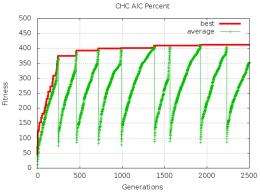
An evolutionary computation approach developed by Franklin University’s Esmail Bonakdarian, Ph.D., was used to analyze data from two classical economics experiments. As can be seen in this figure, optimization of the search over subsets of the maximum model proceeds initially at a quick rate and then slowly continues to improve over time until it converges. The top curve (red) shows the optimum value found so far, while the lower, jagged line (green) shows the current average fitness value for the population in each generation. Credit: Ohio Supercomputer Center
A Franklin University professor recently developed an evolutionary computation approach that offers researchers the flexibility to search for models that can best explain experimental data derived from many types of applications, including economics.
To test the algorithm underlying that approach, Esmail Bonakdarian, Ph.D., an assistant professor of Computing Sciences and Mathematics at Franklin, leveraged the Glenn IBM 1350 Opteron cluster, the flagship system of the Ohio Supercomputer Center (OSC).
Every day researchers are confronted by large sets of survey or experimental data and faced with the challenge of making sense of this collection and turning it into useful knowledge, Bonakdarian said. This data usually consists of a series of observations over a number of dimensions, and the objective is to establish a relationship between the variable of interest and other variables, for purposes of prediction or exploration.
Bonakdarian employed his evolutionary computation approach to analyze data from two well-known, classical public goods problems from economics: When goods are provided to a larger community without required individual contributions, it often results in free-riding. However, people also tend to show a willingness to cooperate and sacrifice for the good of the group.
While OSC resources are more often used to make discoveries in fields such as physics, chemistry or the biosciences, or to solve complex industrial and manufacturing challenges, it is always fascinating to see how our research clients employ our supercomputers to address issues in broader fields of interest, such as we find in Dr. Bonakdarians work in economics and evolutionary computing, said Ashok Krishnamurthy, interim co-executive director of the center.
Evolutionary algorithms are inherently suitable for parallel or distributed execution, Bonakdarian said. Given the right platform, this would allow for the simultaneous evaluation of many candidate solutions, i.e., models, in parallel, greatly speeding up the work.
Regression analysis has been the traditional tool for finding and establishing statistically significant relationships in research projects, such as for the economics examples Bonakdarian chose. As long as the number of independent variables is relatively small, or the experimenter has a fairly clear idea of the possible underlying relationship, it is feasible to derive the best model using standard software packages and methodologies.
However, Bonakdarian cautioned that if the number of independent variables is large, and there is no intuitive sense about the possible relationship between these variables and the dependent variable, the experimenter may have to go on an automated fishing expedition to discover the important and relevant independent variables.
As an alternative, Bonakdarian suggests using an evolutionary algorithm as a way to evolve the best minimal subset with the largest explanatory value.
This approach offers more flexibility as the user can specify the exact search criteria on which to optimize the model, he said. The user can then examine a ranking of the top models found by the system. In addition to these measures, the algorithm can also be tuned to limit the number of variables in the final model. We believe that this ability to direct the search provides flexibility to the analyst and results in models that provide additional insights.
More information: http://cs.franklin … akdarian.pdf
Provided by Ohio Supercomputer Center
-
Free tool kit to assist big-data scientists
Jul 19, 2011 |
not rated yet |
0
-
Using mathematics to identify the good guys
Oct 28, 2010 |
not rated yet |
0
-
The kids are alright
May 26, 2011 |
not rated yet |
0
-
As long as original version still available, tweaking Twain is OK, professor says
Jan 12, 2011 |
not rated yet |
0
-
Modern society made up of all types
Nov 04, 2010 |
not rated yet |
0
-
Stars containing dark matter should look different from other stars
Feb 20, 2012 |
4.5 / 5 (17) |
11
-
Physicists discover evidence of rare hypernucleus, a component of strange matter
Feb 17, 2012 |
4.7 / 5 (38) |
22
-
Fast photon control brings quantum photonic technologies closer
Feb 13, 2012 |
5 / 5 (8) |
1
-
Engineers build first sub-10-nm carbon nanotube transistor
Feb 01, 2012 |
4.9 / 5 (36) |
32
-
Something old, something new: Evolution and the structural divergence of duplicate genes
Jan 31, 2012 |
4.6 / 5 (7) |
1
-
Computer Architecture Help
Feb 15, 2012
-
Emulators on lower powered spartphones - PSX4droid
Feb 14, 2012
-
Digital scratch pad?
Feb 13, 2012
-
Quantum computer faster than regular computer?
Feb 13, 2012
-
Synergistic relations between computer science and technology.
Feb 06, 2012
-
how do iphone gloves work?
Feb 05, 2012
- More from Physics Forums - Computing & Technology
More news stories
Stanford research team cracks animated NuCaptcha
(PhysOrg.com) -- The research team from Stanford University, led by Elie Bursztein, that previously had cracked regular CAPTCHAs and then audio CAPTCHAs, now has also successfully cracked the animated version called NuCapt ...
Tiny, implantable medical device can propel itself through bloodstream
Someday, your doctor may turn to you and say, "Take two surgeons and call me in the morning." If that day arrives, you may just have Ada Poon to thank.
16 hours ago |
5 / 5 (9) |
8
|
Italian engineer invents floating solar panels
Rays of the winter sun bounce off gleaming mirrors on the tiny lake of Colignola in Italy, where engineers have built a cost-effective prototype for floating, rotating solar panels.
Technology / Energy & Green Tech
20 hours ago |
4.7 / 5 (6) |
5
Microsoft hits Motorola, Google with EU complaint
Microsoft on Wednesday lodged a formal complaint with the European Union's competition regulator against Motorola Mobility and its soon-to-be owner Google, saying Motorola's aggressive enforcement of patent ...
16 hours ago |
2 / 5 (1) |
2
Calif. pledges better mobile privacy disclosures
(AP) -- Mobile applications seeking to collect personal information will have to forewarn users as part of an agreement reached in California.
8 hours ago |
not rated yet |
0
Researchers build first physical 'metatronic' circuit
(PhysOrg.com) -- The technological world of the 21st century owes a tremendous amount to advances in electrical engineering, specifically, the ability to finely control the flow of electrical charges using ...
Spitzer finds solid buckyballs in space
(PhysOrg.com) -- Astronomers using data from NASA's Spitzer Space Telescope have, for the first time, discovered buckyballs in a solid form in space. Prior to this discovery, the microscopic carbon spheres ...
Faster than light neutrinos? More like faulty wiring
You can shelf your designs for a warp drive engine (for now) and put the DeLorean back in the garage; it turns out neutrinos may not have broken any cosmic speed limits after all.
CT colonography shown to be comparable to standard colonoscopy
Computerized tomographic (CT) colonography (CTC), also known as virtual colonoscopy, is comparable to standard colonoscopy in its ability to accurately detect cancer and precancerous polyps in people ages 65 and older, according ...
Physicists surprised by disappearing and reappearing superconductivity in iron selenium chalcogenides
Superconductivity is a rare physical state in which matter is able to conduct electricity -- maintain a flow of electrons -- without any resistance. This phenomenon can only be found in certain materials at low temperatures, ...
Study: Virtual colonoscopy effective screening tool for adults over 65
Computed tomography (CT) colonography can be used as a primary screening tool for colorectal cancer in adults over the age of 65, according to a new study published online in the journal Radiology.
Aug 04, 2011
Rank: not rated yet