Chimpanzees are spontaneously generous after all
August 8, 2011
Chimpanzees

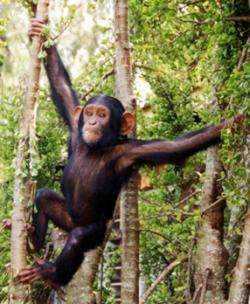
Researchers at the Yerkes National Primate Research Center have shown chimpanzees have a significant bias for prosocial behavior. This, the study authors report, is in contrast to previous studies that positioned chimpanzees as reluctant altruists and led to the widely held belief that human altruism evolved in the last six million years only after humans split from apes. The current study findings are available in the online edition of Proceedings of the National Academy of Sciences.

According to Yerkes researchers Victoria Horner, PhD, Frans de Waal, PhD, and their colleagues, may not have shown prosocial behaviors in other studies because of design issues, such as the complexity of the apparatus used to deliver rewards and the distance between the animals.

"I have always been skeptical of the previous negative findings and their over-interpretation, says Dr. de Waal. "This study confirms the prosocial nature of chimpanzees with a different test, better adapted to the species," he continues.

In the current study, Dr. Horner and colleagues greatly simplified the test, which focused on offering seven adult female chimpanzees a choice between two similar actions: one that rewards both the "actor," the term used in the paper for the lead study participant, and a partner, and another that rewards only the actor/chooser herself. Examples of the critically important simplified design aspects include allowing the study partners to sit close together and ensuring conspicuous , which the researchers achieved by wrapping pieces of banana in paper that made a upon removal.

In each trial, the chooser, which was always tested with her partner in sight, selected between differently colored tokens from a bin. One colored token could be exchanged with an experimenter for treats for both members of the pair (prosocial); the other colored token would result in a treat only for the chooser (selfish). All seven chimpanzees showed an overwhelming preference for the prosocial choice. The study also showed the choosers behaved altruistically especially towards partners who either patiently waited or gently reminded them that they were there by drawing attention to themselves. The chimpanzees making the choices were less likely to reward partners who made a fuss, begged persistently or spat water at them, thus showing their was spontaneous and not subject to intimidation.

"We were excited to find female after female chose the option that gave both her and her partner food," says Dr. Horner. "It was also interesting to me that being overly persistent did not go down well with the choosers. It was far more productive for partners to be calm and remind the choosers they were there from time to time," she continues.

The authors say this study puts to rest a longstanding puzzle surrounding chimpanzee altruism. It is well-known these apes help each other in the wild and show various forms of empathy, such as reassurance of distressed parties. The negative findings of previous studies did not fit this image. These results, however, confirm chimpanzee altruism in a well-controlled experiment, suggesting human altruism is less of an anomaly than previously thought.

The study authors next plan to determine whether the altruistic tendency of the chimpanzees towards their partners is related to social interactions within the group, such as reciprocal exchanges of food or social support.

For eight decades, the Yerkes National Primate Research Center, Emory University, has been dedicated to conducting essential basic science and translational research to advance scientific understanding and to improve the health and well-being of humans and nonhuman primates. Today, the center, as one of only eight National Institutes of Health–funded national primate research centers, provides leadership, training and resources to foster scientific creativity, collaboration and discoveries. Yerkes-based research is grounded in scientific integrity, expert knowledge, respect for colleagues, an open exchange of ideas and compassionate quality animal care.

Within the fields of microbiology and immunology, neurologic diseases, neuropharmacology, behavioral, cognitive and developmental neuroscience, and psychiatric disorders, the center's research programs are seeking ways to: develop vaccines for infectious and noninfectious diseases; treat drug addiction; interpret brain activity through imaging; increase understanding of progressive illnesses such as Alzheimer's and Parkinson's diseases; unlock the secrets of memory; determine how the interaction between genetics and society shape who we are; and advance knowledge about the evolutionary links between biology and behavior.

Provided by Emory University (news : web)

4.8 /5 (6 votes)  

Filter


Move the slider to adjust rank threshold, so that you can hide some of the comments.


Display comments: newest first

hush1
Aug 08, 2011

Rank: 1 / 5 (1)
In Astrophysics "the Universe tastes like raspberries" a researcher once said in jest.

"Within the fields of microbiology and immunology, neurologic diseases, neuropharmacology, behavioral, cognitive and developmental neuroscience, and psychiatric disorders"
the Universe tastes like bananas, signaling a "significant bias for prosocial behavior".

"These results, however, confirm chimpanzee altruism in a well-controlled experiment, suggesting human altruism is less of an anomaly than previously thought."

Finding good in a bad label: Altruism.
Taking away the basis for bias.
HealingMindN
Aug 08, 2011

Rank: not rated yet
The next experiment should be testing the altruism of our future simian over lords for their human cattle. Will they give us peanuts if we make big cow eyes at them - or will they throw tihs at us?
Squirrel
Aug 08, 2011

Rank: not rated yet
The chimps were rather mean if you read the paper. The chimps were presented with equal numbers of tokens that either gave a wrapped piece of fruit to themselves or that plus another to a second chimp. They only did this on 60% of occasions n. Statistically significant but given they could have without cost their partner fruit on every occasion hardly prosocial.
Pete1983
Aug 08, 2011

Rank: not rated yet
The universe doesn't taste like raspberries, that's the milky way friend.
Vendicar_Decarian
Aug 09, 2011

Rank: 1 / 5 (1)
Evolution has produced Altruism because Altruism is beneficial to a species, and by extension to a group. The method Nature has chosen to accomplish this is empathy and compassion.

On the eve of the destruction of the American State, I note that the lack of compassion and empathy to the controlling Republican party has been accompanies with the rapid decline of the American Nation, in direct accordance with what one would expect from the observations made in the first paragraph.

Magnette
Aug 09, 2011

Rank: not rated yet
It would be interesting to see if they garnered the same results when using seven male Chimps instead of seven females.

Would the males be as generous as the female? Is it a similar nurturing instinct in the female chimps as in human females?
michaelick
Aug 09, 2011

Rank: not rated yet
We humans like to believe that we are superiour to other animals in order to legitimate our exploiting of the environment. However, reality shows that this is simply not true. Inspired by such thoughts I created this facebook page some time ago:

https://www.faceb...90910192
JadedIdealist
Aug 09, 2011

Rank: not rated yet
Personally I expect animals with full language(us) to be more altruistic than other animals.
Why?
Fame.
Only with full langauge can you be more likely to get laid by telling people that you're the second cousin of the famous martyr who laid down his life for the good of us all.
It's in our interests that someone else has kids with that person, so in our interests to talk them up.
hush1
Aug 09, 2011

Rank: not rated yet
My rating comes from Paulthebassguy.
Paulthebassguy rates all of his own comments the highest possible with the aid of a second label synonymous to him.

Anonymous ratings don't matter. Much more of interest are the thoughts expressed in the commentary thread. You can read and gain more by participation than just rating alone.
hush1
Aug 09, 2011

Rank: not rated yet
@Pete
Correction duly noted. I stand corrected. Thks.
Pete1983
Aug 11, 2011

Rank: not rated yet
@hush1, no worries. I just prefer to think of the universe tasting like coal tofu with a few skittles in it. Tofu for dark energy, coal for dark matter, and our matter is the skittles!
aroc91
Aug 14, 2011

Rank: not rated yet
Evolution has produced Altruism because Altruism is beneficial to a species, and by extension to a group. The method Nature has chosen to accomplish this is empathy and compassion.

On the eve of the destruction of the American State, I note that the lack of compassion and empathy to the controlling Republican party has been accompanies with the rapid decline of the American Nation, in direct accordance with what one would expect from the observations made in the first paragraph.


How very relevant... Oh wait.
Rank 4.8 /5 (6 votes)
Relevant PhysicsForums posts
  • Eye biology videos
    created3 hours ago
  • Flowering Plant Revived After 30,000 Years in Permafrost
    createdFeb 21, 2012
  • Toba volcano eruptions - 1.000 - 10,000 breeding pairsunb
    createdFeb 20, 2012
  • How is a specific gene removed from DNA
    createdFeb 20, 2012
  • Reproduction and Human evolution
    createdFeb 19, 2012
  • Viruses: Living or Non-living organisms
    createdFeb 19, 2012
  • More from Physics Forums - Biology

More news stories

Surprising diversity at a synapse hints at complex diversity of neural circuitry

A new study reveals a dazzling degree of biological diversity in an unexpected place – a single neural connection in the body wall of flies.

Biology / Other

created 10 hours ago | popularity 5 / 5 (4) | comments 0 | with audio podcast

Men might not 'become extinct' after all: Theory of the 'rotting' Y chromosome dealt a fatal blow

If you were to discover that a fundamental component of human biology has survived virtually intact for the past 25 million years, you'd be quite confident in saying that it is here to stay.

Biology / Biotechnology

created 13 hours ago | popularity 5 / 5 (6) | comments 1 | with audio podcast

New family of legless amphibians found in India

Since before the age of dinosaurs it has burrowed unbothered beneath the monsoon-soaked soils of remote northeast India - unknown to science and mistaken by villagers as a deadly, miniature snake.

Biology / Plants & Animals

created 21 hours ago | popularity 5 / 5 (8) | comments 3

Climate change affects bird migration timing in North America

Bird migration timing across North America has been affected by climate change, according to a study published Feb. 22 in the open access journal PLoS ONE.

Biology / Ecology

created 9 hours ago | popularity 4.5 / 5 (2) | comments 2

New iridescent lizard species found in Cambodia

A new species of lizard with striking iridescent rainbow skin, a long tail and very short legs has been discovered in the rainforest in northeast Cambodia, conservationists announced Wednesday.

Biology / Plants & Animals

created 10 hours ago | popularity not rated yet | comments 0


Researchers build first physical 'metatronic' circuit

(PhysOrg.com) -- The technological world of the 21st century owes a tremendous amount to advances in electrical engineering, specifically, the ability to finely control the flow of electrical charges using ...

Spitzer finds solid buckyballs in space

(PhysOrg.com) -- Astronomers using data from NASA's Spitzer Space Telescope have, for the first time, discovered buckyballs in a solid form in space. Prior to this discovery, the microscopic carbon spheres ...

Faster than light neutrinos? More like faulty wiring

You can shelf your designs for a warp drive engine (for now) and put the DeLorean back in the garage; it turns out neutrinos may not have broken any cosmic speed limits after all.

Physicists surprised by disappearing and reappearing superconductivity in iron selenium chalcogenides

Superconductivity is a rare physical state in which matter is able to conduct electricity -- maintain a flow of electrons -- without any resistance. This phenomenon can only be found in certain materials at low temperatures, ...

CT colonography shown to be comparable to standard colonoscopy

Computerized tomographic (CT) colonography (CTC), also known as virtual colonoscopy, is comparable to standard colonoscopy in its ability to accurately detect cancer and precancerous polyps in people ages 65 and older, according ...

Stanford research team cracks animated NuCaptcha

(PhysOrg.com) -- The research team from Stanford University, led by Elie Bursztein, that previously had cracked regular CAPTCHAs and then audio CAPTCHAs, now has also successfully cracked the animated version called NuCapt ...