E. coli metabolism reversed for speedy production of fuels, chemicals
August 10, 2011
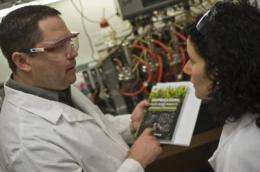
Rice University engineering researchers Ramon Gonzalez (left) and Clementina Dellomonaco reversed one of the most efficient of all metabolic pathways -- the beta oxidation cycle -- to engineer bacteria that make biofuels at a breakneck pace. Credit: Jeff Fitlow/Rice University
In a biotechnological tour de force, Rice University engineering researchers this week unveiled a new method for rapidly converting simple glucose into biofuels and petrochemical substitutes. In a paper published online in Nature, Rice's team described how it reversed one of the most efficient of all metabolic pathways -- the beta oxidation cycle -- to engineer bacteria that produce biofuel at a breakneck pace.
Just how fast are Rice's single-celled chemical factories? On a cell-per-cell basis, the bacteria produced the butanol, a biofuel that can be substituted for gasoline in most engines, about 10 times faster than any previously reported organism.
"That's really not even a fair comparison because the other organisms used an expensive, enriched feedstock, and we used the cheapest thing you can imagine, just glucose and mineral salts," said Ramon Gonzalez, associate professor of chemical and biomolecular engineering at Rice and lead co-author of the Nature study.
Gonzalez's laboratory is in a race with hundreds of labs around the world to find green methods for producing chemicals like butanol that have historically come from petroleum.
"We call these 'drop-in' fuels and chemicals, because their structure and properties are very similar, sometimes identical, to petroleum-based products," he said. "That means they can be 'dropped in,' or substituted, for products that are produced today by the petrochemical industry."
Butanol is a relatively short molecule, with a backbone of just four carbon atoms. Molecules with longer carbon chains have been even more troublesome for biotech producers to make, particularly molecules with chains of 10 or more carbon atoms. Gonzalez said that's partly because researchers have focused on ramping up the natural metabolic processes that cells use to build long-chain fatty acids. Gonzalez and students Clementina Dellomonaco, James Clomburg and Elliot Miller took a completely different approach.
"Rather than going with the process nature uses to build fatty acids, we reversed the process that it uses to break them apart," Gonzalez said. "It's definitely unconventional, but it makes sense because the routes nature has selected to build fatty acids are very inefficient compared with the reversal of the route it uses to break them apart."
The beta oxidation process is one of biology's most fundamental, Gonzalez said. Species ranging from single-celled bacteria to human beings use beta oxidation to break down fatty acids and generate energy.
In the Nature study, Gonzalez's team reversed the beta oxidation cycle by selectively manipulating about a dozen genes in the bacteria Escherichia coli. They also showed that selective manipulations of particular genes could be used to produce fatty acids of particular lengths, including long-chain molecules like stearic acid and palmitic acid, which have chains of more than a dozen carbon atoms.
"This is not a one-trick pony," Gonzalez said. "We can make many kinds of specialized molecules for many different markets. We can also do this in any organism. Some producers prefer to use industrial organisms other than E. coli, like algae or yeast. That's another advantage of using reverse-beta oxidation, because the pathway is present in almost every organism."
-
Research yields pricey chemicals from biodiesel waste
Jun 30, 2008 |
not rated yet |
0
-
Biotech breakthrough could end biodiesel's glycerin glut
Jun 26, 2007 |
not rated yet |
0
-
Scientist engineers E. coli to produce biodiesel
Sep 03, 2010 |
not rated yet |
0
-
Researchers engineer E. coli to produce record-setting amounts of alternative fuel
Mar 17, 2011 |
not rated yet |
0
-
Turning bacteria into butanol biofuel factories
Mar 02, 2011 |
not rated yet |
0
-
Stars containing dark matter should look different from other stars
Feb 20, 2012 |
4.5 / 5 (17) |
11
-
Physicists discover evidence of rare hypernucleus, a component of strange matter
Feb 17, 2012 |
4.7 / 5 (38) |
22
-
Fast photon control brings quantum photonic technologies closer
Feb 13, 2012 |
5 / 5 (8) |
1
-
Engineers build first sub-10-nm carbon nanotube transistor
Feb 01, 2012 |
4.9 / 5 (36) |
32
-
Something old, something new: Evolution and the structural divergence of duplicate genes
Jan 31, 2012 |
4.6 / 5 (7) |
1
-
Cis-trans Selectivity in Wittig Reactions
4 hours ago
-
Chemical Kinetics
4 hours ago
-
heat-driven chemical reaction and thermodynamics
11 hours ago
-
phenol to benzene
15 hours ago
-
TQM, QA and QC
16 hours ago
-
oxidising power
22 hours ago
- More from Physics Forums - Chemistry
More news stories
Scientists create potent molecules aimed at treating muscular dystrophy
While RNA is an appealing drug target, small molecules that can actually affect its function have rarely been found. But now scientists from the Florida campus of The Scripps Research Institute have for the first time designed ...
9 hours ago |
5 / 5 (4) |
0
|
Flesh-eating bacteria inspire superglue
(PhysOrg.com) -- A bio-inspired superglue has been developed by Oxford University researchers that cant be matched for sticking molecules together and not letting go.
20 hours ago |
5 / 5 (8) |
3
|
Researchers discover what cancer cells need to travel
(PhysOrg.com) -- Cancer cells must prepare for travel before invading new tissues, but new Cornell research has found a possible way to stop these cells from ever hitting the road.
19 hours ago |
4.9 / 5 (12) |
0
|
New microfluidic device could be used to diagnose and monitor cancer and other diseases
Separating complex mixtures of cells, such as those found in a blood sample, can offer valuable information for diagnosing and treating disease. However, it may be necessary to search through billions of other ...
Chemistry / Analytical Chemistry
19 hours ago |
5 / 5 (2) |
0
|
New way to tap largest remaining treasure trove of potential new antibiotics
Scientists are reporting use of a new technology for sifting through the world's largest remaining pool of potential antibiotics to discover two new antibiotics that work against deadly resistant microbes, ...
12 hours ago |
5 / 5 (4) |
0
Researchers build first physical 'metatronic' circuit
(PhysOrg.com) -- The technological world of the 21st century owes a tremendous amount to advances in electrical engineering, specifically, the ability to finely control the flow of electrical charges using ...
Spitzer finds solid buckyballs in space
(PhysOrg.com) -- Astronomers using data from NASA's Spitzer Space Telescope have, for the first time, discovered buckyballs in a solid form in space. Prior to this discovery, the microscopic carbon spheres ...
Faster than light neutrinos? More like faulty wiring
You can shelf your designs for a warp drive engine (for now) and put the DeLorean back in the garage; it turns out neutrinos may not have broken any cosmic speed limits after all.
Physicists surprised by disappearing and reappearing superconductivity in iron selenium chalcogenides
Superconductivity is a rare physical state in which matter is able to conduct electricity -- maintain a flow of electrons -- without any resistance. This phenomenon can only be found in certain materials at low temperatures, ...
CT colonography shown to be comparable to standard colonoscopy
Computerized tomographic (CT) colonography (CTC), also known as virtual colonoscopy, is comparable to standard colonoscopy in its ability to accurately detect cancer and precancerous polyps in people ages 65 and older, according ...
Stanford research team cracks animated NuCaptcha
(PhysOrg.com) -- The research team from Stanford University, led by Elie Bursztein, that previously had cracked regular CAPTCHAs and then audio CAPTCHAs, now has also successfully cracked the animated version called NuCapt ...
Aug 10, 2011
Rank: 1 / 5 (1)
Aug 10, 2011
Rank: not rated yet
Aug 10, 2011
Rank: 5 / 5 (1)
Glucose is extremely abundant - it is the sole building block of the polymer cellulose, the stuff that basically all plants are made of.
Aug 10, 2011
Rank: 5 / 5 (1)
Aug 10, 2011
Rank: not rated yet
Aug 10, 2011
Rank: not rated yet
Switch grass modified for easy digestion.
http://arstechnic...uels.ars
Aug 11, 2011
Rank: not rated yet
combined with the probability that many other Bacteria operate with similarly, very rapid 'digestion of Cellulose' should soon be available.
Due to the logistical expense of transporting 'Broom Grass' to refineries, just make small 'Digesting Refineries' for use right in the fields ... gather into Threshing Machines, and dump directly into the on-site refinery. The Fuel could power the farm equipment, irrigation systems, 'Generators' to Power the Farm Operations!
Aug 11, 2011
Rank: not rated yet
Aug 11, 2011
Rank: not rated yet
Food production will need to increase by about a factor of 2 this century. Much of that can come from crop yields, but a significant chunk will likely have to come from marshalling more of net primary production for human uses.
Marginal lands aren't very productive. You're going to conscript vast resources from natural uses and it's still going to be a nightmare trying to collect and use this sparse resource of questionable economic value.
Aug 11, 2011
Rank: not rated yet
BTW, isn't butanol better than ethanol in that it does not allow water to dissolve in it? Ethanol has a tendency to make stuff rust because of the water content.
To make it easier to use marginal lands I suggest including the genes for making bacteria-carrying nodules in the root system, enabling the crops to fixate nitrogen.
Aug 12, 2011
Rank: not rated yet
That's plausible but potentially dangerous. It's also plausible for bacteria to stumble onto that trigger and eat your crops. If you depend on those crops to produce significant quantities of fuel(or worse, food AND fuel) you're in trouble.
If those crops grow food and fuel you have to leave most of the cellulose in the field anyway, because otherwise you're just mining soil carbon; stealing from the future and calling it GDP.
Butanol is not very soluble in water; when the concentration goes high enough it naturally separates out and floats to the surface. It is a very good diesel replacement.
Marginal land is by definition of marginal economic utility; it doesn't have to be marginal in terms of biodiversity or natural beauty.
Aug 12, 2011
Rank: not rated yet
Aug 16, 2011
Rank: not rated yet
You can, but that's not "free crop waste". You're either replacing food with fuel or appropriating more of NPP.
If you do your yields will be shit and the economics of gathering this resource questionable(see the collapse of jatropha).
Marginal land is defined as not very economical to farm. Marginal land can still be beautiful, biodiverse or provide important ecosystem services.