Free computer science courses, new teaching technology reinvent online education
August 17, 2011 By Jamie Beckett
Free computer science classes online

Enlarge

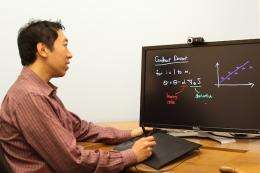
Computer Science professor Andrew Ng uses tablet-recording technology he developed to instantly display notes for his interactive video lecture.

Stanford Engineering professors are offering three of the school’s most popular computer science courses for free online this fall, and at the same time launching an experiment that could transform the way online education is delivered.

The professors are taking technologies designed to enhance learning for Stanford and extending them to a broad online audience. They are delivering lectures as short, interactive video clips that allow students to progress at their own pace through course materials. They are offering live quizzes with instant feedback.  And they are testing new technologies that allow students to rank questions that should be posed to the instructors.

The professors also hope to extend the benefits of Stanford-style education to those who lack access.

“Both in the United States and elsewhere, many people simply do not have access to a high-quality education.  By putting out this initial set of courses, we hope to teach some of the latest computing technologies to anyone who wants to learn it – for free,” said Andrew Ng, an associate professor of who is teaching a new online machine learning course.

The three courses – Machine Learning, Introduction to Artificial Intelligence and Introduction to Databases – cover material that forms the basis of some of the most prevalent technologies today, from online shopping to web search and robotics.

“By opening up education, we hope to give more learning, job and advancement opportunities to anyone who wants them,” said Computer Science Department Chair Jennifer Widom, who is teaching the database course.

Demand has been enormous. Already more than 58,000 people have expressed interest in the artificial intelligence course taught by Sebastian Thrun, a Stanford research professor of computer science and a Google Fellow, and Google Director of Research Peter Norvig.

“The time is right for this – technology has progressed, connectivity has progressed and video has progressed,” Thrun said. “It’s thrilling to be able to take Stanford education out into the world to people who can’t afford it or wouldn’t have access.”

Formal registration for the classes kicks off today; classes start on Oct. 10 and extend through December. All three are being offered in partnership with the Stanford Center for Professional Development (SCPD), which brings more than 40 years of distance-learning expertise to the table.  Both SCPD students and regular Stanford students, as well as the general public, will have access to the new online learning tools.

Students in the free courses are expected to read course materials, complete assignments and take quizzes and an exam. Thrun said online students should expect to devote at least 12 hours a week to the course, just as Stanford students do. What online students won’t receive, however, is one-on-one interaction with professors, the full content of lectures – or a Stanford degree.

The online courses build on recent innovations by Stanford to increase interaction with students. These include ClassX, a video processing platform that facilitates lecture recording; CourseWare, an online course hosting site with social networking features; and OpenClassroom, a web platform designed to share Stanford lectures freely with the world.

In January 2010, computer science Professor Daphne Koller piloted the idea of shifting classroom time from lectures – which are largely passive activities for students – to more engaging activities. She recorded lectures as short videos for students to watch online and used class time to solve problems, host guest lecturers from the technology industry and review material students found difficult.

“The idea was to improve both the classroom experience and the online experience,” she said.

She incorporated questions and quizzes into the videos to keep students thinking about the material and help them learn more effectively.

 “One of the disadvantages of traditional instruction is how long it takes to get feedback on your work,” said Ng. “If you submit homework and get a graded version back a week later, you may already have forgotten much of what you did.  With technologies that give you immediate feedback, a student can immediately determine what they do and don’t understand, and more efficiently focus their efforts.”

Provided by Stanford University (news : web)

4.8 /5 (8 votes)  

Filter


Move the slider to adjust rank threshold, so that you can hide some of the comments.


Display comments: newest first

Techno1
Aug 17, 2011

Rank: 3.4 / 5 (5)
She recorded lectures as short videos for students to watch online and used class time to solve problems, host guest lecturers from the technology industry and review material students found difficult


this is how teaching should have always been ever since tape recorders and video recorders were first invented.

The idea of professors giving the same (or similar) lecture over and over again every year is absurd.

Lecture should be outside the class room. Class room should be for TEACHING specific problem areas and "problem solving" and "guided" critical thinking related to the material.

It's a shame the american classroom model is so poor compared to real world application of knowledge.
Techno1
Aug 17, 2011

Rank: 2.6 / 5 (5)
People are only just now beginning to comprehend the basic applications of information technology that is already a damn century old.

Wonder what will happen when we REALLY understand the applications of modern computers and smartphones? Somekind of damn revolution!

It's sad how people still do things the same old way, even when technology has advanced so much in the past several decades.

Most people's jobs are already obsolete, but they and their employers are so old fashioned and simple minded they don't realize it yet, haven't given it much thought, etc.
Rank 4.8 /5 (8 votes)
Related Stories
Relevant PhysicsForums posts

More news stories

Global influence of U.S. Constitution on the decline, study reveals

The U.S. Constitution's global influence is on the decline, finds a new study by David S. Law, JD, PhD, professor of law at Washington University in St. Louis.

Other Sciences / Economics & Business

created 18 hours ago | popularity 4.5 / 5 (2) | comments 8

Immigration chief seeks to reassure Silicon Valley

(AP) -- The Obama administration's top immigration official said Wednesday he wants to keep more foreign-born high-tech entrepreneurs in the U.S. But to make that happen, he said he needs those entrepreneurs to turn their ...

Other Sciences / Other

created 9 hours ago | popularity 5 / 5 (2) | comments 0

What is the value of a green card? Researcher calculates increase in income

Just what does it mean to get a green card? To some applicants, about $1,000 each month.

Other Sciences / Economics & Business

created 17 hours ago | popularity not rated yet | comments 2

Increasingly, children's books are where the wild things aren't: study

Was your favorite childhood book crawling with wild animals and set in places like jungles or deep forests? Or did it take place inside a house or in a city, with few if any untamed creatures in sight?

Other Sciences / Social Sciences

created 11 hours ago | popularity 4.8 / 5 (4) | comments 0

Making the bones speak

In a narrow, modest laboratory in Michigan State University’s Giltner Hall, students pore over African skeletons from the Middle Ages in an effort to make the bones speak.

Other Sciences / Archaeology & Fossils

created 18 hours ago | popularity not rated yet | comments 0


Researchers build first physical 'metatronic' circuit

(PhysOrg.com) -- The technological world of the 21st century owes a tremendous amount to advances in electrical engineering, specifically, the ability to finely control the flow of electrical charges using ...

Spitzer finds solid buckyballs in space

(PhysOrg.com) -- Astronomers using data from NASA's Spitzer Space Telescope have, for the first time, discovered buckyballs in a solid form in space. Prior to this discovery, the microscopic carbon spheres ...

Faster than light neutrinos? More like faulty wiring

You can shelf your designs for a warp drive engine (for now) and put the DeLorean back in the garage; it turns out neutrinos may not have broken any cosmic speed limits after all.

Physicists surprised by disappearing and reappearing superconductivity in iron selenium chalcogenides

Superconductivity is a rare physical state in which matter is able to conduct electricity -- maintain a flow of electrons -- without any resistance. This phenomenon can only be found in certain materials at low temperatures, ...

Stanford research team cracks animated NuCaptcha

(PhysOrg.com) -- The research team from Stanford University, led by Elie Bursztein, that previously had cracked regular CAPTCHAs and then audio CAPTCHAs, now has also successfully cracked the animated version called NuCapt ...

Going up: Japan builder eyes space elevator

A Japanese construction firm claimed Wednesday it could execute an out-of-this-world plan to put tourists in space within 40 years by building an elevator that stretches a quarter of the way to the moon.