Astronauts might have to abandon space station (Update)
August 29, 2011 By MARCIA DUNN , AP Aerospace Writer
Astronauts might have to abandon space station (AP)

Enlarge

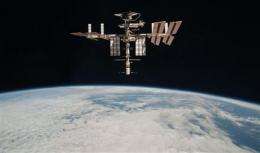
This May 23, 2011 file photo released by NASA, shows the International Space Station flying at an altitude of approximately 220 miles, in an image taken by Expedition 27 crew member Paolo Nespoli from the Soyuz TMA-20 following its undocking. Astronauts may need to temporarily abandon the International Space Station this fall if last week's Russian launch accident prevents new crews from flying, a NASA official said Monday. (AP Photo/NASA, Paolo Nespoli)

(AP) -- Astronauts may need to take the unprecedented step of temporarily abandoning the International Space Station if last week's Russian launch accident prevents new crews from flying there this fall.

Until officials figure out what went wrong with Russia's essential Soyuz rockets, there will be no way to launch any more astronauts before the current residents have to leave in mid-November.

The unsettling predicament comes just weeks after NASA's final space shuttle flight.

"We have plenty of options," NASA's space station program manager, Mike Suffredini, assured reporters Monday. "We'll focus on crew safety as we always do."

Abandoning the space station, even for a short period, would be an unpleasant last resort for the world's five space agencies that have spent decades working on the project. Astronauts have been living aboard the space station since 2000, and the goal is to keep it going until 2020.

Suffredini said flight controllers could keep a deserted space station operating indefinitely, as long as all major systems are working properly. The risk to the station goes up, however, if no one is on board to fix equipment breakdowns.

Six astronauts from three countries presently are living on the orbiting complex. Three are due to leave next month; the other three are supposed to check out in mid-November. They can't stay any longer because of spacecraft and landing restrictions.

The Sept. 22 launch of the very next crew - the first to fly in this post-shuttle era - already has been delayed indefinitely. Russia's Soyuz spacecraft have been the sole means of getting full-time station residents up and down for two years. The capsule is parked at the station until they ride it home.

To keep the orbiting outpost with a full staff of six for as long as possible, the one American and two Russians due to return to Earth on Sept. 8 will remain on board at least an extra week.

As for supplies, the space station is well stocked and could go until next summer, Suffredini said. Atlantis dropped off a year's supply of goods just last month on the final space shuttle voyage. The unmanned craft destroyed Wednesday was carrying 3 tons of supplies.

For now, operations are normal in orbit, Suffredini noted, and the additional week on board for half the crew will mean additional science research.

The Soyuz has been extremely reliable over the decades; this was the first failure in 44 Russian supply hauls for the space station. Even with such a good track record, many in and outside NASA were concerned about retiring the space shuttles before a replacement was ready to fly astronauts.

Russian space officials have set up an investigation team and until it comes up with a cause for the accident and a repair plan, the launch and landing schedules remain in question. None of the spacecraft debris has been recovered yet; the wreckage fell into a remote, wooded section of Siberia. The third stage malfunctioned; a sudden loss of pressure apparently was noted between the engine and turbopump.

While a crew may well have survived such an accident because of safety precautions built into the manned version of the rocket, no one wants to take any chances.

One or two unmanned Soyuz launches are on tap for October, one commercial and the other another space station supply run. Those would serve as important test flights before putting humans on board, Suffredini said.

NASA considered vacating the space station before, following the space shuttle Columbia disaster in 2003. Back then, shuttles were still being used to ferry some station residents back and forth. Instead, the station got by with two-man crews for three years because of the significant cutback in supplies.

The space station's population doubled in 2009, to six. It wasn't until the space station was completed this year that science research finally took priority.

Even if the space shuttles still were flying, space station crews still would need Soyuz-launched capsules to serve as lifeboats, Suffredini said. The capsules are certified for no more than 6 1/2 months in space, thus the need to regularly rotate crews. Complicating matters is the need to land the capsules during daylight hours in Kazakhstan, resulting in weeks of blackout periods.

NASA wants American private companies to take over crew hauls, but that's three to five years away at best. Until then, Soyuz capsules are the only means of transporting astronauts to the space station.

Japan and Europe have their own cargo ships and rockets, for unmanned use only. Commercial front-runner Space Exploration Technologies Corp., or SpaceX, plans to launch a space station supply ship from Cape Canaveral at the end of November. That would be put on hold if no one is on board to receive the vessel.

Suffredini said he hasn't had time to consider the PR impact of abandoning the space station, especially coming so soon after the end of the 30-year shuttle program.

"Flying safely is much, much more important than anything else I can think about right this instant," he said. "I'm sure we'll have an opportunity to discuss any political implications if we spend a lot of time on the ground. But you know, we'll just have to deal with them because we're going to do what's safest for the crew and for the space station."

More information: NASA: http://www.nasa.gov/mission-pages/station/main/index.html

©2011 The Associated Press. All rights reserved. This material may not be published, broadcast, rewritten or redistributed.

4.1 /5 (7 votes)  

Filter


Move the slider to adjust rank threshold, so that you can hide some of the comments.


Display comments: newest first

Eric_B
Aug 29, 2011

Rank: 1 / 5 (1)
i think the russians should built a frame for the station to attach rockets to it (if that would be possible
) and ship it to the moon rather than dumping it in the ocean.
hard2grep
Aug 29, 2011

Rank: not rated yet
great, we are going to have cannibal astronauts because we cannot afford NASA.We could tell them to get as much space junk rounded up as possible and make a solar sail. Why not put a station up high enough to use solar panels and some Ion engines; Or does that put you in the radiation belt. Either way, we are going to have space cannibals.
antialias_physorg
Aug 30, 2011

Rank: 5 / 5 (1)
i think the russians should built a frame for the station to attach rockets to it (if that would be possible

The station is in LEO. The energy requirements for getting it to the moon would be enormous. The space station is also not structurally designed to take any kind of serious acceleration.

And what would we do with it if we got it there? It would then orbit the moon instead of the Earth. The scientific value would be exactly the same (only the supply ship trips would be vastly more costly). The ISS is in no way usful as a 'supply point' or 'drop off' station to the moon.

When we decide to try do do that we'll net a completely different space-station design.
Mayday
Aug 30, 2011

Rank: 5 / 5 (1)
What a colossal waste. And so predictable -- if not to happen now, than in the very near future. But, yes, the gentleman is quite right: it is far too late to start considering PR and political angles. The horse is out of the barn. I just hope that the Space-X team doesn't chomp at the bit and rush their great program straight into premature and dangerous delivery. But humans being human, this does not look good.
NameIsNotNick
Aug 30, 2011

Rank: not rated yet
i think the russians should built a frame for the station to attach rockets to it (if that would be possible

The station is in LEO. The energy requirements for getting it to the moon would be enormous.

Only if you are in a hurry. From orbit, low thrust for prolonged time could slowly spiral up to escape velocity. Keeping it supplied and crewed might be problematical though.
NameIsNotNick
Aug 30, 2011

Rank: 5 / 5 (1)
"Flying safely is much, much more important than anything else... we're going to do what's safest for the crew and for the space station."

The safest thing to do is to never go into space! I don't think the astronauts feel this way... there is always a trade-off between safety and expanding our horizons.
antialias_physorg
Aug 30, 2011

Rank: not rated yet
The amount of fuel you'd have to deliver to the ISS would be atrocious.

The ISS was recently boosted to a 45km higher orbit which required 1.4 tonnes of fuel.
http://www.scienc...2141.htm

And don't forget: Every time you send it further out the amount of fuel you need for supply missions increases: So while the fuel for boosting the ISS would be needed only once the increase for the supply missions will have to be paid on each and every flight.

It would also mean less cargo per flight - so you'd also need more resupply missions.

low thrust for prolonged time could slowly spiral up to escape velocity.

It doesn't matter whether you do it slow, fast, in a spiral or in a straight line. The total energy needed is always the same.
Shootist
Aug 30, 2011

Rank: 1 / 5 (1)
Steve Postrel emails: Step 1 of my supervillain plan to save the US space program is now complete. Step 2 is to sabotage the follow-on Russian tests. Step 3 is to get NASA to evacuate the ISS. Step 4 is to blow the orbiting cash sump out of the sky with my laser. Step 5 is to bribe the Congress to divert all the funds that used to go into the space RV into a prize fund for private operators to go to the moon, asteroids, and Mars.

Bwa-ha-ha!

Faster, please.
Rank 4.1 /5 (7 votes)
Related Stories
Relevant PhysicsForums posts
  • Calculating the magnitude
    created2 hours ago
  • What is this spectrum I took?
    created12 hours ago
  • Orientation of Space
    created13 hours ago
  • Geologically Active Moon Now: NASA
    created20 hours ago
  • advice on building a science fair telescope
    createdFeb 22, 2012
  • Rise of the Sun
    createdFeb 22, 2012
  • More from Physics Forums - General Astronomy

More news stories

Spitzer finds solid buckyballs in space

(PhysOrg.com) -- Astronomers using data from NASA's Spitzer Space Telescope have, for the first time, discovered buckyballs in a solid form in space. Prior to this discovery, the microscopic carbon spheres ...

Space & Earth / Astronomy

created 14 hours ago | popularity 4.7 / 5 (12) | comments 8 | with audio podcast

Going up: Japan builder eyes space elevator

A Japanese construction firm claimed Wednesday it could execute an out-of-this-world plan to put tourists in space within 40 years by building an elevator that stretches a quarter of the way to the moon.

Space & Earth / Space Exploration

created 21 hours ago | popularity 3.5 / 5 (13) | comments 26

ENASA satellite finds Earth's clouds are getting lower

(PhysOrg.com) -- Earth's clouds got a little lower -- about one percent on average -- during the first decade of this century, finds a new NASA-funded university study based on NASA satellite data. The results ...

Space & Earth / Earth Sciences

created 18 hours ago | popularity 5 / 5 (8) | comments 13 | with audio podcast

Fresh scandal embroils US climate science debate

A fresh scandal over climate change has erupted in the United States after leaked documents appeared to show a right-wing funded campaign to influence how climate science is taught in schools.

Space & Earth / Environment

created 11 hours ago | popularity 4.1 / 5 (9) | comments 8

World's oceans get an acid bath

Among the repercussions of global climate change, the effect of ocean acidification on marine life is one of the least-understood variables.

Space & Earth / Environment

created 18 hours ago | popularity 4.3 / 5 (6) | comments 4 | with audio podcast


Researchers build first physical 'metatronic' circuit

(PhysOrg.com) -- The technological world of the 21st century owes a tremendous amount to advances in electrical engineering, specifically, the ability to finely control the flow of electrical charges using ...

Faster than light neutrinos? More like faulty wiring

You can shelf your designs for a warp drive engine (for now) and put the DeLorean back in the garage; it turns out neutrinos may not have broken any cosmic speed limits after all.

Physicists surprised by disappearing and reappearing superconductivity in iron selenium chalcogenides

Superconductivity is a rare physical state in which matter is able to conduct electricity -- maintain a flow of electrons -- without any resistance. This phenomenon can only be found in certain materials at low temperatures, ...

Stanford research team cracks animated NuCaptcha

(PhysOrg.com) -- The research team from Stanford University, led by Elie Bursztein, that previously had cracked regular CAPTCHAs and then audio CAPTCHAs, now has also successfully cracked the animated version called NuCapt ...

Flesh-eating bacteria inspire superglue

(PhysOrg.com) -- A bio-inspired superglue has been developed by Oxford University researchers that can’t be matched for sticking molecules together and not letting go.

Scientists create potent molecules aimed at treating muscular dystrophy

While RNA is an appealing drug target, small molecules that can actually affect its function have rarely been found. But now scientists from the Florida campus of The Scripps Research Institute have for the first time designed ...