A planet made of diamond (w/ video)
August 25, 2011
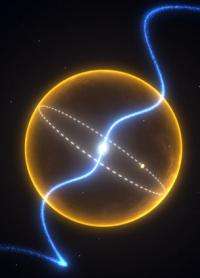
An artist's visualisation of the pulsar and its orbiting planet. Image credit - Swinburne Astronomy Productions
A once-massive star that's been transformed into a small planet made of diamond: that is what University of Manchester astronomers think they've found in the Milky Way.
The discovery has been made by an international research team, led by Professor Matthew Bailes of Swinburne University of Technology in Melbourne, Australia, and is reported in the journal Science.
The researchers, from The University of Manchester as well as institutions in Australia, Germany, Italy, and the USA, first detected an unusual star called a pulsar using the Parkes radio telescope of the Australian Commonwealth Scientific and Industrial Research Organisation (CSIRO) and followed up their discovery with the Lovell radio telescope, based at Jodrell Bank Observatory in Cheshire, and one of the Keck telescopes in Hawaii.
Pulsars are small spinning stars about 20 km in diameter the size of a small city that emit a beam of radio waves. As the star spins and the radio beam sweeps repeatedly over Earth, radio telescopes detect a regular pattern of radio pulses.
For the newly discovered pulsar, known as PSR J1719-1438, the astronomers noticed that the arrival times of the pulses were systematically modulated. They concluded that this was due to the gravitational pull of a small companion planet, orbiting the pulsar in a binary system.
This video is not supported by your browser at this time.
The pulsar and its planet are part of the Milky Way's plane of stars and lie 4,000 light-years away in the constellation of Serpens (the Snake). The system is about an eighth of the way towards the Galactic Centre from the Earth.The modulations in the radio pulses tell astronomers a number of things about the planet.
First, it orbits the pulsar in just two hours and ten minutes, and the distance between the two objects is 600,000 kma little less than the radius of our Sun.
Second, the companion must be small, less than 60,000 km (that's about five times the Earth's diameter). The planet is so close to the pulsar that, if it were any bigger, it would be ripped apart by the pulsar's gravity.
But despite its small size, the planet has slightly more mass than Jupiter.
"This high density of the planet provides a clue to its origin", said Professor Bailes.
The team thinks that the 'diamond planet' is all that remains of a once-massive star, most of whose matter was siphoned off towards the pulsar.
Pulsar J1719-1438 is a very fast-spinning pulsarwhat's called a millisecond pulsar. Amazingly, it rotates more than 10,000 times per minute, has a mass of about 1.4 times that of our Sun but is only 20 km in diameter. About 70 per cent of millisecond pulsars have companions of some kind.
Astronomers think it is the companion that, in its star form, transforms an old, dead pulsar into a millisecond pulsar by transferring matter and spinning it up to a very high speed. The result is a fast-spinning millisecond pulsar with a shrunken companionmost often a so-called white dwarf.
"We know of a few other systems, called ultra-compact low-mass X-ray binaries, that are likely to be evolving according to the scenario above and may likely represent the progenitors of a pulsar like J1719-1438" said team member Dr Andrea Possenti, Director at INAF-Osservatorio Astronomico di Cagliari.
But pulsar J1719-1438 and its companion are so close together that the companion can only be a very stripped-down white dwarf, one that has lost its outer layers and over 99.9 per cent of its original mass.
"This remnant is likely to be largely carbon and oxygen, because a star made of lighter elements like hydrogen and helium would be too big to fit the measured orbiting times," said Dr Michael Keith (CSIRO), one of the research team members.
The density means that this material is certain to be crystalline: that is, a large part of the star may be similar to a diamond.
"The ultimate fate of the binary is determined by the mass and orbital period of the donor star at the time of mass transfer. The rarity of millisecond pulsars with planet-mass companions means that producing such 'exotic planets' is the exception rather than the rule, and requires special circumstances," said Dr Benjamin Stappers from The University of Manchester.
The team found pulsar J1719-1438 among almost 200,000 Gigabytes of data using special codes on supercomputers at Swinburne University of Technology in Australia, The University of Manchester in the UK, and the INAF-Osservatorio Astronomico di Cagliari, Italy.
The discovery was made during a systematic search for pulsars over the whole sky that also involves the 100 metre Effelsberg radio telescope of the Max-Planck-Institute for Radioastronomy (MPIfR) in Germany. "This is the largest and most sensitive survey of this type ever conducted. We expected to find exciting things, and it is great to see it happening. There is more to come!" said Professor Michael Kramer, Director at the MPIfR.
Professor Matthew Bailes leads the 'Dynamic Universe' theme in a new wide-field astronomy initiative, the Centre of Excellence for All-sky Astrophysics (CAASTRO).
The discovery of the new binary system is of special significance for him and fellow team member Professor Andrew Lyne, from The University of Manchester, who jointly ignited the whole pulsar-planet field in 1991 with what proved to an erroneous claim of the first extra-solar planet. The next year though the first extra-solar planetary system was discovered around the pulsar PSR B1257+12.
-
Astronomers weigh 'recycled' millisecond pulsar
Jan 12, 2006 |
not rated yet |
0
-
Chandra Finds Long-Sought Link to Origin of Millisecond Pulsars
Jul 21, 2005 |
not rated yet |
0
-
Astronomers discover fastest-spinning pulsar
Jan 12, 2006 |
not rated yet |
0
-
New technique improves estimates of pulsar ages
Jun 09, 2009 |
not rated yet |
0
-
Astronomers find bizarre planet-mass object orbiting neutron star
Sep 12, 2007 |
not rated yet |
0
-
Stars containing dark matter should look different from other stars
Feb 20, 2012 |
4.5 / 5 (17) |
11
-
Physicists discover evidence of rare hypernucleus, a component of strange matter
Feb 17, 2012 |
4.7 / 5 (38) |
22
-
Fast photon control brings quantum photonic technologies closer
Feb 13, 2012 |
5 / 5 (8) |
1
-
Engineers build first sub-10-nm carbon nanotube transistor
Feb 01, 2012 |
4.9 / 5 (36) |
32
-
Something old, something new: Evolution and the structural divergence of duplicate genes
Jan 31, 2012 |
4.6 / 5 (7) |
1
-
Calculating the magnitude
2 hours ago
-
What is this spectrum I took?
13 hours ago
-
Orientation of Space
13 hours ago
-
Geologically Active Moon Now: NASA
20 hours ago
-
advice on building a science fair telescope
Feb 22, 2012
-
Rise of the Sun
Feb 22, 2012
- More from Physics Forums - General Astronomy
More news stories
Spitzer finds solid buckyballs in space
(PhysOrg.com) -- Astronomers using data from NASA's Spitzer Space Telescope have, for the first time, discovered buckyballs in a solid form in space. Prior to this discovery, the microscopic carbon spheres ...
14 hours ago |
4.7 / 5 (12) |
8
|
Going up: Japan builder eyes space elevator
A Japanese construction firm claimed Wednesday it could execute an out-of-this-world plan to put tourists in space within 40 years by building an elevator that stretches a quarter of the way to the moon.
Space & Earth / Space Exploration
21 hours ago |
3.5 / 5 (13) |
26
ENASA satellite finds Earth's clouds are getting lower
(PhysOrg.com) -- Earth's clouds got a little lower -- about one percent on average -- during the first decade of this century, finds a new NASA-funded university study based on NASA satellite data. The results ...
Space & Earth / Earth Sciences
18 hours ago |
5 / 5 (8) |
13
|
Fresh scandal embroils US climate science debate
A fresh scandal over climate change has erupted in the United States after leaked documents appeared to show a right-wing funded campaign to influence how climate science is taught in schools.
11 hours ago |
4.1 / 5 (9) |
8
World's oceans get an acid bath
Among the repercussions of global climate change, the effect of ocean acidification on marine life is one of the least-understood variables.
18 hours ago |
4.3 / 5 (6) |
4
|
Researchers build first physical 'metatronic' circuit
(PhysOrg.com) -- The technological world of the 21st century owes a tremendous amount to advances in electrical engineering, specifically, the ability to finely control the flow of electrical charges using ...
Faster than light neutrinos? More like faulty wiring
You can shelf your designs for a warp drive engine (for now) and put the DeLorean back in the garage; it turns out neutrinos may not have broken any cosmic speed limits after all.
Physicists surprised by disappearing and reappearing superconductivity in iron selenium chalcogenides
Superconductivity is a rare physical state in which matter is able to conduct electricity -- maintain a flow of electrons -- without any resistance. This phenomenon can only be found in certain materials at low temperatures, ...
Stanford research team cracks animated NuCaptcha
(PhysOrg.com) -- The research team from Stanford University, led by Elie Bursztein, that previously had cracked regular CAPTCHAs and then audio CAPTCHAs, now has also successfully cracked the animated version called NuCapt ...
Flesh-eating bacteria inspire superglue
(PhysOrg.com) -- A bio-inspired superglue has been developed by Oxford University researchers that cant be matched for sticking molecules together and not letting go.
Scientists create potent molecules aimed at treating muscular dystrophy
While RNA is an appealing drug target, small molecules that can actually affect its function have rarely been found. But now scientists from the Florida campus of The Scripps Research Institute have for the first time designed ...
Aug 25, 2011
Rank: 4.8 / 5 (24)
Aug 25, 2011
Rank: 5 / 5 (8)
Aug 25, 2011
Rank: 4.9 / 5 (9)
My guess is they'd try and destroy before trying to harvest it. After all you can't very well artificially inflate the value of diamonds if you have a planet's mass worth of them and everyone knows it.
Aug 25, 2011
Rank: 4.7 / 5 (6)
Aug 25, 2011
Rank: 4.5 / 5 (2)
As the star/white dwarf lost mass wouldn't the pressure keeping the crystal intact drop below a threshold and cause rapid disintegration of at least the oxygen crystals at the surface? I realize that the carbon in diamonds is stable but not so much crystals of oxygen or carbon dioxide or monoxide?
Aug 25, 2011
Rank: 4.6 / 5 (12)
I love it because it gives you that sense of wonder, and awe of the amazing things the universe can create.
I hate it because my name isn't Kirk and I don't have a spaceship with lasers to shoot at it with.
Aug 25, 2011
Rank: 1.8 / 5 (10)
Like "fall-out" particles from nuclear explosions here on Earth, the grains that formed first grew largest and trapped the highest amounts of short-lived radioactivity.
http://www.omatum...Data.htm
With kind regards,
Oliver K. Manuel
Former NASA Principal
Investigator for Apollo
Aug 25, 2011
Rank: 5 / 5 (1)
Hey omatumr, I'm not sure what you're getting at there, it's commonly accepted that our solar system is a 3rd generation (i.e from 3 supernovas) solar system. At least to my knowledge anyway.
Aug 25, 2011
Rank: 5 / 5 (2)
"Hey omatumr, I'm not sure what you're getting at there, it's commonly accepted that our solar system is a 3rd generation (i.e from 3 supernovas) solar system. At least to my knowledge anyway."
I'm just curious(seriously). I was aware that more than one SN event had been implicated. Do you have any links to relevant papers? Thanks.
Aug 26, 2011
Rank: 5 / 5 (4)
I really don't I'm sorry, and some initial google searching hasn't yielded any results unfortunately. I did see an article here on physorg that made mention of this at some stage within the last month, but finding it is a whole other matter.
However wikipedia does have this:
http://en.wikiped...r_System
Studies of ancient meteorites reveal traces of stable daughter nuclei of short-lived isotopes, such as iron-60, that only form in exploding, short-lived stars. This indicates that one or more supernovae occurred near the Sun while it was forming. A shock wave from a supernova may have triggered the formation of the Sun by creating regions of over-density within the cloud, causing these regions to collapse.
------------
So by the looks of it, it's certainly less certain that I originally made it out to be, but it certainly seems that we have material from multiple supernovas in our system. We're recycled recycled recyled star stuff..
Aug 26, 2011
Rank: 4.8 / 5 (16)
Aug 26, 2011
Rank: 5 / 5 (3)
Thanks for your reply. I was just curious if more than one SN contributor had been ID'd as a pre-solar nebula "seeder". It seems pretty certain more than one SN was responsible for current solar system abundances, but teasing apart that info will be tricky.
And collapse of the solar nebula induced by a nearby passing SN shockwave does seem a likely trigger for the birth of the sun (& solar system).
Aug 26, 2011
Rank: 4.3 / 5 (12)
Aug 26, 2011
Rank: not rated yet
God Squad's back...
Aug 26, 2011
Rank: 5 / 5 (4)
Quite the opposite. "God does not play dice" is an Einstein quote.
Aug 26, 2011
Rank: not rated yet
Aug 26, 2011
Rank: 5 / 5 (7)
Aug 26, 2011
Rank: 5 / 5 (3)
Right next to a pulsar? Erm... I'd prefer to go somewhre else if it's all the same to you.
Aug 26, 2011
Rank: 5 / 5 (3)
Aug 26, 2011
Rank: not rated yet
In a sense, gravity is relative. The amount of gravity experienced is dependent on the amount of mass in a certain volume and your distance from the center of gravity. Stars are so big because of the radiative pressure exerted from fusion. This is the core of a collapsed star, so the gravity on the diamond planet is fairly high on the surface relative to the gravity of it when it was a functioning star. While it is unlikely for a planet to collapse down to this level, the planet's unique formation process from a star allowed this to happen.
Continued...
Aug 26, 2011
Rank: not rated yet
The material is extremely dense, allowing for the higher gravity at relatively low mass, and the gravity provides magnitudes more pressure than you would experience on say, earth.
That said, you are somewhat right, in that some crystal types may degenerate at or near the surface, but that is pretty tertiary to the observations - if the surface is dusted with a few percent of non crystalline substances, it does not refute the overall conclusion.
-So many good comments on this article. So many. i'm going to go on a limb and say that Pete's comment
was my favorite, but the dice one was good, and the solar eclipse idea...not to denigrate all the other ones that were good too.
Aug 26, 2011
Rank: 1.6 / 5 (7)
First Fe,Ni that formed iron meteorites and inner cores of terrestrial planets.
Next S that formed FeS inclusions in iron meteorites and Earth's liquid outer core
Etc, etc, on out past the silicates that formed stone meteorites and Earth's mantle
Finally, H, He, C and N that formed the giant gaseous outer planets.
The scenario [1], constructed from literally hundreds of analyses on meteorites, planets, and the Sun, was unpopular with proponents of the SSM Sun and AGW story [2].
1. "Neutron Repulsion", The APEIRON Journal, in press, 19 pages (2011)
http://arxiv.org/...2.1499v1
2. "Deep Roots of Climategate"
https://dl-web.dr...oots.pdf
Aug 26, 2011
Rank: not rated yet
Aug 26, 2011
Rank: 2.1 / 5 (7)
From outer layer of the supernova, where lightweight elements were abundant.
www.omatumr.com/Origin.htm
That is why diamonds in meteorites are filled with primordial He accompanied by Xe with twice the normal abundance of Xe-136 (produced by the r-process).
www.omatumr.com/D...Data.htm
That is why we predicted in 1983 that Jupiter's He-rich atmosphere would contain excess Xe-136.
http://articles.a...ype=.pdf
Solar abundance of the elements", Meteoritics 18, 209-222 (1983)
When we got data from the Galileo mission to Jupiter in 1998, there was excess Xe-136!
"Isotopic ratios in Jupiter confirm intra-solar diffusion",
Meteoritics and Planetary Science 33-A97, 5011 (1998).
www.lpi.usra.edu/...5011.pdf
Aug 27, 2011
Rank: not rated yet
Aug 27, 2011
Rank: not rated yet
Aug 27, 2011
Rank: 5 / 5 (1)
Many stars, especially comparatively younger ones like the Sun, contain elements heavier than hydrogen and helium that can not be produced by the nuclear fusion reaction that powers them. Iron is one example. This fact leads to the conclusion that these heavier elements must have already existed within the nebula in which our Sun formed. Furthermore, since supernovae typically generate energies high enough to produce most of the heavier elements found in the Sun, deduction leads to the scenario where some ancient star(s) exploded and cast the heavy elements into interstellar space. Subsequently, new stars like our Sun formed from this material. Based on the measured quantities of heavier elements in the Sun it's theorized that it must be a 3rd generation star; that is at least two other stars preceded it.
--Paul Braxton
Aug 28, 2011
Rank: 3 / 5 (2)
Aug 29, 2011
Rank: not rated yet
I actually caught an interview with one of the main astronomers for this on my drive home from work last week, and he was very careful to say "that the density suggests it is mostly made up of diamond, however without viewing it directly we can only asusme" (I'm paraphrasing of course).
Aug 29, 2011
Rank: 5 / 5 (1)
Please wikipedia star lifecycles. Basically, if a star is large enough, it creates carbon in its core from fusion. The pulsar siphoned off all the outer material to leave the carbon core.
Aug 30, 2011
Rank: not rated yet
Aug 30, 2011
Rank: 1 / 5 (3)
That seemingly far-fetched idea is in fact very possible.
Furthermore, the core of Jupiter probably contains high levels of actinide elements (Th, U, Pu) that were made by the r-process (rapid neutron capture). Radioactivity of those elements likely produces Jupiter's excess heat.
"Strange xenon", with about twice the normal abundance of Xe-136, is trapped in microscopic diamonds on carbonaceous meteorites like Allende.
The diamonds formed in the outer part of the supernova debris, and that same debris - rich in H, He, N and C - accreted to form Jupiter.
In arguing for remote element synthesis, Professor Anders (a.k.a. Alperovitch) of the University of Chicago mislabeled the meteorite diamonds as "interstellar diamonds."
The history of that long debate (1972-2011) is here:
"Neutron Repulsion"
http://arxiv.org/...2.1499v1
Aug 30, 2011
Rank: 3.7 / 5 (3)