New polymeric material brings companies one step closer to cheaper plastic solar cells and electronics
August 17, 2011
New polymeric material brings companies one step closer to cheaper plastic solar cells and electronics

Enlarge

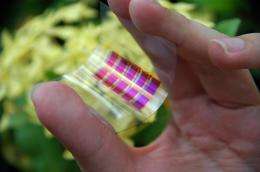
Flexible, organic solar cells - IMRE’s polymer can help save costs and resources in making devices like organic solar cells and next generation printed circuits on plastic. Credit: Agency for Science, Technology and Research (A*STAR)

A single polymer that can be used in both new age plastic electronics as well as plastic solar cells could spell greater cost-savings and open up new design options for electronic and solar cell companies. A*STAR’s IMRE has developed a new polymer that not only produces a high charge mobility of 0.2 cm2/V.s, which is the same value achieved by commercially available semiconducting materials but also has a high solar power conversion efficiency of 6.3%. This makes IMRE’s polymer one of the few that has both these properties. In addition to this, polymers of the same class as IMRE’s, which are those that use thiophene and benzothiadiazole as the building blocks, could only achieve 2.2% power conversion.

“Current polymers are usually good in one aspect or another, either as a good conductor for use in electronics or endowed with high efficiency - but not both”, said IMRE Senior Scientist, Dr. Chen Zhi Kuan, the principal researcher working on the polymers. “IMRE’s functions not only as a good material to make electronic components, the same material can be used to convert sunlight to electricity efficiently”. The polymer can also be easily applied in roll-to-roll printing techniques which is similar to how newspapers are currently printed making it possible to manufacture large area-scale printed electronics and organic quickly and cheaply.

With IMRE’s polymer, manufacturers could save cost using just a single bulk resource for making both printed electronics and organic solar cells. The material could also possibly be used in designing new devices where both power harnessing and electronics are needed in a single component. An example of this would be chemical sensors based on organic thin-film transistors and powered by organic solar cells.

“This breakthrough will help speed up the development of and organic solar cells, and make them more readily available in the marketplace,” said Prof Andy Hor, Executive Director of IMRE.
New polymeric material brings companies one step closer to cheaper plastic solar cells and electronics
Enlarge

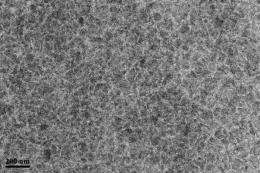
IMRE’s polymer has both high charge mobility and high power conversion efficiency in a single material as opposed to most polymers that have either one or the other, not both - A transmission electron microscopy image of the IMRE polymer, PC71BM film, showing phase separation between the polymer fibres (light) and PC71BM (dark). Credit: Agency for Science, Technology and Research (A*STAR)

Printed electronics often rely on organic materials like polymers that can be easily processed and manufactured as opposed to traditional electronics (or metal electronics) which rely on inorganics such as copper or silicon. The polymers can be made into thinner, lighter and cost-effective electronic components and organic solar cells.

The IMRE team is developing other organic materials-based polymers that can be scaled up to production and integrated easily into organic electronics. These materials can be used to make energy harvesting and low-power consumption devices like low-cost organic solar cells, new flexible display devices, next generation smart labels and RFID tags.

The research and results were recently published in Advanced Materials.

Provided by Agency for Science, Technology and Research (A*STAR)


Rank not rated yet
Relevant PhysicsForums posts
  • slit width order of wavelength
    created3 hours ago
  • Non-Uniform Charge Distribution of a Metal Cone
    created7 hours ago
  • velocity from acceleration if acceleration is a function of space...
    created10 hours ago
  • Electrohydroconvection Engine?
    created12 hours ago
  • Question about entropy=0 in an irreversible process
    created12 hours ago
  • Question about Firing tank shell in freefall
    created14 hours ago
  • More from Physics Forums - Classical Physics

More news stories

Scientists create potent molecules aimed at treating muscular dystrophy

While RNA is an appealing drug target, small molecules that can actually affect its function have rarely been found. But now scientists from the Florida campus of The Scripps Research Institute have for the first time designed ...

Chemistry / Biochemistry

created 9 hours ago | popularity 5 / 5 (4) | comments 0 | with audio podcast

Flesh-eating bacteria inspire superglue

(PhysOrg.com) -- A bio-inspired superglue has been developed by Oxford University researchers that can’t be matched for sticking molecules together and not letting go.

Chemistry / Biochemistry

created 20 hours ago | popularity 5 / 5 (8) | comments 3 | with audio podcast

Researchers discover what cancer cells need to travel

(PhysOrg.com) -- Cancer cells must prepare for travel before invading new tissues, but new Cornell research has found a possible way to stop these cells from ever hitting the road.

Chemistry / Biochemistry

created 19 hours ago | popularity 4.9 / 5 (12) | comments 0 | with audio podcast

New microfluidic device could be used to diagnose and monitor cancer and other diseases

Separating complex mixtures of cells, such as those found in a blood sample, can offer valuable information for diagnosing and treating disease. However, it may be necessary to search through billions of other ...

Chemistry / Analytical Chemistry

created 19 hours ago | popularity 5 / 5 (2) | comments 0 | with audio podcast

New way to tap largest remaining treasure trove of potential new antibiotics

Scientists are reporting use of a new technology for sifting through the world's largest remaining pool of potential antibiotics to discover two new antibiotics that work against deadly resistant microbes, ...

Chemistry / Biochemistry

created 12 hours ago | popularity 5 / 5 (4) | comments 0


Researchers build first physical 'metatronic' circuit

(PhysOrg.com) -- The technological world of the 21st century owes a tremendous amount to advances in electrical engineering, specifically, the ability to finely control the flow of electrical charges using ...

Spitzer finds solid buckyballs in space

(PhysOrg.com) -- Astronomers using data from NASA's Spitzer Space Telescope have, for the first time, discovered buckyballs in a solid form in space. Prior to this discovery, the microscopic carbon spheres ...

Faster than light neutrinos? More like faulty wiring

You can shelf your designs for a warp drive engine (for now) and put the DeLorean back in the garage; it turns out neutrinos may not have broken any cosmic speed limits after all.

Physicists surprised by disappearing and reappearing superconductivity in iron selenium chalcogenides

Superconductivity is a rare physical state in which matter is able to conduct electricity -- maintain a flow of electrons -- without any resistance. This phenomenon can only be found in certain materials at low temperatures, ...

CT colonography shown to be comparable to standard colonoscopy

Computerized tomographic (CT) colonography (CTC), also known as virtual colonoscopy, is comparable to standard colonoscopy in its ability to accurately detect cancer and precancerous polyps in people ages 65 and older, according ...

Stanford research team cracks animated NuCaptcha

(PhysOrg.com) -- The research team from Stanford University, led by Elie Bursztein, that previously had cracked regular CAPTCHAs and then audio CAPTCHAs, now has also successfully cracked the animated version called NuCapt ...