Running robot: MABEL is now the world's fastest two-legged robot with knees (w/ video)
August 16, 2011
Running robot: MABEL is now the world's fastest two-legged robot with knees (w/ video)

Enlarge

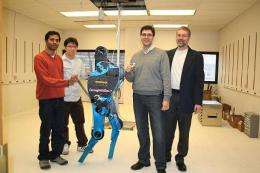
(PhysOrg.com) -- A robot in a University of Michigan lab can run like a human -- a feat that represents the height of agility and efficiency for a two-legged machine. With a peak pace of 6.8 miles per hour, MABEL is believed to be the world's fastest bipedal robot with knees.

"It's stunning," said Jessy Grizzle, a professor in the Department of Electrical Engineering and Computer Science. "I have never seen a machine doing a motion like this."

This video is not supported by your browser at this time.

MABEL was built in 2008 in collaboration with Jonathan Hurst, who was then a doctoral student at the Robotics Institute at Carnegie Mellon University. Grizzle and U-M doctoral students Koushil Sreenath and Hae-Won Park have spent the years since ratcheting up MABEL's training. They've been progressively improving the feedback algorithms that enable the robot to keep its balance while reacting to its environment in real time.

MABEL started off walking smoothly and quickly over flat surfaces. Then it moved on to uneven ground. It took its first real jog in late July, and with that, Sreenath met the ultimate goal of his research just days before he was scheduled to defend his thesis.

Few robots can run, and the researchers say no machine but MABEL can do it with such a human-like gait. Its weight is distributed like a person's. It has a heavier torso and light, flexible legs with springs that act like tendons. MABEL is in the air for 40 percent of each stride, "like a real runner," Grizzle said. Other running robots are almost speed-walking. Their so-called flight phase when both feet are off the ground lasts for less than 10 percent of each step.

"We envision some extraordinary potential applications for legged research: exoskeletons that enable wheelchair-bound people to walk again or that give rescuers super-human abilities, and powered that behave like their biological counterparts," said developer Hurst, who is now an assistant professor in the Department of Mechanical, Industrial and Manufacturing Engineering at Oregon State University.

Two-legged robots with good running form would also have the advantage of being able to travel over rough terrain and inside places built for humans. They could one-day serve as robotic soldiers or rescuers, the engineers say.

"The robotics community has been trying to come up with machines that can go places where humans can go, so a human morphology is important," Grizzle said. "If you would like to send in robots to search for people when a house is on fire, it probably needs to be able to go up and down stairs, step over the baby's toys on the floor, and maneuver in an environment where wheels and tracks may not be appropriate."

Wheels are a great way to move across flat surfaces, Sreenath said, but when the ground gets rocky, two legs are much more efficient.

"Imagine a future where you don't have to first clear a path and build roads before a vehicle could move around," Sreenath said, "but rather, we have a class of running machines like animals that could transport you around with no roads, but with a smooth and efficient ride."

More information: http://www.eecs.um … s/MABEL.html

Provided by University of Michigan (news : web)

3.5 /5 (10 votes)  

Filter


Move the slider to adjust rank threshold, so that you can hide some of the comments.


Display comments: newest first

Egleton
Aug 16, 2011

Rank: not rated yet
I wonder how efficient they are? I expect that they could ride motorbikes if they needed to go faster.
Ojorf
Aug 16, 2011

Rank: 3 / 5 (2)
Sure won't sneak up on you quietly.
baudrunner
Aug 16, 2011

Rank: 3.7 / 5 (3)
Close scrutiny of the picture reveals that two attendants are supporting this robot, leading me to doubt that this thing is completely autonomous. Also, it is missing a pair of feet, so it more resembles a machine on a couple of pogo sticks. The absence of a video demonstrating this thing's capability further fuels my skepticism.
emsquared
Aug 16, 2011

Rank: 5 / 5 (1)
That thing looks a little like a well played IRL game of QWOP... (google it)
Isaacsname
Aug 16, 2011

Rank: not rated yet
Harumph, I'll be impressed when they can do the hokey-pokey.
iiibogdan
Aug 16, 2011

Rank: 5 / 5 (3)
Ooooooh...so it's supported by an arm...unimpressive

Big dog is much more advanced
http://www.youtub...zBcnX1Ww

and biped
http://www.youtub...UudkjEG4
tigger
Aug 16, 2011

Rank: 5 / 5 (1)
Yep... Boston Dynamics kick arse on this thing. Remove that supporting arm!
Shakescene21
Aug 16, 2011

Rank: 5 / 5 (2)
I was impressed until I saw the video. Let's see if this bot can run without the supporting arm,
HTK
Aug 22, 2011

Rank: not rated yet
HMM... what 's that huge black bar supporting the robot.

If they took that away the robot will fall.
Rank 3.5 /5 (10 votes)
Related Stories
Relevant PhysicsForums posts

More news stories

PlayStation Vita game gadgets debut outside Asia

Sony's slick PlayStation Vita handheld videogame gadget hit major markets around the world on Wednesday as the Japanese entertainment titan bucked a trend towards play on smartphones.

Electronics / Consumer & Gadgets

created 11 hours ago | popularity not rated yet | comments 0

Energy-recycling computer technology from UM goes global through AMD

An energy-recycling computer circuit born at the University of Michigan will enable a new generation of power efficient laptop PCs and servers.

Electronics / Hardware

created 18 hours ago | popularity 5 / 5 (1) | comments 0

Review: Vita sets new standard for portable games

(AP) -- The PlayStation Vita won't replace your smartphone. For starters, it isn't a telephone (although it will eventually let you use Skype). And it's too big to fit in your pants pocket, unless you're wearing ...

Electronics / Consumer & Gadgets

created Feb 21, 2012 | popularity 3.7 / 5 (3) | comments 2

Engineering research brings seven adult-sized humanoid robots together for first time in US

Seven adult-sized humanoid robots took the stage during Drexel University's celebration of National Engineers Week, in a first-of-its-kind assembly of robotic technology. A showcase event on Feb. 20 introduced all seven of ...

Electronics / Robotics

created Feb 21, 2012 | popularity not rated yet | comments 2

British firm develops 'cheapest wireless tablet'

A British technology company claims to have developed the world's least expensive computer tablet for wireless Internet access.

Electronics / Consumer & Gadgets

created Feb 19, 2012 | popularity 4.6 / 5 (10) | comments 2


Researchers build first physical 'metatronic' circuit

(PhysOrg.com) -- The technological world of the 21st century owes a tremendous amount to advances in electrical engineering, specifically, the ability to finely control the flow of electrical charges using ...

Spitzer finds solid buckyballs in space

(PhysOrg.com) -- Astronomers using data from NASA's Spitzer Space Telescope have, for the first time, discovered buckyballs in a solid form in space. Prior to this discovery, the microscopic carbon spheres ...

Faster than light neutrinos? More like faulty wiring

You can shelf your designs for a warp drive engine (for now) and put the DeLorean back in the garage; it turns out neutrinos may not have broken any cosmic speed limits after all.

Physicists surprised by disappearing and reappearing superconductivity in iron selenium chalcogenides

Superconductivity is a rare physical state in which matter is able to conduct electricity -- maintain a flow of electrons -- without any resistance. This phenomenon can only be found in certain materials at low temperatures, ...

Stanford research team cracks animated NuCaptcha

(PhysOrg.com) -- The research team from Stanford University, led by Elie Bursztein, that previously had cracked regular CAPTCHAs and then audio CAPTCHAs, now has also successfully cracked the animated version called NuCapt ...

Going up: Japan builder eyes space elevator

A Japanese construction firm claimed Wednesday it could execute an out-of-this-world plan to put tourists in space within 40 years by building an elevator that stretches a quarter of the way to the moon.