Cosmic thread that binds us revealed
September 29, 2011
Cosmic thread that binds us revealed

Enlarge

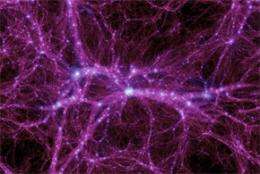
Simulated view of the interconnecting filaments between galaxies. Credit: Michael Boylan-Kolchin, University of California Irvine

(PhysOrg.com) -- Astronomers at The Australian National University have found evidence for the textile that forms the fabric of the Universe.

In findings published in the October , the researchers discovered proof of a vast filament of material that connects our to nearby clusters of galaxies, which are similarly interconnected to the rest of the Universe.

The team included Dr. Stefan Keller, Dr. Dougal Mackey and Professor Gary Da Costa from the Research School of at ANU.

“By examining the positions of ancient groupings of stars, called globular clusters, we found that the clusters form a narrow plane around the Milky Way rather than being scattered across the sky,” Dr. Keller said.

“Furthermore, the Milky Way’s entourage of small satellites are seen to inhabit the same plane.

“What we have discovered is evidence for the cosmic thread that connects us to the vast expanse of the Universe.

“The filament of star clusters and small galaxies around the Milky Way is like the umbilical cord that fed our Galaxy during its youth.”

Dr. Keller said there were two types of matter that made up the Universe – the dominant, enigmatic dark matter and ordinary matter in the form of galaxies, stars and planets.

“A consequence of the Big Bang and the dominance of dark matter is that ordinary matter is driven, like foam on the crest of a wave, into vast interconnected sheets and filaments stretched over enormous cosmic voids – much like the structure of a kitchen sponge,” he said.

“Unlike a sponge, however, gravity draws the material over these interconnecting filaments towards the largest lumps of matter, and our findings show that the globular clusters and satellite galaxies of the Milky Way trace this cosmic filament.

“Globular clusters are systems of hundreds of thousands of ancient stars tightly packed in a ball. In our picture, most of these star clusters are the central cores of small galaxies that have been drawn along the by gravity.

“Once these small galaxies got too close the Milky Way the majority of stars were stripped away and added to our galaxy, leaving only their cores.

“It is thought that the Milky Way has grown to its current size by the consumption of hundreds of such smaller galaxies over cosmic time.”

Provided by Australian National University

4.7 /5 (27 votes)  

Filter


Move the slider to adjust rank threshold, so that you can hide some of the comments.


Display comments: newest first

Isaacsname
Sep 29, 2011

Rank: not rated yet
" small galaxies that have been drawn along the filament by gravity "

So that picture represents the conduits that gravitational forces propagate through the universe with, they're formed by overlapping gravitational fields of the matter they contain ?
Dane
Sep 29, 2011

Rank: 5 / 5 (1)
Cool!
SteveL
Sep 29, 2011

Rank: 4.4 / 5 (15)
Just a thought: If "normal matter" (baryonic) makes up such a small percentage of all matter, how can it be the "normal" matter? If the vast majority of matter is dark or non-baryonic, then it should be considered the normal matter.
rawa1
Sep 29, 2011

Rank: 2 / 5 (11)
IMO these dark matter fibbers conceptually corresponds the worm holes and dark strings. They're not worm holes in strict sense, but they still enable to spread information faster with the rest of Universe, than along another directions.

Cosmic strings are originally very thin, but hyperdimensional objects, but when observed from low dimensional perspective, they may appear fuzzy. They exhibit Rayleigh-Plateau and Gregory-Laflamme instabilities typical for hyperdimensional non-Newtonian fluids (they're covered with galaxies like fibbers of slime are covered with droplets).

In aether theory the gravitational waves correspond the indeterministic CMBR noise (i.e. not harmonic waves) - but these fibers can behave like SOFAR channel in underwater and they could enable the spreading of weak harmonic ripples with superluminal speed at limited distance - at least in principle.
NotAsleep
Sep 29, 2011

Rank: 1 / 5 (1)
This article seems to rely on the universe contracting rather than expanding... unless matter is finicky about which large mass it likes to gravitate towards. If all matter is interconnected by this web it would seem that gravity could channel mass along infinite distances
ShotmanMaslo
Sep 29, 2011

Rank: 5 / 5 (6)
This article seems to rely on the universe contracting rather than expanding... unless matter is finicky about which large mass it likes to gravitate towards. If all matter is interconnected by this web it would seem that gravity could channel mass along infinite distances


Gravitationally bound structures do contract even in an expanding universe. These cosmic filaments may be the largest such structures possible, larger ones were torn apart by the expansion.
Pyle
Sep 29, 2011

Rank: 4.4 / 5 (5)
Asleep, I didn't get that at all. DE is still underlying all of this enabling/causing expansion in these models. DE dominates on cosmic scales while on galactic scales gravity dominates.

Zephyr: Nonsense. but I 5'd you for "fibbers". Probably unintentional, but it made me chuckle.

SteveL: Good point. Normal because we are made of it and most familiar with it. If we ever really observe DM directly, or at least figure out what it is, then it won't be considered not normal any more.

Finally, I love the dark matter filaments illustrations. They look cool. Still think DM is a plug, for now, but it makes for some neat drawings.
Shootist
Sep 29, 2011

Rank: not rated yet
Nothing magical or mysterious; just minimum energy orbital transfers on the scale of galactic clusters. Q.E.D.
rawa1
Sep 29, 2011

Rank: 2 / 5 (2)
probably unintentional, but it made me chuckle.
Definitely - thank you for notice. I'm relying on spell-checker too much..
dtyarbrough
Sep 29, 2011

Rank: 1 / 5 (8)
The doppler affect does not occur with light. Redshift does not occur until the light passes through the first gas cloud it encounters on it way to earth. The cloud lies on this single plane, not the galaxies.
HannesAlfven
Sep 29, 2011

Rank: 2 / 5 (8)
Re: The filament of star clusters and small galaxies around the Milky Way is like the umbilical cord that fed our Galaxy during its youth.

Well then, it seems that this is grounds for agreement between plasma-based cosmology and the Big Bang. Keep in mind that the interstellar "clouds" are also filamentary. Birkeland Current magnetic rope structures are also observed regularly connecting the Sun with the Earth.

We see filamentation at all scales, and yet we are frequently told that these filaments occur through chance mechanisms.

If we do not seek out unifying theories, we certainly will never find them.
HannesAlfven
Sep 29, 2011

Rank: 2.4 / 5 (9)
Re: The filament of star clusters and small galaxies around the Milky Way is like the umbilical cord that fed our Galaxy during its youth.

Well then, it seems that there are grounds for agreement between plasma-based cosmology and the more conventional framework.

We see filaments connecting galaxies. We see filaments in galaxies. We see filaments all around us in interstellar space (the interstellar "clouds"). We see filaments regularly connecting the Sun with the Earth.

At what point do we reconsider the notion that all of these filaments are there by chance? If filaments are common, then there is arguably a mechanism holding them together.

In the electric universe, we call it Marklund convection. And it's the same thing that happens to charged particles around transmission lines. The transmission lines act as ion pumps.
Callippo
Sep 29, 2011

Rank: 1.4 / 5 (8)
Milky Way is like the umbilical cord that fed our Galaxy during its youth
We have no evidence of directional flow along cosmic threads. Instead of this, it's speculated, they're coalescing like the fluid drips.

http://www.aether...ings.avi

http://www.aether...rips.avi

IMO they were formed in the following mechanism during cosmic inflation

http://www.aether...apse.gif
Callippo
Sep 29, 2011

Rank: 1 / 5 (3)
There is study, which is probably most relevant to subject so far. http://prl.aps.or.../e101102
brant
Sep 29, 2011

Rank: 2.8 / 5 (6)
If you use basic electrical theory and apply it to plasma. Using the right hand rule I would say that the plasma forms into filaments because of magnetism... Same as a wire. You can see the helicity...
Crazy_council
Sep 29, 2011

Rank: 1.8 / 5 (5)
I think that this is the same as one of the predictions for electric universe theory. That charge would form filiment lines between galaxys, just like it does here on earth. I read it i think on the thunderbolts website.

quite a few of there predictions are simila to what we see, i am not a mad supporter of the EU theory, it just a lot of there predictions make sence, why do we need dark energy and dark matter.

typicalguy
Sep 29, 2011

Rank: 3.4 / 5 (7)
Why do we need dark matter? Because of the evidence. Everyone that disagrees with the theory for it ignores the fact that it has gravitational lensing.
Mayday
Sep 30, 2011

Rank: 1 / 5 (1)
The more I see these models, the more I wonder what is in the open holes that is pushing the visible material into these sheets and strings. It seems very much like soap foam or risen bread. What is the expanding material(?) or force that is generating these "bubbles?" And why are they so similarly sized and so homogenous over such vast distances and time scales? It seems that the slightest perturbance would mix it up more, no?

Maybe our universe is expanding because we're moving through a greater medium(multiverse) toward an area of lower pressure, so the "bubbles" expand. I just hope no one puts our "bread" in the oven!
Pirouette
Sep 30, 2011

Rank: 3.5 / 5 (2)
I love this article and am greatly interested in this topic now. However, since I am not a neurologist or brain expert, I am not familiar with all the terminology dealing with the brain.
But I must say that this article does make me think of the parallels between these cosmic filaments and the neurons in a brain that enable messages to travel from one part of said brain to one or more part(s) in other areas of said brain. The neurons are an information superhighway and I'm wondering if these cosmic filaments spoken of could possibly be something similar to neurons. I need to study the brain further because this possibility is highly intriguing. For some reason, the term in "firing synapses" comes to mind. I must have read it somewhere and it stuck with me.
Pirouette
Sep 30, 2011

Rank: 2.3 / 5 (3)
I was wrong! It is the neuron vesicles within neurons that CARRY the messages in the brain, but it is the AXON that moves the message along via info superhighway (firing synapses).

http://en.wikiped...one3.JPG
also: http://en.wikiped...pped.jpg
Words below in parentheses indicate the comparison of the cosmic filaments to the brain's firing synapses.
In this Wikipedia illustration, the neuron sends a message via axon (filament) utilizing "electrical impulses" toward other neurons who, in turn send messages back and forth to other neurons. In this cosmic filaments article, I think there may be a parallel with stars (neurons), the axon moving electrical impulses through the axon firing synapses (cosmic filaments), and the space between neurons being gray matter could parallel tbe space between stars and galaxies (dark matter). This possibility is giving me a slight chill.
Crazy_council
Sep 30, 2011

Rank: 2.5 / 5 (4)
Why do we need dark matter? Because of the evidence. Everyone that disagrees with the theory for it ignores the fact that it has gravitational lensing.

the evidence ( lenzin ) could point to other things rather than dark matter/energy.
If the fabric of the universe is spinning, this could account for a lot of the evidence we find for dark matter/force.
Pirouette
Sep 30, 2011

Rank: 1.8 / 5 (5)
I would understand if everyone disagreed with my theory since it is way out there. :)
But the main concern for some people, I think, would be that if these cosmic filaments do, in reality, electronically and gravitationally connect stars and galaxies to each other throughout the Universe, might it not indicate a designer (created) Universe, and not one well organized by mere chance?
Rawa1 said "IMO these dark matter fibbers conceptually corresponds the worm holes and dark strings. They're not worm holes in strict sense, but they still enable to spread information faster with the rest of Universe, than along another directions."
I agree. It's either a Communications line, OR similar to a spider's web for catching and holding stars.
I am considering Fibonacci numbers and other beautiful works of nature, including the brain.
I can see these miracles of Nature increased exponentially in cosmic terms. Should I say it?
CHollman82
Oct 01, 2011

Rank: 5 / 5 (2)
If all matter is interconnected by this web it would seem that gravity could channel mass along infinite distances


Gravity acts over unlimited distance regardless...
MorituriMax
Oct 03, 2011

Rank: not rated yet
Just a thought: If "normal matter" (baryonic) makes up such a small percentage of all matter, how can it be the "normal" matter? If the vast majority of matter is dark or non-baryonic, then it should be considered the normal matter.

Probably because we can see it and study it, and are made of it, hence, normal.
FroguetteMiNote
Oct 04, 2011

Rank: 3.5 / 5 (2)
In this cosmic filaments article, I think there may be a parallel with stars (neurons), the axon moving electrical impulses through the axon firing synapses (cosmic filaments), and the space between neurons being gray matter could parallel tbe space between stars and galaxies (dark matter). This possibility is giving me a slight chill.


And a great mathematician figured it all in the XVIIth century:
"But to show him another prodigy equally astonishing, let him examine the most delicate things he knows..Let him see therein an infinity of universes, each of which has its firmament, its planets, its earth, in the same proportion as in the visible world; in each earth animals, and in the last mites, in which he will find again all that the first had, finding still in these others the same thing without end and without cessation. Let him lose himself in wonders as amazing in their littleness as the others in their vastness"
Blaise Pascal, Pensées, #72
TheGhostofOtto1923
Oct 06, 2011

Rank: 1 / 5 (1)
If you use basic electrical theory and apply it to plasma. Using the right hand rule I would say that the plasma forms into filaments because of magnetism... Same as a wire. You can see the helicity...
Diz mek mee whan to seeeng!
http://www.youtub...a_player
TheGhostofOtto1923
Oct 06, 2011

Rank: not rated yet
Oh so sorry calypso has no sense of rhythm.
Pirouette
Oct 07, 2011

Rank: 1 / 5 (1)
@ Proquette

I have a feeling that your quote was meant for me. If so, thank you. There are vast similarities between the macro and micro. Many years ago, I think it was in the1980s, my then young son had an amazing program on his computer that showed Fractals, whereby no matter where you clicked on the large pattern on the screen, it zoomed in to show the same pattern again, but in micro. I found it fascinating but I still don't know how it was done.
Regarding my brain analogy, the firing synapses does remind me of the electromagnetic current of the "rope" connection between all of these "globes" in the Universe. Truly fascinating, I want more!!
Rank 4.7 /5 (27 votes)
Related Stories
Relevant PhysicsForums posts
  • Calculating the magnitude
    created2 hours ago
  • What is this spectrum I took?
    created13 hours ago
  • Orientation of Space
    created13 hours ago
  • Geologically Active Moon Now: NASA
    created20 hours ago
  • advice on building a science fair telescope
    createdFeb 22, 2012
  • Rise of the Sun
    createdFeb 22, 2012
  • More from Physics Forums - General Astronomy

More news stories

Spitzer finds solid buckyballs in space

(PhysOrg.com) -- Astronomers using data from NASA's Spitzer Space Telescope have, for the first time, discovered buckyballs in a solid form in space. Prior to this discovery, the microscopic carbon spheres ...

Space & Earth / Astronomy

created 14 hours ago | popularity 4.7 / 5 (12) | comments 8 | with audio podcast

Going up: Japan builder eyes space elevator

A Japanese construction firm claimed Wednesday it could execute an out-of-this-world plan to put tourists in space within 40 years by building an elevator that stretches a quarter of the way to the moon.

Space & Earth / Space Exploration

created 21 hours ago | popularity 3.5 / 5 (13) | comments 26

ENASA satellite finds Earth's clouds are getting lower

(PhysOrg.com) -- Earth's clouds got a little lower -- about one percent on average -- during the first decade of this century, finds a new NASA-funded university study based on NASA satellite data. The results ...

Space & Earth / Earth Sciences

created 18 hours ago | popularity 5 / 5 (8) | comments 13 | with audio podcast

Fresh scandal embroils US climate science debate

A fresh scandal over climate change has erupted in the United States after leaked documents appeared to show a right-wing funded campaign to influence how climate science is taught in schools.

Space & Earth / Environment

created 11 hours ago | popularity 4.1 / 5 (9) | comments 8

World's oceans get an acid bath

Among the repercussions of global climate change, the effect of ocean acidification on marine life is one of the least-understood variables.

Space & Earth / Environment

created 18 hours ago | popularity 4.3 / 5 (6) | comments 4 | with audio podcast


Researchers build first physical 'metatronic' circuit

(PhysOrg.com) -- The technological world of the 21st century owes a tremendous amount to advances in electrical engineering, specifically, the ability to finely control the flow of electrical charges using ...

Faster than light neutrinos? More like faulty wiring

You can shelf your designs for a warp drive engine (for now) and put the DeLorean back in the garage; it turns out neutrinos may not have broken any cosmic speed limits after all.

Physicists surprised by disappearing and reappearing superconductivity in iron selenium chalcogenides

Superconductivity is a rare physical state in which matter is able to conduct electricity -- maintain a flow of electrons -- without any resistance. This phenomenon can only be found in certain materials at low temperatures, ...

Stanford research team cracks animated NuCaptcha

(PhysOrg.com) -- The research team from Stanford University, led by Elie Bursztein, that previously had cracked regular CAPTCHAs and then audio CAPTCHAs, now has also successfully cracked the animated version called NuCapt ...

Flesh-eating bacteria inspire superglue

(PhysOrg.com) -- A bio-inspired superglue has been developed by Oxford University researchers that can’t be matched for sticking molecules together and not letting go.

Scientists create potent molecules aimed at treating muscular dystrophy

While RNA is an appealing drug target, small molecules that can actually affect its function have rarely been found. But now scientists from the Florida campus of The Scripps Research Institute have for the first time designed ...