DNA confirms existence of NZ bird thought extinct
September 26, 2011
DNA confirms existence of NZ bird thought extinct

Enlarge

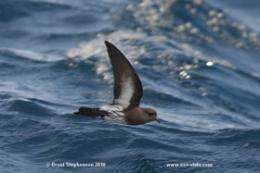
New Zealand Storm-petrel. Credit: Brent Stephenson

(PhysOrg.com) -- An examination of ancient and modern DNA by the University of Otago has confirmed that the New Zealand storm-petrel, once thought to be extinct, is a bird which continues to fly our southern skies.

University of Otago Senior Lecturer in Dr Bruce Robertson, who led the study, says the research confirms that the storm petrel is a “distinct ” of seabird, rather than an extinct plumage variant or subspecies, and hence is worthy of a species recovery programme.

The exciting find has been just published on-line in the journal Molecular Phylogenetics and Evolution.

The authors, Dr. Robertson, Dr. Brent Stephenson of Eco-Vista, and Dr. Sharyn Goldstien of Canterbury University, used DNA methods to confirm conclusively this finding using DNA samples from museum skins and birds recently captured, since the first bird thought to be the extinct storm petrel flew into the wheelhouse of a fishing vessel operating in the Hauraki Gulf in 2003.

Scientists had evidence of the existence of a NZ storm-petrel with three museum skins collected in the 1800s and held by the museums in England and France. Using ancient sequencing, samples from two of the 150-year-old skins were tested and matched against blood samples from living birds.

“We found they were one and the same, and these are a distinct species of storm-petrel,” he says.

“Since 2003, researchers had largely accepted that the bird was the NZ storm-petrel, but until we had taxonomic certainty, the conservation effort to protect the bird was paralysed; there was always going to be this controversy because no one knew exactly what the museum skins were.

“Hopefully now the NZ Storm-Petrel will be given a conservation priority that would be given to a nationally endangered species. This will help us to fund further study of the bird, such as where it breeds.”

Dr. Robertson adds that once scientists have more information, they can better direct conservation efforts and begin a species recovery program.

The four-year study, which started in 2006, was also funded by the Department of and the National Geographic Fund.

Provided by University of Otago


Rank not rated yet
Related Stories
Relevant PhysicsForums posts
  • Eye biology videos
    created4 hours ago
  • Flowering Plant Revived After 30,000 Years in Permafrost
    createdFeb 21, 2012
  • Toba volcano eruptions - 1.000 - 10,000 breeding pairsunb
    createdFeb 20, 2012
  • How is a specific gene removed from DNA
    createdFeb 20, 2012
  • Reproduction and Human evolution
    createdFeb 19, 2012
  • Viruses: Living or Non-living organisms
    createdFeb 19, 2012
  • More from Physics Forums - Biology

More news stories

Surprising diversity at a synapse hints at complex diversity of neural circuitry

A new study reveals a dazzling degree of biological diversity in an unexpected place – a single neural connection in the body wall of flies.

Biology / Other

created 10 hours ago | popularity 5 / 5 (4) | comments 0 | with audio podcast

Men might not 'become extinct' after all: Theory of the 'rotting' Y chromosome dealt a fatal blow

If you were to discover that a fundamental component of human biology has survived virtually intact for the past 25 million years, you'd be quite confident in saying that it is here to stay.

Biology / Biotechnology

created 13 hours ago | popularity 5 / 5 (6) | comments 1 | with audio podcast

New family of legless amphibians found in India

Since before the age of dinosaurs it has burrowed unbothered beneath the monsoon-soaked soils of remote northeast India - unknown to science and mistaken by villagers as a deadly, miniature snake.

Biology / Plants & Animals

created 21 hours ago | popularity 5 / 5 (8) | comments 3

Climate change affects bird migration timing in North America

Bird migration timing across North America has been affected by climate change, according to a study published Feb. 22 in the open access journal PLoS ONE.

Biology / Ecology

created 9 hours ago | popularity 4.5 / 5 (2) | comments 2

New iridescent lizard species found in Cambodia

A new species of lizard with striking iridescent rainbow skin, a long tail and very short legs has been discovered in the rainforest in northeast Cambodia, conservationists announced Wednesday.

Biology / Plants & Animals

created 10 hours ago | popularity not rated yet | comments 0


Researchers build first physical 'metatronic' circuit

(PhysOrg.com) -- The technological world of the 21st century owes a tremendous amount to advances in electrical engineering, specifically, the ability to finely control the flow of electrical charges using ...

Spitzer finds solid buckyballs in space

(PhysOrg.com) -- Astronomers using data from NASA's Spitzer Space Telescope have, for the first time, discovered buckyballs in a solid form in space. Prior to this discovery, the microscopic carbon spheres ...

Faster than light neutrinos? More like faulty wiring

You can shelf your designs for a warp drive engine (for now) and put the DeLorean back in the garage; it turns out neutrinos may not have broken any cosmic speed limits after all.

Physicists surprised by disappearing and reappearing superconductivity in iron selenium chalcogenides

Superconductivity is a rare physical state in which matter is able to conduct electricity -- maintain a flow of electrons -- without any resistance. This phenomenon can only be found in certain materials at low temperatures, ...

CT colonography shown to be comparable to standard colonoscopy

Computerized tomographic (CT) colonography (CTC), also known as virtual colonoscopy, is comparable to standard colonoscopy in its ability to accurately detect cancer and precancerous polyps in people ages 65 and older, according ...

Stanford research team cracks animated NuCaptcha

(PhysOrg.com) -- The research team from Stanford University, led by Elie Bursztein, that previously had cracked regular CAPTCHAs and then audio CAPTCHAs, now has also successfully cracked the animated version called NuCapt ...