Scientists release most accurate simulation of the universe to date
September 29, 2011 By Tim Stephens
Scientists release most accurate simulation of the universe to date

Enlarge

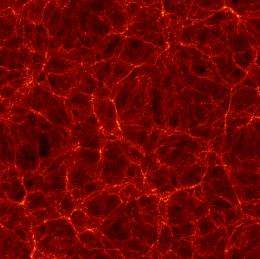
Bolshoi z=0

(PhysOrg.com) -- The Bolshoi supercomputer simulation, the most accurate and detailed large cosmological simulation run to date, gives physicists and astronomers a powerful new tool for understanding such cosmic mysteries as galaxy formation, dark matter, and dark energy.

The simulation traces the evolution of the large-scale structure of the universe, including the evolution and distribution of the dark matter halos in which galaxies coalesced and grew. Initial studies show good agreement between the simulation's predictions and astronomers' observations.

"In one sense, you might think the initial results are a little boring, because they basically show that our standard works," said Joel Primack, distinguished professor of physics at the University of California, Santa Cruz. "What's exciting is that we now have this highly accurate simulation that will provide the basis for lots of important new studies in the months and years to come."


Bolshoi Simulation Visualization

Primack and Anatoly Klypin, professor of astronomy at New Mexico State University, lead the team that produced the Bolshoi simulation. Klypin wrote the computer code for the simulation, which was run on the Pleiades supercomputer at NASA Ames Research Center. "These huge cosmological simulations are essential for interpreting the results of ongoing astronomical observations and for planning the new large surveys of the universe that are expected to help determine the nature of the mysterious dark energy," Klypin said.

Primack, who directs the University of California High-Performance Astrocomputing Center (UC-HIPACC), said the initial release of data from the Bolshoi simulation began in early September. "We've released a lot of the data so that other astrophysicists can start to use it," he said. "So far it's less than one percent of the actual output, because the total output is so huge, but there will be additional releases in the future."

The previous benchmark for large-scale cosmological simulations, known as the Millennium Run, has been the basis for some 400 papers since 2005. But the fundamental parameters used as the input for the Millennium Run are now known to be inaccurate. Produced by the Virgo Consortium of mostly European scientists, the Millennium simulation used cosmological parameters based on the first release of data from NASA's Wilkinson Microwave Anisotropy Probe (WMAP). WMAP provided a detailed map of subtle variations in the cosmic microwave background radiation, the primordial radiation left over from the Big Bang. But the initial WMAP1 parameters have been superseded by subsequent releases: WMAP5 (five-year results released in 2008) and WMAP7 (seven-year results released in 2010).

The Bolshoi simulation is based on WMAP5 parameters, which are consistent with the later WMAP7 results. "The WMAP1 cosmological parameters on which the Millennium simulation is based are now known to be wrong," Primack said. "Moreover, advances in supercomputer technology allow us to do a much better simulation with higher resolution by almost an order of magnitude. So I expect the Bolshoi simulation will have a big impact on the field."
Scientists release most accurate simulation of the universe to date
Enlarge

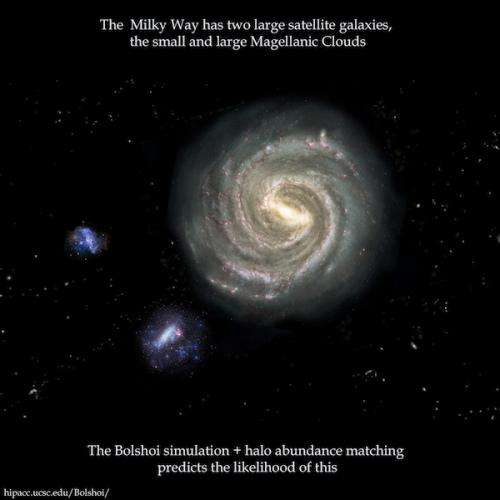
Bolshoi predictions agree with Observations

The standard explanation for how the universe evolved after the Big Bang is known as the Lambda Cold Dark Matter model, and it is the theoretical basis for the Bolshoi simulation. According to this model, gravity acted initially on slight density fluctuations present shortly after the Big Bang to pull together the first clumps of dark matter. These grew into larger and larger clumps through the hierarchical merging of smaller progenitors. Although the nature of dark matter remains a mystery, it accounts for about 82 percent of the matter in the universe. As a result, the evolution of structure in the universe has been driven by the gravitational interactions of dark matter. The ordinary matter that forms stars and planets has fallen into the "gravitational wells" created by clumps of dark matter, giving rise to galaxies in the centers of dark matter halos.

A principal purpose of the Bolshoi simulation is to compute and model the evolution of dark matter halos. The characteristics of the halos and subhalos in the Bolshoi simulation are presented in a paper that has been accepted for publication in the Astrophysical Journal and is now available online. The authors are Klypin, NMSU graduate student Sebastian Trujillo-Gomez, and Primack.

A second paper, also accepted for publication in the Astrophysical Journal and available online, presents the abundance and properties of galaxies predicted by the Bolshoi simulation of dark matter. The authors are Klypin, Trujillo-Gomez, Primack, and UCSC postdoctoral researcher Aaron Romanowsky. A comparison of the Bolshoi predictions with galaxy observations from the Sloan Digital Sky Survey showed very good agreement, according to Primack.

The Bolshoi simulation focused on a representative section of the universe, computing the evolution of a cubic volume measuring about one billion light-years on a side and following the interactions of 8.6 billion particles of . It took 6 million CPU-hours to run the full computation on the Pleiades supercomputer, recently ranked as the seventh fastest supercomputer in the world.

A variant of the Bolshoi simulation, known as BigBolshoi or MultiDark, was run on the same supercomputer with the same number of particles, but this time in a volume 64 times larger. BigBolshoi was run to predict the properties and distribution of galaxy clusters and other very large structures in the universe, as well as to help with dark energy projects such as the Baryon Oscillation Spectroscopic Survey (BOSS).

Another variant, called MiniBolshoi, is currently being run on the Pleiades supercomputer. MiniBolshoi focuses on a smaller portion of the universe and provides even higher resolution than Bolshoi. The Bolshoi simulation and its two variants will be made publicly available to astrophysical researchers worldwide in phases via the MultiDark Database, hosted by the Potsdam Astrophysics Institute in Germany and supported by grants from Spain and Germany.

Primack, Klypin, and their collaborators are continuing to analyze the results of the Bolshoi simulation and submit papers for publication. Among their findings are results showing that the correctly predicts the number of galaxies as bright as the Milky Way that have satellite as bright as the Milky Way's major satellites, the Large and Small Magellanic Clouds.

"A lot more papers are on the way," Primack said.

More information: http://hipacc.ucsc … edu/Bolshoi/

Provided by University of California - Santa Cruz (news : web)

4.9 /5 (16 votes)  

Filter


Move the slider to adjust rank threshold, so that you can hide some of the comments.


Display comments: newest first

DiverseByDesign
Sep 29, 2011

Rank: 5 / 5 (5)
Kind of disappointed by the video as presented. Just seems like a visual presentation of spinning galaxies and stars, not a simulation of the universe. I expected a simulation video of the universe chronologically. Maybe I just misunderstood the intentions.
omatranter
Sep 29, 2011

Rank: 3.3 / 5 (4)
""The WMAP1 cosmological parameters on which the Millennium simulation is based are now known to be wrong," Primack said""

yet 2005 they said this of the first run with bad data?

http://www.guardi...learning
"For the first time we have a replica universe which looks just like the real one"

makes you wonder?
omatranter
Sep 29, 2011

Rank: 1.8 / 5 (5)
"Prof Frenk said: "We programmed the biggest computer in Europe with these ingredients and the laws of physics and we just let it compute a universe. We let it churn away - in fact we shut down all science in Germany, we excluded all German science for a month while this very large machine ground away - and at the end we got this beautiful universe, which for all intents and purposes looks like the real thing." 2005
A2G
Sep 29, 2011

Rank: 2.3 / 5 (6)
Old rule may apply: Garbage in, garbage out.
TimESimmons
Sep 29, 2011

Rank: 1.7 / 5 (6)
we now have this highly accurate simulation

except for a complete absence of spiral galaxies. What could be missing from the simulation?

http://www.presto...ndex.htm
89118a
Sep 29, 2011

Rank: not rated yet
OK, sounds good. However, no mention of Sloan Great Wall sized objects.

Wow, follow the video link for an even better video called Bolshoi II;

http://vimeo.com/29406342
grosyhpgrosyhpgrosyhp
Sep 29, 2011

Rank: 5 / 5 (2)
"Bolshoi" is "Big" in Russian. Good name for the supercomputer simulation of the universe =)
bewertow
Sep 29, 2011

Rank: 3 / 5 (2)
In the comments section: haters who are too dumb to study physics complain.
astro_optics
Sep 29, 2011

Rank: 3 / 5 (2)
didn't look like the BigBang to me!
omatumr
Sep 29, 2011

Rank: 1.4 / 5 (10)
The Bolshoi Supercomputer Simulation, the most accurate and detailed large cosmological simulation run to date, a powerful new tool for understanding such cosmic mysteries as galaxy formation, dark matter, and dark energy.


How did they decide BSS is "the most accurate cosmological simulation"?

Are BSS simulations better than experimental observations [1,2]?

1. "Is the Universe Expanding?", Journal of Cosmology 13, 4187-4190 (2011)

http://journalofc...102.html

2. "Neutron repulsion", The APEIRON Journal, in press (2011)

http://arxiv.org/...2.1499v1

With kind regards,
Oliver K. Manuel
http://myprofile....anuelo09
Sonhouse
Sep 30, 2011

Rank: 5 / 5 (2)
didn't look like the BigBang to me!

That would be because it ISN'T the BB, but starting at a point in time millions of years later.
Rank 4.9 /5 (16 votes)
Related Stories
Relevant PhysicsForums posts
  • Calculating the magnitude
    created2 hours ago
  • What is this spectrum I took?
    created12 hours ago
  • Orientation of Space
    created12 hours ago
  • Geologically Active Moon Now: NASA
    created19 hours ago
  • advice on building a science fair telescope
    createdFeb 22, 2012
  • Rise of the Sun
    createdFeb 22, 2012
  • More from Physics Forums - General Astronomy

More news stories

Spitzer finds solid buckyballs in space

(PhysOrg.com) -- Astronomers using data from NASA's Spitzer Space Telescope have, for the first time, discovered buckyballs in a solid form in space. Prior to this discovery, the microscopic carbon spheres ...

Space & Earth / Astronomy

created 14 hours ago | popularity 4.7 / 5 (12) | comments 8 | with audio podcast

Going up: Japan builder eyes space elevator

A Japanese construction firm claimed Wednesday it could execute an out-of-this-world plan to put tourists in space within 40 years by building an elevator that stretches a quarter of the way to the moon.

Space & Earth / Space Exploration

created 21 hours ago | popularity 3.5 / 5 (13) | comments 26

ENASA satellite finds Earth's clouds are getting lower

(PhysOrg.com) -- Earth's clouds got a little lower -- about one percent on average -- during the first decade of this century, finds a new NASA-funded university study based on NASA satellite data. The results ...

Space & Earth / Earth Sciences

created 18 hours ago | popularity 5 / 5 (8) | comments 13 | with audio podcast

Fresh scandal embroils US climate science debate

A fresh scandal over climate change has erupted in the United States after leaked documents appeared to show a right-wing funded campaign to influence how climate science is taught in schools.

Space & Earth / Environment

created 11 hours ago | popularity 4.1 / 5 (9) | comments 8

World's oceans get an acid bath

Among the repercussions of global climate change, the effect of ocean acidification on marine life is one of the least-understood variables.

Space & Earth / Environment

created 18 hours ago | popularity 4.3 / 5 (6) | comments 4 | with audio podcast


Researchers build first physical 'metatronic' circuit

(PhysOrg.com) -- The technological world of the 21st century owes a tremendous amount to advances in electrical engineering, specifically, the ability to finely control the flow of electrical charges using ...

Faster than light neutrinos? More like faulty wiring

You can shelf your designs for a warp drive engine (for now) and put the DeLorean back in the garage; it turns out neutrinos may not have broken any cosmic speed limits after all.

Physicists surprised by disappearing and reappearing superconductivity in iron selenium chalcogenides

Superconductivity is a rare physical state in which matter is able to conduct electricity -- maintain a flow of electrons -- without any resistance. This phenomenon can only be found in certain materials at low temperatures, ...

Stanford research team cracks animated NuCaptcha

(PhysOrg.com) -- The research team from Stanford University, led by Elie Bursztein, that previously had cracked regular CAPTCHAs and then audio CAPTCHAs, now has also successfully cracked the animated version called NuCapt ...

Flesh-eating bacteria inspire superglue

(PhysOrg.com) -- A bio-inspired superglue has been developed by Oxford University researchers that can’t be matched for sticking molecules together and not letting go.

Scientists create potent molecules aimed at treating muscular dystrophy

While RNA is an appealing drug target, small molecules that can actually affect its function have rarely been found. But now scientists from the Florida campus of The Scripps Research Institute have for the first time designed ...