'Albedo effect' in forest disturbances can cause added warming, bonus cooling
October 19, 2011
'Albedo effect' in forest disturbances can cause added warming, bonus cooling

Enlarge

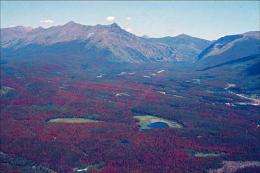
The defoliation from major epidemics of bark beetle infestation, such as these in these stands of lodgepole pine in British Columbia, can increase reflectivity of heat back into space and largely offset warming that would otherwise result from increased release of carbon dioxide, a new study suggests. (Photo courtesy of Oregon State University)

Wildfire, insect outbreaks and hurricanes destroy huge amounts of forest every year and increase the amount of carbon dioxide entering the atmosphere, but scientists are now learning more about another force that can significantly affect their climate impact.

Researchers conclude in a new study that the albedo effect, which controls the amount of energy reflected back into space, is important in the climatic significance of several types of major disturbances.

In some cases – mostly in boreal forests with significant snow cover – increases in reflectivity can provide cooling. If the area disturbed by fire or insects is large, this cooling can substantially offset the increase in global warming that would otherwise be caused by these forest disturbances and the release of greenhouse gases. In other cases where the ground itself is unusually dark, albedo decreases can magnify concerns about warming.

Wildfires are not the only disturbance that significantly alters surface albedo, this study concluded. Insect outbreaks and defoliation by hurricanes can also change surface reflectivity, with effects on climate as great as those caused by release from the disturbed area.

"On a global scale, warming caused by increased carbon dioxide still trumps everything else," said Beverly Law, a professor in the Department of Forest Ecosystems and Society at Oregon State University. "On a smaller or local scale, however, changes in albedo can be fairly important, especially in areas with significant amounts of snow, such as high latitudes or higher elevations."

Albedo is a measure of radiation reflected by a surface, in this case the surface of the planet. Lighter colors such as snow reflect more light and heat back into space than the dark colors of a full forest and tree canopy.

"This decreased absorption of heat by the land surface is a local atmospheric cooling effect," said Tom O'Halloran, a recent postdoctoral researcher at OSU who is now with the Department of Environmental Studies at Sweet Briar College. "This was clear in one case we studied of trees killed by mountain pine beetles in British Columbia.

"In areas with substantial snow cover, we found that canopy removal due to either fire or insect attack increased reflected radiation and approximately offset the warming that would be caused by increased release of carbon dioxide," O'Halloran said. "However, we haven't been able to measure the full impact from the current beetle outbreak, which could take decades to complete."

This complex phenomenon would be much less in lower latitudes or areas without snow for much of the year, the researchers said. It relates primarily to boreal or colder mid-latitude forests, such as the Canadian insect outbreak over 374,000 square kilometers of forest.

"The impacts of insects on forest carbon dynamics and resulting changes in albedo are generally ignored in large-scale modeling," Law said.

The study also found that forest disturbance does not always cause an albedo increase. When Hurricane Wilma in 2005 partially defoliated more than 2,400 square kilometers of a mangrove forest in the Florida Everglades, it exposed an underlying land surface darker than the previous forest canopy. In that case, an albedo decrease effectively doubled the warming impact of released carbon dioxide.

All of the forces studied in this research – fire, insect attack and hurricanes – are expected to increase in severity, frequency or extent under climate change scenarios, the scientists said. In the United States alone, these events affect 20,000 to 40,000 square kilometers of forest a year. If Earth system models are to be accurate, this makes it important to more accurately incorporate changes in albedo.

Globally, forest disturbances are a major factor in the carbon cycle and greenhouse gas warming. They can instantly switch forests from carbon sinks into carbon sources for two decades or more. In cold regions where forest recovery is slower, albedo increases can persist for 100 years.

Provided by Oregon State University (news : web)

3.4 /5 (5 votes)  

Rank 3.4 /5 (5 votes)
Related Stories
Relevant PhysicsForums posts
  • Is the Earth really going to die
    created14 hours ago
  • Do some geologists actually act a lot like Randy Marsh?
    createdFeb 11, 2012
  • Discrepancy between oxygen and carbon-dioxide levels
    createdFeb 09, 2012
  • where gems are found in the world
    createdFeb 09, 2012
  • Wind Waves in Reservoir ~ Wind run-up and Wind set-up
    createdFeb 08, 2012
  • Balance of oxygen in the atmosphere
    createdFeb 01, 2012
  • More from Physics Forums - Earth

More news stories

Spitzer finds solid buckyballs in space

(PhysOrg.com) -- Astronomers using data from NASA's Spitzer Space Telescope have, for the first time, discovered buckyballs in a solid form in space. Prior to this discovery, the microscopic carbon spheres ...

Space & Earth / Astronomy

created 15 hours ago | popularity 4.7 / 5 (12) | comments 8 | with audio podcast

Going up: Japan builder eyes space elevator

A Japanese construction firm claimed Wednesday it could execute an out-of-this-world plan to put tourists in space within 40 years by building an elevator that stretches a quarter of the way to the moon.

Space & Earth / Space Exploration

created 22 hours ago | popularity 3.5 / 5 (13) | comments 26

ENASA satellite finds Earth's clouds are getting lower

(PhysOrg.com) -- Earth's clouds got a little lower -- about one percent on average -- during the first decade of this century, finds a new NASA-funded university study based on NASA satellite data. The results ...

Space & Earth / Earth Sciences

created 19 hours ago | popularity 5 / 5 (8) | comments 13 | with audio podcast

Fresh scandal embroils US climate science debate

A fresh scandal over climate change has erupted in the United States after leaked documents appeared to show a right-wing funded campaign to influence how climate science is taught in schools.

Space & Earth / Environment

created 11 hours ago | popularity 4.1 / 5 (9) | comments 8

World's oceans get an acid bath

Among the repercussions of global climate change, the effect of ocean acidification on marine life is one of the least-understood variables.

Space & Earth / Environment

created 18 hours ago | popularity 4.3 / 5 (6) | comments 4 | with audio podcast


Researchers build first physical 'metatronic' circuit

(PhysOrg.com) -- The technological world of the 21st century owes a tremendous amount to advances in electrical engineering, specifically, the ability to finely control the flow of electrical charges using ...

Faster than light neutrinos? More like faulty wiring

You can shelf your designs for a warp drive engine (for now) and put the DeLorean back in the garage; it turns out neutrinos may not have broken any cosmic speed limits after all.

Physicists surprised by disappearing and reappearing superconductivity in iron selenium chalcogenides

Superconductivity is a rare physical state in which matter is able to conduct electricity -- maintain a flow of electrons -- without any resistance. This phenomenon can only be found in certain materials at low temperatures, ...

Stanford research team cracks animated NuCaptcha

(PhysOrg.com) -- The research team from Stanford University, led by Elie Bursztein, that previously had cracked regular CAPTCHAs and then audio CAPTCHAs, now has also successfully cracked the animated version called NuCapt ...

Flesh-eating bacteria inspire superglue

(PhysOrg.com) -- A bio-inspired superglue has been developed by Oxford University researchers that can’t be matched for sticking molecules together and not letting go.

Scientists create potent molecules aimed at treating muscular dystrophy

While RNA is an appealing drug target, small molecules that can actually affect its function have rarely been found. But now scientists from the Florida campus of The Scripps Research Institute have for the first time designed ...