Climate: which nations, cities most at risk?
October 26, 2011 by Marlowe Hood
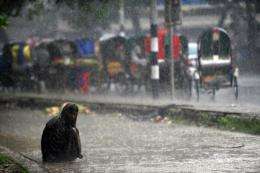
A Bangladeshi homeless man sits on the side of a road during a seasonal rainfall in Dhaka in May 2011. A third of humanity, mostly in Africa and South Asia, face the biggest risks from climate change but rich nations in northern Europe will be least exposed, according to a report released Wednesday.
A third of humanity, mostly in Africa and South Asia, face the biggest risks from climate change but rich nations in northern Europe will be least exposed, according to a report released Wednesday.
Bangladesh, India and the Democratic Republic of Congo (DRC) are among 30 countries with "extreme" exposure to climate shift, according to a ranking of 193 nations by Maplecroft, a British firm specialising in risk analysis.
Five Southeast Asian nations -- Indonesia, Myanmar, Vietnam, the Philippines and Cambodia -- are also in the highest category, partly because of rising seas and increasing severe tropical storms.
Maplecroft's tool, the Climate Change Vulnerability Index (CCVI), looks at exposure to extreme weather events such as drought, cyclones, wildfires and storm surges, which translate into water stress, loss of crops and land lost to the sea.
How vulnerable a society is to these events is also measured, along with a country's potential to adapt to future climate change-related hazards.
Of 30 nations identified in the new report as at "extreme" risk from climate change, two-thirds are in Africa and all are developing countries.
Africa is especially exposed to drought, severe flooding and wildfires, the report says.
"Many countries there are particularly vulnerable to even relatively low exposure to climate events," said Charlie Beldon, co-author of the study.
Weak economies, inadequate healthcare and corrupt governance also leave little margin for absorbing climate impacts.
At the other end of the spectrum, Iceland, Finland, Ireland, Sweden and Estonia top the list of nations deemed to be least at risk.
With the exception of Israel and oil-rich Qatar and Bahrain, the 20 least vulnerable countries are in northern and central Europe.
China and the United States -- the world's No. 1 and No. 2 carbon emitters -- are in the "medium" and "low" risk categories, respectively.
In a parallel analysis of major cities at risk, Maplecroft pointed to Dhaka, Addis Ababa, Manila, Calcutta and the Bangladesh city of Chittagong as being most exposed.
Three other Indian metropolitan areas -- Chennai, Mumbai and New Delhi -- were listed as being at "high" risk.
"Vulnerability to climate change has the potential to undermine future development, particularly in India," Beldon observed.
Recent studies -- reviewed in a special report by the UN's Intergovernmental Panel on Climate Change (IPCC), due out next month -- point to strengthening evidence of links between global warming and extreme weather events.
Record droughts in Australia and Africa, floods in Pakistan and central America, and fires in Russia and the United States may all be fuelled in part by climate change, some experts say.
Current warming trends are on track to boost average global temperatures by 3.0 degrees Celsius (5.4 degrees Fahrenheit) above pre-industrial levels, according to some predictions.
(c) 2011 AFP
-
UN chief calls for urgent action on climate change
Sep 08, 2011 |
not rated yet |
0
-
UN sketches countries with climate risk profile
Jun 11, 2009 |
not rated yet |
0
-
Asia's giants exposed to natural disasters - survey
Aug 11, 2011 |
not rated yet |
0
-
New climate forceasting system to be created
Sep 04, 2009 |
not rated yet |
0
-
Europe faces drought and flood burden: climate scientist
Apr 12, 2011 |
not rated yet |
0
-
Stars containing dark matter should look different from other stars
Feb 20, 2012 |
4.5 / 5 (17) |
11
-
Physicists discover evidence of rare hypernucleus, a component of strange matter
Feb 17, 2012 |
4.7 / 5 (38) |
22
-
Fast photon control brings quantum photonic technologies closer
Feb 13, 2012 |
5 / 5 (8) |
1
-
Engineers build first sub-10-nm carbon nanotube transistor
Feb 01, 2012 |
4.9 / 5 (36) |
32
-
Something old, something new: Evolution and the structural divergence of duplicate genes
Jan 31, 2012 |
4.6 / 5 (7) |
1
-
Is the Earth really going to die
14 hours ago
-
Do some geologists actually act a lot like Randy Marsh?
Feb 11, 2012
-
Discrepancy between oxygen and carbon-dioxide levels
Feb 09, 2012
-
where gems are found in the world
Feb 09, 2012
-
Wind Waves in Reservoir ~ Wind run-up and Wind set-up
Feb 08, 2012
-
Balance of oxygen in the atmosphere
Feb 01, 2012
- More from Physics Forums - Earth
More news stories
Spitzer finds solid buckyballs in space
(PhysOrg.com) -- Astronomers using data from NASA's Spitzer Space Telescope have, for the first time, discovered buckyballs in a solid form in space. Prior to this discovery, the microscopic carbon spheres ...
14 hours ago |
4.7 / 5 (12) |
8
|
Going up: Japan builder eyes space elevator
A Japanese construction firm claimed Wednesday it could execute an out-of-this-world plan to put tourists in space within 40 years by building an elevator that stretches a quarter of the way to the moon.
Space & Earth / Space Exploration
21 hours ago |
3.5 / 5 (13) |
26
ENASA satellite finds Earth's clouds are getting lower
(PhysOrg.com) -- Earth's clouds got a little lower -- about one percent on average -- during the first decade of this century, finds a new NASA-funded university study based on NASA satellite data. The results ...
Space & Earth / Earth Sciences
18 hours ago |
5 / 5 (8) |
13
|
Fresh scandal embroils US climate science debate
A fresh scandal over climate change has erupted in the United States after leaked documents appeared to show a right-wing funded campaign to influence how climate science is taught in schools.
11 hours ago |
4.1 / 5 (9) |
8
World's oceans get an acid bath
Among the repercussions of global climate change, the effect of ocean acidification on marine life is one of the least-understood variables.
18 hours ago |
4.3 / 5 (6) |
4
|
Researchers build first physical 'metatronic' circuit
(PhysOrg.com) -- The technological world of the 21st century owes a tremendous amount to advances in electrical engineering, specifically, the ability to finely control the flow of electrical charges using ...
Faster than light neutrinos? More like faulty wiring
You can shelf your designs for a warp drive engine (for now) and put the DeLorean back in the garage; it turns out neutrinos may not have broken any cosmic speed limits after all.
Physicists surprised by disappearing and reappearing superconductivity in iron selenium chalcogenides
Superconductivity is a rare physical state in which matter is able to conduct electricity -- maintain a flow of electrons -- without any resistance. This phenomenon can only be found in certain materials at low temperatures, ...
Stanford research team cracks animated NuCaptcha
(PhysOrg.com) -- The research team from Stanford University, led by Elie Bursztein, that previously had cracked regular CAPTCHAs and then audio CAPTCHAs, now has also successfully cracked the animated version called NuCapt ...
Flesh-eating bacteria inspire superglue
(PhysOrg.com) -- A bio-inspired superglue has been developed by Oxford University researchers that cant be matched for sticking molecules together and not letting go.
Scientists create potent molecules aimed at treating muscular dystrophy
While RNA is an appealing drug target, small molecules that can actually affect its function have rarely been found. But now scientists from the Florida campus of The Scripps Research Institute have for the first time designed ...
Oct 26, 2011
Rank: 1 / 5 (1)
Ihr seid Euch selbst überlassen.
Oct 26, 2011
Rank: 4.1 / 5 (14)
Oct 26, 2011
Rank: 1.3 / 5 (15)
Oct 26, 2011
Rank: 4.4 / 5 (14)
Oct 26, 2011
Rank: 1.3 / 5 (15)
Oct 26, 2011
Rank: 4.4 / 5 (13)
Oct 26, 2011
Rank: 4.4 / 5 (16)
Oct 26, 2011
Rank: 5 / 5 (4)
Oct 27, 2011
Rank: 5 / 5 (8)
Go on prove that degree then ( i wont hold my breath ), also since when does a degree in computing maths = an expertise in Climatology?
Oct 27, 2011
Rank: 5 / 5 (8)
Oct 27, 2011
Rank: 1.4 / 5 (11)
Don't worry bub, Freeman Dyson doesn't have a Ph.D. but he agrees with you. The polar bears will be fine.
And Dyson is more learned, more intelligent and more educated than anyone who reads, writes or otherwise uses this site. Plus, being the polymath he is; between vetting Feynman and running the Union of Concerned Scientists, Dyson was an actual Climate Scientist.
Oct 27, 2011
Rank: 1.4 / 5 (11)
They claim accuracy of 3 significant figures. Not Possible, not probable, not even likely. This is *one* of Dyson's complaints of Mann, et. al.
Oct 27, 2011
Rank: 4.6 / 5 (10)
Oct 27, 2011
Rank: 4.6 / 5 (10)
http://www.npr.or...olygraph
Maybe Freeman Dyson would support the witch hunt, seeing as the reported observations contradict his prediction?
Oct 27, 2011
Rank: 4.6 / 5 (10)
http://www.cbc.ca...ion.html
Oct 29, 2011
Rank: 1 / 5 (2)
Your high school diploma doesn't hold any weight here.
Oct 29, 2011
Rank: 1 / 5 (2)
I doubt it as he appears to be an honorable man, although somewhat confused due to his very great age.
Oct 29, 2011
Rank: 1 / 5 (2)
When he printed it on his computer it actually said "Fomputing Maffs", initially, but he corrected it on the second try.
He has the printout framed and hanging on his wall just below the picture of him accepting the "Nobels prize of Physimatistics."
Oct 31, 2011
Rank: 1 / 5 (1)
A degree in computing maths makes you a specialist in several scientific disciplines, climatology, ecology, biology ... what more? - Wow!