Electricity from the nose: Engineers make power from human respiration
October 4, 2011 by Jim Beal
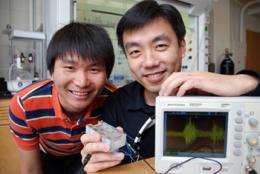
Graduate Student Jian Shi and Materials Science and Engineering Assistant Professor Xudong Wang demonstrate a material that could be used to capture energy from respiration.
(PhysOrg.com) -- The same piezoelectric effect that ignites your gas grill with the push of a button could one day power sensors in your body via the respiration in your nose.
Writing in the September issue of the journal Energy and Environmental Science, Materials Science and Engineering Assistant Professor Xudong Wang, postdoctoral Researcher Chengliang Sun and graduate student Jian Shi report creating a plastic microbelt that vibrates when passed by low-speed airflow such as human respiration.
In certain materials, such as the polyvinylidene fluoride (PVDF) used by Wangs team, an electric charge accumulates in response to applied mechanical stress. This is known as the piezoelectric effect. The researchers engineered PVDF to generate sufficient electrical energy from respiration to operate small electronic devices.
Basically, we are harvesting mechanical energy from biological systems. The airflow of normal human respiration is typically below about two meters per second, says Wang. We calculated that if we could make this material thin enough, small vibrations could produce a microwatt of electrical energy that could be useful for sensors or other devices implanted in the face.
Researchers are taking advantage of advances in nanotechnology and miniaturized electronics to develop a host of biomedical devices that could monitor blood glucose for diabetics or keep a pacemaker battery charged so that it would not need replacing. Whats needed to run these tiny devices is a miniscule power supply. Waste energy in the form or blood flow, motion, heat, or in this case respiration, offers a consistent source of power.
Wangs team used an ion-etching process to carefully thin material while preserving its piezoelectric properties. With improvements, he believes the thickness can be controlled down to the submicron level. Because PVDF is biocompatible, he says the development represents a significant advance toward creating a practical micro-scale device for harvesting energy from respiration.
-
Resistive switches based on piezoelectric nanowires allow electrical signals to be produced from mechanical actions
Jul 26, 2011 |
not rated yet |
0
-
Raiders of the lost amp
Jul 05, 2011 |
not rated yet |
0
-
New material could efficiently power tiny generators
Oct 22, 2009 |
not rated yet |
0
-
Running Hamsters Can Power Nano Devices (Video)
Feb 12, 2009 |
not rated yet |
0
-
Energy harvesting skin generates power from air conditioners
Apr 20, 2011 |
not rated yet |
0
-
Stars containing dark matter should look different from other stars
Feb 20, 2012 |
4.5 / 5 (17) |
11
-
Physicists discover evidence of rare hypernucleus, a component of strange matter
Feb 17, 2012 |
4.7 / 5 (38) |
22
-
Fast photon control brings quantum photonic technologies closer
Feb 13, 2012 |
5 / 5 (8) |
1
-
Engineers build first sub-10-nm carbon nanotube transistor
Feb 01, 2012 |
4.9 / 5 (36) |
32
-
Something old, something new: Evolution and the structural divergence of duplicate genes
Jan 31, 2012 |
4.6 / 5 (7) |
1
-
Calculating forces involved in seesaw motion
4 hours ago
-
Writing shear and moment equations for a simple beam problem?
5 hours ago
-
Furnace Shell Spray Cooling Design
21 hours ago
-
Ways to measure the speed of a golf ball?
Feb 21, 2012
-
Water Skin Effect in Plastic Pipe
Feb 21, 2012
-
Undergraduate Engineering Physics To Graduate Aerospace Engineering
Feb 21, 2012
- More from Physics Forums - General Engineering
More news stories
Stanford research team cracks animated NuCaptcha
(PhysOrg.com) -- The research team from Stanford University, led by Elie Bursztein, that previously had cracked regular CAPTCHAs and then audio CAPTCHAs, now has also successfully cracked the animated version called NuCapt ...
Tiny, implantable medical device can propel itself through bloodstream
Someday, your doctor may turn to you and say, "Take two surgeons and call me in the morning." If that day arrives, you may just have Ada Poon to thank.
18 hours ago |
5 / 5 (9) |
8
|
Italian engineer invents floating solar panels
Rays of the winter sun bounce off gleaming mirrors on the tiny lake of Colignola in Italy, where engineers have built a cost-effective prototype for floating, rotating solar panels.
Technology / Energy & Green Tech
22 hours ago |
4.7 / 5 (6) |
5
Microsoft hits Motorola, Google with EU complaint
Microsoft on Wednesday lodged a formal complaint with the European Union's competition regulator against Motorola Mobility and its soon-to-be owner Google, saying Motorola's aggressive enforcement of patent ...
17 hours ago |
2 / 5 (1) |
2
Calif. pledges better mobile privacy disclosures
(AP) -- Mobile applications seeking to collect personal information will have to forewarn users as part of an agreement reached in California.
10 hours ago |
not rated yet |
0
Researchers build first physical 'metatronic' circuit
(PhysOrg.com) -- The technological world of the 21st century owes a tremendous amount to advances in electrical engineering, specifically, the ability to finely control the flow of electrical charges using ...
Spitzer finds solid buckyballs in space
(PhysOrg.com) -- Astronomers using data from NASA's Spitzer Space Telescope have, for the first time, discovered buckyballs in a solid form in space. Prior to this discovery, the microscopic carbon spheres ...
Faster than light neutrinos? More like faulty wiring
You can shelf your designs for a warp drive engine (for now) and put the DeLorean back in the garage; it turns out neutrinos may not have broken any cosmic speed limits after all.
Physicists surprised by disappearing and reappearing superconductivity in iron selenium chalcogenides
Superconductivity is a rare physical state in which matter is able to conduct electricity -- maintain a flow of electrons -- without any resistance. This phenomenon can only be found in certain materials at low temperatures, ...
Going up: Japan builder eyes space elevator
A Japanese construction firm claimed Wednesday it could execute an out-of-this-world plan to put tourists in space within 40 years by building an elevator that stretches a quarter of the way to the moon.
Flesh-eating bacteria inspire superglue
(PhysOrg.com) -- A bio-inspired superglue has been developed by Oxford University researchers that cant be matched for sticking molecules together and not letting go.
Oct 04, 2011
Rank: not rated yet
Oct 04, 2011
Rank: not rated yet
Oh wait - sniff - anyone got a tissue?
:-)
Oct 04, 2011
Rank: 4.5 / 5 (2)
Oct 05, 2011
Rank: not rated yet
Oct 09, 2011
Rank: not rated yet
Oct 11, 2011
Rank: not rated yet
Why not use the latest energy harvesting ICs and appropriate transducer(s) and stick the integrated pkg up the other body orifices (particularly the one at the lower end --Who knows, it may even prevent certain disease and possibly become a candidate for the next revised Nobel.)
This is not even high school worthy. If we truly consider this news worthy / Engineering innovation we are truly lost.
It seems, above all else, we seem to be in a race to get anything and everything that we sneeze up at the dinner table to the patent office. (I wonder if they are looking for any other orifices?)
On the other hand it may become the in-thing/latest fashion-trend, to power up those smart phones, just breath a little faster ..oh..oh you're almost there.
(At last we have a means to outdo the iPhone).
Just my rantings: I hope no one is offended - ABOVE ALL, please keep in mind this ONLY the opinion of one truly disappointed individual.