High-purity hydrogen generated from a single device
October 7, 2011 by Lisa Zyga feature
High-purity hydrogen generated from a single device

Enlarge

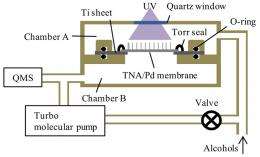
An illustration of the TNA/Pd membrane reactor. Image credit: Hattori, et al. ©2011 American Institute of Physics

(PhysOrg.com) -- There are many ways to generate hydrogen, such as water electrolysis and steam reforming of gas, but the hydrogen produced by these methods tends to be combined with other byproduct and residual gases. For this reason, a second step to purify the hydrogen is usually required after it is produced. Now in a new study, scientists have developed a method for generating hydrogen with a purity of more than 99% within a single membrane, eliminating the need for a separate purification step.

The researchers, Masashi Hattori, Kei Noda, and Kazumi Matsushige, from Kyoto University in Kyoto, Japan, have published their study on the integration of and purification in a recent issue of Applied Physics Letters.

Their method generates hydrogen by shining ultraviolet (UV) light onto a membrane just a few tens of micrometers thick. The membrane is made of two layers: a nanotube array (TNA), which serves as the to generate the hydrogen, and a palladium (Pd) thin film, which serves as the hydrogen purification part.

The membrane forms the basis of a reactor that also includes a UV light and two chambers, one above and one below the membrane. The researchers pumped a fuel, such as or ethanol, into the upper chamber and then turned on the . The light caused a photocatalytic reaction, turning the fuel into carbon dioxide (CO2), formaldehyde (CH2O), and hydrogen (H2) in the upper chamber. In the lower chamber, after passing through the membrane, the researchers measured the purity of the generated H2 to be 99-100% when using either methanol or . Although the scientists did detect some small amounts of CO2 and CH2O in the lower chamber, they concluded that these were not from the but that they were already present as background gases.

“The purification of the produced hydrogen gas was done with the Pd layer,” Noda told PhysOrg.com. “Only hydrogen can pass through the Pd layer and appear in the lower chamber. Other gases still exist inside the upper chamber.”

By integrating the hydrogen generation and purification processes within a single membrane, the researchers hope that the new device will overcome some of the problems faced by previous approaches. For instance, the small membrane reactor, which operates at room temperature, could lead to the miniaturization and low-energy operation of fuel cells, which could have applications for mobile and on-site hydrogen reforming systems. However, the researchers still have a lot of work to do before the device is ready for these applications.

"The performance of the TNA/Pd membrane we reported here is not satisfactory yet," Noda said. “For example, the amount of produced hydrogen with the membrane is quite low at present. The replacement of Pd with Pd alloys with another metal is also necessary to suppress hydrogen embrittlement. In terms of production cost, the thickness of hydrogen permeable metals should be reduced. But, we will make a lot of effort to improve the performance of this new membrane toward practical applications.”

More information: Masashi Hattori, et al. “High-purity hydrogen generation by ultraviolet illumination with the membrane composed of titanium dioxide nanotube array and Pd layer.” Applied Physics Letters 99, 123107 (2011) DOI:10.1063/1.3643052

Copyright 2011 PhysOrg.com.
All rights reserved. This material may not be published, broadcast, rewritten or redistributed in whole or part without the express written permission of PhysOrg.com.

4.5 /5 (15 votes)  

Filter


Move the slider to adjust rank threshold, so that you can hide some of the comments.


Display comments: newest first

kevinrtrs
Oct 07, 2011

Rank: 2 / 5 (3)
Now, what to do with that left-over formaldehyde???? They don't say.
rawa1
Oct 07, 2011

Rank: 1.6 / 5 (7)
Formaldehyde can be removed chemically, for example by its reaction with amines or amides. But I don't believe, this process is economically viable anyway with respect to high price of palladium in particular. IMO the only reason of hydrogen economy is to make energy from renewable sources transportable at sufficient energy density. The cold fusion produces energy at sufficient energy density (actually nearly ideal for common use) and it will remove the need of hydrogen transportation anyway. BTW The hidden environmental risks of hydrogen economy is, it can destroy ozone layer with reduction of ozone at high altitude. We don't need to bother with such research at all (one gram of hydrogen/nickel catalyst stores the energy of half ton of oil).

Actually, the cold fusion could produce enough of energy to reverse whole carbon dioxide cycle - so it could be possible to produce artificial hydrocarbons for plastic industry with hydrogenation of carbon dioxide from air.
Pkunk_
Oct 07, 2011

Rank: 4.2 / 5 (5)

Actually, the cold fusion could produce enough of energy to reverse whole carbon dioxide cycle - so it could be possible to produce artificial hydrocarbons for plastic industry with hydrogenation of carbon dioxide from air.


I'm pretty sure you would be welcomed with open arms by other great cold fusion scientists like Ahmedinejad , Hugo Chavez and Fidel Castro. They too believe the Capitalists have been hiding this great secret of Cold Fusion from the world for far too long.
TheGhostofOtto1923
Oct 07, 2011

Rank: 5 / 5 (2)
Here is an update on the amazing Energy Catalyzer shipping container. As you can see it is a nice shade of blue and has 2 doors. It produces some kw or mw and was shipped to somewheres in the US. Apparently.
http://energycata...o-public
Jeddy_Mctedder
Oct 07, 2011

Rank: 5 / 5 (2)
pure hydrogen finally. put this on a balloon and finally break the godamn record for keeping a balloon aloft .

shockingly people are still stuck on helium.
guess what-all lift gasses escape their envelope slowly. hydrogen is the only renewable lift gas, you can suck h20 out of the air by condensating it, and then get all the free hydrogen you need to replenish your lift gas stocks.
Wolf358
Oct 07, 2011

Rank: not rated yet
Over time, wouldn't the device get plugged-up with deuterium?
jimbo92107
Oct 07, 2011

Rank: 5 / 5 (7)
pure hydrogen finally. put this on a balloon and finally break the godamn record for keeping a balloon aloft.


Why not replenish your hydrogen supply constantly by placing one of these membranes (sans the palladium) on the top of your lifting body? The small amount of impurities wouldn't matter as far as lifting capacity. You could even burn the excess hydrogen in a simple engine to drive a prop, then drink the exhaust.
eachus
Oct 07, 2011

Rank: not rated yet
I just realized that skeptics wrt LENR (aka cold fusion), are making a classic category error. Huh? Ask those same people for their opinion on dark matter, and you will get lots of answers--you can even get long-winded explanations (I'm guilty too on the long part...) of why interactions between the dark matter that is present in the area of the solar system is not detected through interactions with normal matter.

Now suppose someone comes up with a combination of a dark matter candidate and method for detecting it. No need to suppose, some such experiments are getting millions in funding. But do those same physicists spend even 5 seconds considering that LENR could be due to dark matter?

To put up a straw man, if deuterium interacts (through the weak force) with a WIMP, the reaction 2 d --> He4 gamma becomes d (d X) --> He4 X energy. The momentum of the He4 (alpha) particle can be used to calculate the mass of the WIMP.

Now go do the experiment!
SemiNerd
Oct 07, 2011

Rank: 5 / 5 (1)
Over time, wouldn't the device get plugged-up with deuterium?

Given the price of heavy water, if that were so D2 (or DH) would entirely justify the use of these as panels even if the rest of the H2 were just released.

Sadly, I expect that not to be the case.
Callippo
Oct 07, 2011

Rank: 1 / 5 (2)
other great cold fusion scientists like Ahmedinejad , Hugo Chavez
I'm not sure, if the replacement of oil will be welcomed just with these guys. But I can see, many conservatives see the risk of cold fusion in the return of communism. Such people apparently don't care, if the world becomes poor, until they could remain rich in it.
Sean_W
Oct 07, 2011

Rank: not rated yet
Less expensive pure hydrogen would no doubt be good news for the chemical industry and make many chemical processes and engineering possibilities more practical.
yoatmon
Oct 09, 2011

Rank: not rated yet
I'm all else but enthusiastic about using gases or fossil fuels for the production of hydrogen. Several methods with relatively high efficiency have been proposed just using water (even waste waters) on a photosynthesis similar process.
I have a faint suspicion that someone seems to be worried about boycotting or detouring the oil industry.
hudres
Oct 09, 2011

Rank: not rated yet
Congratulations! PhysOrg has once again reported something as news that is over 50 years old The purification of hydrogen using palladium has been a staple of electron tube manufacture since the second world war. The original hydrogen thyratron electron tube (Google it if you don't know what I am talking about) manufacturing process used palladium to introduce pure hydrogen into the tube during manufacture. In the current world you can buy hydrogen purifiers using palladium from scientific laboratory equipment suppliers.

Have you guys ever heard of fact checking? Try Googling a topic before you print it as news. And, for the record, it is a low efficiency process and it is doubtful that the presence of any membrane will improve it.

BTW: If you don't know what and electron tube is, Google that too.
tadchem
Oct 11, 2011

Rank: not rated yet
Hydrogen can easily permeate the palladium layer. The molecules dissociate and mass individually through the palladium lattice - something no other element can to as their atoms are too large. Titanium metal has the same property. I would think a TiO2/Ti layer would work as well.
kaasinees
Oct 11, 2011

Rank: 1 / 5 (2)
high-purity hydrogen????
Is non-pure hydrogen contaminated with rogue quarks ? Hmm maybe it wouldn't be hydrogen anymore.

Ahhh the physorg logic... makes so much sense.
yoatmon
Oct 12, 2011

Rank: not rated yet
The only material that I know of that can contain hydrogen and not allow it to escape is graphene. The lattice between the carbon atoms is so small that hydrogen atoms cannot permeate it.
that_guy
Oct 13, 2011

Rank: not rated yet
I'm all else but enthusiastic about using gases or fossil fuels for the production of hydrogen. Several methods with relatively high efficiency have been proposed just using water (even waste waters) on a photosynthesis similar process.
I have a faint suspicion that someone seems to be worried about boycotting or detouring the oil industry.

Yeah, I'm pretty sure the breakthrough here is the purity of the Hy, and the price for that purity.

Obviously, this process is not meant to replace traditional fuel, since you're taking something that is already a fuel, and then using energy to turn it into a less practical fuel that has slightly less energy.
Rank 4.5 /5 (15 votes)
Relevant PhysicsForums posts

More news stories

Researchers build first physical 'metatronic' circuit

(PhysOrg.com) -- The technological world of the 21st century owes a tremendous amount to advances in electrical engineering, specifically, the ability to finely control the flow of electrical charges using ...

Physics / General Physics

created 10 hours ago | popularity 4.7 / 5 (17) | comments 5 | with audio podcast

Faster than light neutrinos? More like faulty wiring

You can shelf your designs for a warp drive engine (for now) and put the DeLorean back in the garage; it turns out neutrinos may not have broken any cosmic speed limits after all.

Physics / General Physics

created 9 hours ago | popularity 4.2 / 5 (22) | comments 23 | with audio podcast

Physicists surprised by disappearing and reappearing superconductivity in iron selenium chalcogenides

Superconductivity is a rare physical state in which matter is able to conduct electricity -- maintain a flow of electrons -- without any resistance. This phenomenon can only be found in certain materials at low temperatures, ...

Physics / Superconductivity

created 13 hours ago | popularity 5 / 5 (5) | comments 2 | with audio podcast

Less is more: Study of tiny droplets could have big impact on industrial applications

(PhysOrg.com) -- Under a microscope, a tiny droplet slides between two fine hairs like a roller coaster on a set of rails until — poof — it suddenly spreads along them, a droplet no more.

Physics / General Physics

created 10 hours ago | popularity 3.7 / 5 (3) | comments 0 | with audio podcast

Study reveals switching mechanism in promising computer memory device

(PhysOrg.com) -- Sometimes knowing that a new technology works is not enough. You also must know why it works to get marketplace acceptance. New information from the National Institute of Standards and Technology ...

Physics / General Physics

created 17 hours ago | popularity 4 / 5 (4) | comments 0 | with audio podcast


Spitzer finds solid buckyballs in space

(PhysOrg.com) -- Astronomers using data from NASA's Spitzer Space Telescope have, for the first time, discovered buckyballs in a solid form in space. Prior to this discovery, the microscopic carbon spheres ...

Stanford research team cracks animated NuCaptcha

(PhysOrg.com) -- The research team from Stanford University, led by Elie Bursztein, that previously had cracked regular CAPTCHAs and then audio CAPTCHAs, now has also successfully cracked the animated version called NuCapt ...

CT colonography shown to be comparable to standard colonoscopy

Computerized tomographic (CT) colonography (CTC), also known as virtual colonoscopy, is comparable to standard colonoscopy in its ability to accurately detect cancer and precancerous polyps in people ages 65 and older, according ...

Going up: Japan builder eyes space elevator

A Japanese construction firm claimed Wednesday it could execute an out-of-this-world plan to put tourists in space within 40 years by building an elevator that stretches a quarter of the way to the moon.

Scientists create potent molecules aimed at treating muscular dystrophy

While RNA is an appealing drug target, small molecules that can actually affect its function have rarely been found. But now scientists from the Florida campus of The Scripps Research Institute have for the first time designed ...

Flesh-eating bacteria inspire superglue

(PhysOrg.com) -- A bio-inspired superglue has been developed by Oxford University researchers that can’t be matched for sticking molecules together and not letting go.