Physicists unveil a theory for a new kind of superconductivity
October 24, 2011
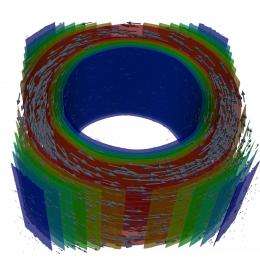
The superfow of two kinds of superconducting electrons (arrows show their velocities) as calculated on supercomputers. Graphic 2 shows superflow of the other subpopulation of electrons on the surface of a vortex cluster. Graphics courtesy of Egor Babaev.
(PhysOrg.com) -- In this 100th anniversary year of the discovery of superconductivity, physicists at the University of Massachusetts Amherst and Swedens Royal Institute of Technology have published a fully self-consistent theory of the new kind of superconducting behavior, Type 1.5, this month in the journal Physical Review B.
In three recent papers, the authors report on their detailed investigations to show that a Type 1.5 superconducting state is indeed possible in a class of materials called multiband superconductors.
For years, most physicists believed that superconductors must be either Type I or Type II. Type 1.5 superconductivity is the subject of intense debate because until now there was no theory to connect the physics with micro-scale properties of real materials, say Egor Babaev of UMass Amherst, currently a fellow at the technology institute in Stockholm, with Mikhail Silaev, a postdoctoral researcher there.
Their new papers now provide a theoretical framework to allow scientists to calculate conditions necessary for the appearance of Type 1.5 superconductivity, which exhibits characteristics of Types I and II previously thought to be antagonistic.
Superconductivity is a state where electric charge flows without resistance. In Type I and Type II, charge flow patterns are dramatically different. Type I, discovered in 1911, has two state-defining properties: Lack of electric resistance and the fact that it does not allow an external magnetic field to pass through it. When a magnetic field is applied to these materials, superconducting electrons produce a strong current on the surface which in turn produces a magnetic field in the opposite direction. Inside this type of superconductor, the external magnetic field and the field created by the surface flow of electrons add up to zero. That is, they cancel each other out.
Type II superconductivity was predicted to exist by a Russian theoretical physicist who said there should be superconducting materials where a complicated flow of superconducting electrons can happen deep in the interior. In Type II material, a magnetic field can gradually penetrate, carried by vortices like tiny electronic tornadoes, Babaev explains. The combined works that theoretically described Type I and II superconductivity won the Nobel Prize in 2003.
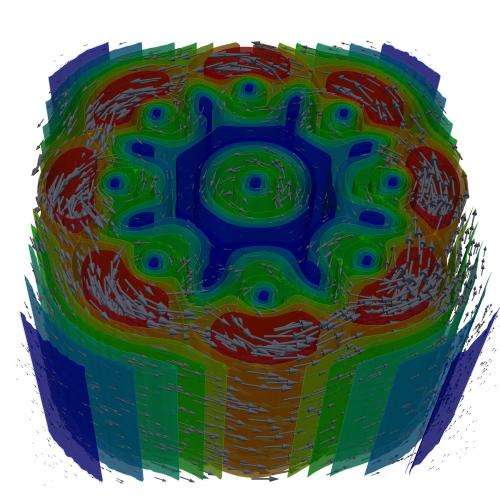
The superfow of two kinds of superconducting electrons (arrows show their velocities) as calculated on supercomputers. Graphic 1 shows the first kind of supercurrent forming vortices. Graphics courtesy of Egor Babaev
Classifying superconductors in this way turned out to be very robust: All superconducting materials discovered in the last half-century can be classified as either, Babaev says. But he believed a state must exist that does not fall into either camp: Type 1.5. By working out the theoretical bases for superconducting materials, he had predicted that in some materials, superconducting electrons could be classed as two competing types or subpopulations, one behaving like electrons in Type I material, the other behaving like electrons in a Type II material.Babaev also said that Type 1.5 superconductors should form something like a super-regular Swiss cheese, with clusters of tightly packed vortex droplets of two kinds of electron: one type bunched together and a second type flowing on the surface of vortex clusters in a way similar to how electrons flow on the exterior of Type I superconductors. These vortex clusters are separated by "voids," with no vortices, no currents and no magnetic field.
The major objection raised by skeptics, he recalls, is that fundamentally there is only one kind of electron, so its difficult to accept that two types of superconducting electron populations could exist with such dramatically different behaviors.
To answer this, Silaev and Babaev developed their theory to explain how real materials can give raise to Type-1.5 superconductivity, taking into account interactions at microscales. In a parallel effort, their colleagues at UMass Amherst and in Sweden including Johan Carlstrom and Julien Garaud, with Babaev, used supercomputers to perform large-scale numerical calculations modeling the behavior of superconducting electrons to better understand the structure of vortex clusters and what they look like in a Type-1.5 superconductor.
They found that under certain conditions they could describe new, additional forces at work between the Type-1.5 vortices, which can give vortex clusters very complicated structure. As more work is done on superconductivity, the team of physicists in Stockholm and at UMass Amherst say the family of multi-band superconducting materials will grow. They expect that some of the newly discovered materials will belong in Type 1.5.
"With the development of theory that works on the microscopic level, as well as our better understanding of inter-vortex interaction, we can now connect the properties of vortex clusters with the properties of electronic structure of concrete materials. This can be useful in establishing whether materials belong in the Type 1.5 superconductivity domain," says Babaev.
More information: http://prb.aps.org … /i13/e134515
http://prb.aps.org … 4/i9/e094515
http://prb.aps.org … /i13/e134518
Provided by University of Massachusetts Amherst (news : web)
-
Superconductivity: The puzzle is taking shape
Sep 13, 2011 |
not rated yet |
0
-
New research sheds light on shimmering superconductivity and the courtship of electrons
Oct 04, 2007 |
not rated yet |
0
-
Light touch transforms material into a superconductor
Jan 14, 2011 |
not rated yet |
0
-
Superconductivity's third side unmasked
Jun 17, 2011 |
not rated yet |
0
-
Brown physicist discovers odd, fluctuating magnetic waves
Feb 23, 2010 |
not rated yet |
0
-
Stars containing dark matter should look different from other stars
Feb 20, 2012 |
4.5 / 5 (17) |
11
-
Physicists discover evidence of rare hypernucleus, a component of strange matter
Feb 17, 2012 |
4.7 / 5 (38) |
22
-
Fast photon control brings quantum photonic technologies closer
Feb 13, 2012 |
5 / 5 (8) |
1
-
Engineers build first sub-10-nm carbon nanotube transistor
Feb 01, 2012 |
4.9 / 5 (36) |
32
-
Something old, something new: Evolution and the structural divergence of duplicate genes
Jan 31, 2012 |
4.6 / 5 (7) |
1
-
linear wave equation vs. linear system
1 hour ago
-
adhesive force and surface tension
1 hour ago
-
Newbie here.
3 hours ago
-
Rainbows in space?
3 hours ago
-
taking mechanical physics next fall
5 hours ago
-
Help: maximum force of an object when given impulse and time on a graph
8 hours ago
- More from Physics Forums - General Physics
More news stories
Researchers build first physical 'metatronic' circuit
(PhysOrg.com) -- The technological world of the 21st century owes a tremendous amount to advances in electrical engineering, specifically, the ability to finely control the flow of electrical charges using ...
10 hours ago |
4.7 / 5 (17) |
5
|
Faster than light neutrinos? More like faulty wiring
You can shelf your designs for a warp drive engine (for now) and put the DeLorean back in the garage; it turns out neutrinos may not have broken any cosmic speed limits after all.
9 hours ago |
4.2 / 5 (22) |
23
|
Physicists surprised by disappearing and reappearing superconductivity in iron selenium chalcogenides
Superconductivity is a rare physical state in which matter is able to conduct electricity -- maintain a flow of electrons -- without any resistance. This phenomenon can only be found in certain materials at low temperatures, ...
13 hours ago |
5 / 5 (5) |
2
|
Less is more: Study of tiny droplets could have big impact on industrial applications
(PhysOrg.com) -- Under a microscope, a tiny droplet slides between two fine hairs like a roller coaster on a set of rails until poof it suddenly spreads along them, a droplet no more.
10 hours ago |
3.7 / 5 (3) |
0
|
Study reveals switching mechanism in promising computer memory device
(PhysOrg.com) -- Sometimes knowing that a new technology works is not enough. You also must know why it works to get marketplace acceptance. New information from the National Institute of Standards and Technology ...
17 hours ago |
4 / 5 (4) |
0
|
Spitzer finds solid buckyballs in space
(PhysOrg.com) -- Astronomers using data from NASA's Spitzer Space Telescope have, for the first time, discovered buckyballs in a solid form in space. Prior to this discovery, the microscopic carbon spheres ...
Stanford research team cracks animated NuCaptcha
(PhysOrg.com) -- The research team from Stanford University, led by Elie Bursztein, that previously had cracked regular CAPTCHAs and then audio CAPTCHAs, now has also successfully cracked the animated version called NuCapt ...
CT colonography shown to be comparable to standard colonoscopy
Computerized tomographic (CT) colonography (CTC), also known as virtual colonoscopy, is comparable to standard colonoscopy in its ability to accurately detect cancer and precancerous polyps in people ages 65 and older, according ...
Going up: Japan builder eyes space elevator
A Japanese construction firm claimed Wednesday it could execute an out-of-this-world plan to put tourists in space within 40 years by building an elevator that stretches a quarter of the way to the moon.
Scientists create potent molecules aimed at treating muscular dystrophy
While RNA is an appealing drug target, small molecules that can actually affect its function have rarely been found. But now scientists from the Florida campus of The Scripps Research Institute have for the first time designed ...
Flesh-eating bacteria inspire superglue
(PhysOrg.com) -- A bio-inspired superglue has been developed by Oxford University researchers that cant be matched for sticking molecules together and not letting go.

Oct 24, 2011
Rank: 1.2 / 5 (9)
In Type I SCs the magnetic vortices are single atom wide and they're always repulsive, in Type II SCs the magnetic vortices are attractive. The Type 1.5 SC is mixed state, so that the magnetic vortices are attractive at long distances, repulsive at short ones.
Oct 24, 2011
Rank: 1.7 / 5 (9)
Oct 24, 2011
Rank: 3 / 5 (6)
Oct 24, 2011
Rank: 3.7 / 5 (9)
Superfow = the process of carefully editing scientific articles for correct spelling, punctuation and grammar.
Oct 24, 2011
Rank: 2.6 / 5 (5)
Supercomputers calculate that the superflow in superconductors is superfly.
Oct 24, 2011
Rank: 2.5 / 5 (6)
Not hardly.
It's a new application of superconductivity we were ignorant of knowing, until now.
Oct 26, 2011
Rank: 3.7 / 5 (3)
New to us, Horus. I bet you're fun at parties.