Stretchable graphene transistors overcome limitations of other materials
October 26, 2011 by Lisa Zyga
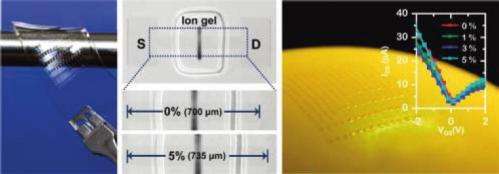
(Left) Graphene-based transistor patterned on a PDMS substrate. (Center) Microscope images of the transistor undergoing stretching up to 5%. (Right) The transistor patterned on a balloon. Image credit: Lee, et al. ©2011 American Chemical Society
(PhysOrg.com) -- When it comes to fabricating stretchable, transparent electronics, finding a material to make transistors from has been a significant challenge for researchers. They've explored a variety of conventional semiconductor materials, including molecules, polymers, and metals, but these materials tend to have intrinsically poor optical and mechanical properties. These drawbacks make it difficult to realize a transistor that can maintain its optical and electrical performance under a high strain. In a new study, researchers have fabricated a stretchable, transparent graphene-based transistor and found that, due to graphenes excellent optical, mechanical, and electrical properties, the transistor overcomes some of the problems faced by transistors made of conventional semiconductor materials.
The researchers, led by Jeong Ho Cho from Soongsil University in Seoul, South Korea, and Jong-Hyun Ahn from Sungkyunkwan University in Suwon, South Korea, have published their study in a recent issue of Nano Letters.
Our work includes important results compared with stretchable and transparent devices reported in the previous literature, Ahn told PhysOrg.com. In fact, it is nearly impossible to fabricate transistors that offer both mechanical stretchability and high optical transparency on unusual substrates such as rubber slabs or balloons by using conventional materials. In particular, graphene devices have the advantage that they can be integrated using printing processes at room temperature without vacuum or high-temperature steps. The capabilities of these systems go far beyond conventional material-based systems.
To fabricate the transistor, the researchers synthesized single layers of graphene and then stacked them layer by layer on copper foil. Using photolithography and etching techniques, the researchers patterned some of the transistors essential elements, including the electrodes and semiconducting channel, onto the graphene. After transferring these components onto a stretchable rubber substrate, the researchers printed the remaining components gate insulators and gate electrodes onto the device using stretchable ion gel.
The researchers found that the graphene-based transistors on rubber substrates had several attractive features. For instance, the low-temperature printing processes made the fabrication technique much simpler than techniques that require high-temperature processes. Also, transistors made of conventional inorganic semiconducting materials cannot be fabricated on rubber substrates due to their poor mechanical properties, which limits their stretchable range.
The researchers experimental results confirmed the graphene transistors good performance. They showed that the devices could be stretched up to 5% for 1,000 times and still maintain their good electrical properties. In one experiment, the researchers fabricated the graphene transistors on a rubber balloon and measured its electrical properties as they inflated the balloon. When stretched more than 5%, the electrical properties began to degrade, due partly to microcracks and other defects in the graphene films.
We will make an effort to improve the range of stretchability and the electronic properties of the current graphene devices and apply them to various wearable electronics and sensory skins, Ahn said.
The researchers predict that the graphene transistors could serve as a valuable component in future transparent and stretchable electronic applications, offering a performance that would be difficult to achieve using conventional electronic materials. Applications could include rollable displays, conformal biosensors that shape themselves on an underlying surface, and others.
Stretchable electronics could be useful for various current and future applications, such as wearable displays and communication devices, conformal and stretchable biosensors (brain sensors, balloon catheters, etc.), sensory skin for robotics, and structural health monitors and eye-ball cameras, Ahn said. Stretchable interconnects and devices would create foldable, rollable and wearable displays. Stretchable sensors could be embedded into gloves and clothing without bulkiness. Surgeon gloves could constantly monitor blood pH and other chemical levels.
More information: Seoung-Ki Lee, et al. Stretchable Graphene Transistors with Printed Dielectrics and Gate Electrodes. Nano Letters ASAP, DOI:10.1021/nl202134z
Copyright 2011 PhysOrg.com.
All rights reserved. This material may not be published, broadcast, rewritten or redistributed in whole or part without the express written permission of PhysOrg.com.
-
Engineers create polymer light-emitting devices that can be stretched like rubber
Aug 05, 2011 |
not rated yet |
0
-
IBM introduces new graphene transistor
Apr 11, 2011 |
not rated yet |
0
-
Toward a better understanding of bilayer graphene
Oct 26, 2010 |
not rated yet |
0
-
Team reports scalable fabrication of self-aligned graphene transistors, circuits
Jun 17, 2011 |
not rated yet |
0
-
Engineers achieve world record with high-speed graphene transistors
Sep 03, 2010 |
not rated yet |
0
-
Stars containing dark matter should look different from other stars
Feb 20, 2012 |
4.5 / 5 (17) |
11
-
Physicists discover evidence of rare hypernucleus, a component of strange matter
Feb 17, 2012 |
4.7 / 5 (38) |
22
-
Fast photon control brings quantum photonic technologies closer
Feb 13, 2012 |
5 / 5 (8) |
1
-
Engineers build first sub-10-nm carbon nanotube transistor
Feb 01, 2012 |
4.9 / 5 (36) |
32
-
Something old, something new: Evolution and the structural divergence of duplicate genes
Jan 31, 2012 |
4.6 / 5 (7) |
1
-
linear wave equation vs. linear system
1 hour ago
-
adhesive force and surface tension
1 hour ago
-
Newbie here.
3 hours ago
-
Rainbows in space?
4 hours ago
-
taking mechanical physics next fall
5 hours ago
-
Help: maximum force of an object when given impulse and time on a graph
8 hours ago
- More from Physics Forums - General Physics
More news stories
New nanotechnology converts heat into power when it's needed most
Never get stranded with a dead cell phone again. A promising new technology called Power Felt, a thermoelectric device that converts body heat into an electrical current, soon could create enough juice to make another call ...
17 hours ago |
4 / 5 (8) |
6
|
New technique produces free-standing piezoelectric ferroelectric nanostructures from PZT material
(PhysOrg.com) -- Researchers have developed a soft template infiltration technique for fabricating free-standing piezoelectrically active ferroelectric nanotubes and other nanostructures from PZT ...
18 hours ago |
5 / 5 (5) |
4
|
Graphene is thinnest known anti-corrosion coating
New research has established the "miracle material" called graphene as the world's thinnest known coating for protecting metals against corrosion. Their study on this potential new use of graphene appears ...
Nanotechnology / Nanomaterials
14 hours ago |
4.6 / 5 (7) |
2
|
Researchers discover how different nanomaterial surfaces affect proteins
A new study led by nanotechnology and biotechnology experts at Rensselaer Polytechnic Institute is providing important details on how proteins in our bodies interact with nanomaterials. In their new study, published in the ...
Nanotechnology / Bio & Medicine
11 hours ago |
5 / 5 (2) |
1
|
A new twist on nanowires
Nanowires — microscopic fibers that can be “grown” in the lab — are a hot research topic today, with a variety of potential applications including light-emitting diodes (LEDs) and sensors. ...
20 hours ago |
4.8 / 5 (4) |
0
|
Researchers build first physical 'metatronic' circuit
(PhysOrg.com) -- The technological world of the 21st century owes a tremendous amount to advances in electrical engineering, specifically, the ability to finely control the flow of electrical charges using ...
Spitzer finds solid buckyballs in space
(PhysOrg.com) -- Astronomers using data from NASA's Spitzer Space Telescope have, for the first time, discovered buckyballs in a solid form in space. Prior to this discovery, the microscopic carbon spheres ...
Faster than light neutrinos? More like faulty wiring
You can shelf your designs for a warp drive engine (for now) and put the DeLorean back in the garage; it turns out neutrinos may not have broken any cosmic speed limits after all.
Physicists surprised by disappearing and reappearing superconductivity in iron selenium chalcogenides
Superconductivity is a rare physical state in which matter is able to conduct electricity -- maintain a flow of electrons -- without any resistance. This phenomenon can only be found in certain materials at low temperatures, ...
Stanford research team cracks animated NuCaptcha
(PhysOrg.com) -- The research team from Stanford University, led by Elie Bursztein, that previously had cracked regular CAPTCHAs and then audio CAPTCHAs, now has also successfully cracked the animated version called NuCapt ...
Going up: Japan builder eyes space elevator
A Japanese construction firm claimed Wednesday it could execute an out-of-this-world plan to put tourists in space within 40 years by building an elevator that stretches a quarter of the way to the moon.
Oct 26, 2011
Rank: 5 / 5 (1)
*waits for thrown tomatoes and hoots of derision*
Oct 26, 2011
Rank: 5 / 5 (1)
Indeed: your comment gives me an idea: Lay them out like muscle cells! Our muscles use a sliding mechanism for contraction and expansion to provide us with an exceptional degree of flexibility AND when damaged, they can be regrown without flushing the whole complex. Imagine, electronic structures that can be 'upgraded' or repaired in situ. They could just reuse the application process that made the structure in the first place. Just an inspired thought.
word-
Oct 26, 2011
Rank: not rated yet
THAT is inspired thinking.
Isaacs - no tomatoes or hoots. If I had it, I'd throw money. Great capitalization of your nueronal gifts.
Oct 26, 2011
Rank: 5 / 5 (1)
Imagine a robot with graphene muscles.
Nov 03, 2011
Rank: not rated yet
A... terminator? :)