New view of Vesta mountain from Dawn mission
October 11, 2011
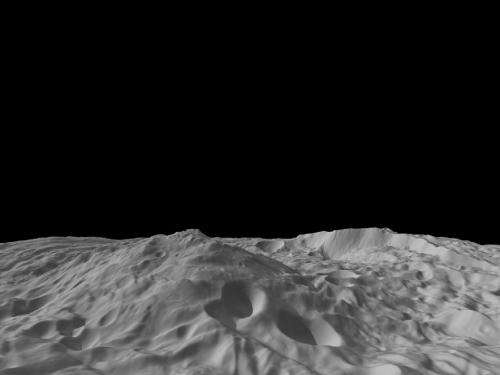
This image of the asteroid Vesta, calculated from a shape model, shows a tilted view of the topography of the south polar region.
(PhysOrg.com) -- A new image from NASA's Dawn spacecraft shows a mountain three times as high as Mt. Everest, amidst the topography in the south polar region of the giant asteroid Vesta.
The peak of Vesta's south pole mountain, seen in the center of the image, rises about 13 miles (22 kilometers) above the average height of the surrounding terrain. Another impressive structure is a large scarp, a cliff with a steep slope, on the right side of this image. The scarp bounds part of the south polar depression, and the Dawn team's scientists believe features around its base are probably the result of landslides.
The image was created from a shape model of Vesta, and shows an oblique perspective view of the topography of the south polar region. The image resolution is about 300 meters per pixel, and the vertical scale is 1.5 times that of the horizontal scale.
Dawn entered orbit around Vesta in July. Members of the mission team will discuss what the spacecraft has seen so far during a news conference at the Annual Meeting of the Geological Society of America in Minneapolis. Among other things, they'll share their hypotheses on the origins of Vesta's curious craters.
More information: The meeting, at the Minneapolis Convention Center, runs from Oct. 9 to 12, with the Dawn news conference scheduled for Wednesday, Oct. 12, at 10 a.m. PDT (noon CDT). The event will air live on the Geological Society of America webcast page at:
http://hosted.medi … 29129e3b7c1d
-
NASA's Dawn collects a bounty of beauty from Vesta
Sep 16, 2011 |
not rated yet |
0
-
NASA's Dawn spacecraft beams back new photo
Jul 22, 2011 |
not rated yet |
0
-
Dawn spacecraft captures video of asteroid approach (w/ video)
Jun 13, 2011 |
not rated yet |
0
-
Dawn beams back asteroid science data
Aug 12, 2011 |
not rated yet |
0
-
Dawn captures first image of nearing asteroid
May 11, 2011 |
not rated yet |
0
-
Stars containing dark matter should look different from other stars
Feb 20, 2012 |
4.5 / 5 (17) |
11
-
Physicists discover evidence of rare hypernucleus, a component of strange matter
Feb 17, 2012 |
4.7 / 5 (38) |
22
-
Fast photon control brings quantum photonic technologies closer
Feb 13, 2012 |
5 / 5 (8) |
1
-
Engineers build first sub-10-nm carbon nanotube transistor
Feb 01, 2012 |
4.9 / 5 (36) |
32
-
Something old, something new: Evolution and the structural divergence of duplicate genes
Jan 31, 2012 |
4.6 / 5 (7) |
1
-
Calculating the magnitude
2 hours ago
-
What is this spectrum I took?
12 hours ago
-
Orientation of Space
12 hours ago
-
Geologically Active Moon Now: NASA
19 hours ago
-
advice on building a science fair telescope
Feb 22, 2012
-
Rise of the Sun
Feb 22, 2012
- More from Physics Forums - General Astronomy
More news stories
Spitzer finds solid buckyballs in space
(PhysOrg.com) -- Astronomers using data from NASA's Spitzer Space Telescope have, for the first time, discovered buckyballs in a solid form in space. Prior to this discovery, the microscopic carbon spheres ...
14 hours ago |
4.7 / 5 (12) |
8
|
Going up: Japan builder eyes space elevator
A Japanese construction firm claimed Wednesday it could execute an out-of-this-world plan to put tourists in space within 40 years by building an elevator that stretches a quarter of the way to the moon.
Space & Earth / Space Exploration
21 hours ago |
3.5 / 5 (13) |
26
ENASA satellite finds Earth's clouds are getting lower
(PhysOrg.com) -- Earth's clouds got a little lower -- about one percent on average -- during the first decade of this century, finds a new NASA-funded university study based on NASA satellite data. The results ...
Space & Earth / Earth Sciences
18 hours ago |
5 / 5 (8) |
13
|
Fresh scandal embroils US climate science debate
A fresh scandal over climate change has erupted in the United States after leaked documents appeared to show a right-wing funded campaign to influence how climate science is taught in schools.
10 hours ago |
4.1 / 5 (9) |
8
World's oceans get an acid bath
Among the repercussions of global climate change, the effect of ocean acidification on marine life is one of the least-understood variables.
17 hours ago |
4.3 / 5 (6) |
4
|
Researchers build first physical 'metatronic' circuit
(PhysOrg.com) -- The technological world of the 21st century owes a tremendous amount to advances in electrical engineering, specifically, the ability to finely control the flow of electrical charges using ...
Faster than light neutrinos? More like faulty wiring
You can shelf your designs for a warp drive engine (for now) and put the DeLorean back in the garage; it turns out neutrinos may not have broken any cosmic speed limits after all.
Physicists surprised by disappearing and reappearing superconductivity in iron selenium chalcogenides
Superconductivity is a rare physical state in which matter is able to conduct electricity -- maintain a flow of electrons -- without any resistance. This phenomenon can only be found in certain materials at low temperatures, ...
CT colonography shown to be comparable to standard colonoscopy
Computerized tomographic (CT) colonography (CTC), also known as virtual colonoscopy, is comparable to standard colonoscopy in its ability to accurately detect cancer and precancerous polyps in people ages 65 and older, according ...
Stanford research team cracks animated NuCaptcha
(PhysOrg.com) -- The research team from Stanford University, led by Elie Bursztein, that previously had cracked regular CAPTCHAs and then audio CAPTCHAs, now has also successfully cracked the animated version called NuCapt ...
Study: Virtual colonoscopy effective screening tool for adults over 65
Computed tomography (CT) colonography can be used as a primary screening tool for colorectal cancer in adults over the age of 65, according to a new study published online in the journal Radiology.
Oct 12, 2011
Rank: not rated yet
Oct 12, 2011
Rank: not rated yet