Chromosome centromeres are inherited epigenetically
November 3, 2011
Chromosome centromeres are inherited epigenetically

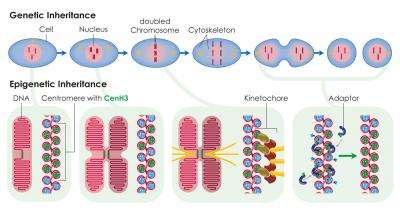
This diagram depicts the epigenetic inheritance of centromeres, as it occurs in higher organisms with a cell nucleus. During cell division, the histone CenH3 ensures that new protein is integrated into the two DNA strands. The position of the centromere can thus be passed on from one generation to the next. Credit: MPI of Immunobiology and Epigenetics

Centromeres are specialised regions of the genome, which can be identified under the microscope as the primary constriction in X-shaped chromosomes. The cell skeleton, which distributes the chromosomes to the two daughter cells during cell division, attaches to the centromeres. In most organisms the position of the centromere is not determined by the DNA sequence. Scientists from the Max Planck Institute of Immunobiology and Epigenetics in Freiburg have succeeded in demonstrating that the position, function and inheritance of the centromere are determined by the histone CenH3, a DNA packaging protein. This discovery may help to further the development of artificial human chromosomes, which could be used for gene therapies in medicine.

Centromeres provide a platform for the development of a protein complex known as the . During cell division, the kinetochore provides a point of attachment for the cell skeleton and enables the chromosomes to move to the opposite poles of the cell. In most organisms the position of the centromere is not determined by the sequence of the DNA , i.e. the DNA sequence, but epigenetically. The only exception to this rule is the unicellular fungus baker's yeast, in which a specific DNA sequence "encodes" the position of the centromere.
Chromosome centromeres are inherited epigenetically

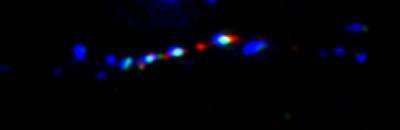
A stretched chromatin fiber reveals that CenH3 with a DNA binding domain (green) is targeting to specific DNA sequence (red). This leads to recruitment and spreading of endogenous CenH3 (blue) into neighboring regions, an important property that allows the self-propagation of the epigenetic centromere mark. Credit: MPI of Immunobiology and Epigenetics

A particularly promising candidate for this kind of epigenetic centromere marking is a variant form of the H3 histone known as CenH3. bind the DNA largely independently of the underlying sequence and help to package the long thread-like . CenH3 arises exclusively in DNA regions at the centromere in various organisms. Patrick Heun's research group at the Institute of and and colleagues from the Helmholtz Research Center in Munich have now discovered that CenH3 alone is sufficient to trigger the formation of the centromere.

For their experiments, the researchers equipped the CenH3 histone with an artificially attached DNA binding domain so that the protein could bind to a DNA region where a centromere does not normally form. Now however, a functioning kinetochore arose there which interacted with the cell skeleton during cell division. Using this approach, the researchers succeeded in distributing artificial minichromosomes between the two during cell division. The protein is able to recruit additional CenH3 proteins independently. "This ensures that sufficient CenH3 is available at the centromere after each cell division. Otherwise, the available CenH3 proteins would be reduced by half after each cell division. In this way, the centromere position can be passed on from generation to generation," says Heun.

The step from a DNA-identified centromere in baker's yeast, in which the position "is set in stone", to a protein-defined centromere position which is easier to change may also play a role in evolution. Despite being up to several million DNA building blocks in size, centromeres can "jump" to other positions without causing the DNA to move. Consequently, in rare cases, a new centromere can arise as it has already occurred in a closely-related ape species. Therefore neo-centromeres might contribute to the emergence of new species.

The insights into the central role of CenH3 for centromere identity could also prove important for medicine. Scientists would like to develop artificial human chromosomes as an alternative to gene therapy using viruses. "Like their natural counterparts, these require a centromere for cell division. Up to now it has not been possible to control the development of a centromere efficiently," says Heun.

More information: Drosophila CenH3 is sufficient for centromere formation, Science, 4 November 2011

Provided by Max-Planck-Gesellschaft (news : web)


Rank 5 /5 (2 votes)
Related Stories
Relevant PhysicsForums posts
  • Eye biology videos
    created4 hours ago
  • Flowering Plant Revived After 30,000 Years in Permafrost
    createdFeb 21, 2012
  • Toba volcano eruptions - 1.000 - 10,000 breeding pairsunb
    createdFeb 20, 2012
  • How is a specific gene removed from DNA
    createdFeb 20, 2012
  • Reproduction and Human evolution
    createdFeb 19, 2012
  • Viruses: Living or Non-living organisms
    createdFeb 19, 2012
  • More from Physics Forums - Biology

More news stories

Surprising diversity at a synapse hints at complex diversity of neural circuitry

A new study reveals a dazzling degree of biological diversity in an unexpected place – a single neural connection in the body wall of flies.

Biology / Other

created 11 hours ago | popularity 5 / 5 (4) | comments 0 | with audio podcast

Men might not 'become extinct' after all: Theory of the 'rotting' Y chromosome dealt a fatal blow

If you were to discover that a fundamental component of human biology has survived virtually intact for the past 25 million years, you'd be quite confident in saying that it is here to stay.

Biology / Biotechnology

created 14 hours ago | popularity 5 / 5 (6) | comments 1 | with audio podcast

New family of legless amphibians found in India

Since before the age of dinosaurs it has burrowed unbothered beneath the monsoon-soaked soils of remote northeast India - unknown to science and mistaken by villagers as a deadly, miniature snake.

Biology / Plants & Animals

created 21 hours ago | popularity 5 / 5 (9) | comments 3

Climate change affects bird migration timing in North America

Bird migration timing across North America has been affected by climate change, according to a study published Feb. 22 in the open access journal PLoS ONE.

Biology / Ecology

created 10 hours ago | popularity 4.5 / 5 (2) | comments 2

New iridescent lizard species found in Cambodia

A new species of lizard with striking iridescent rainbow skin, a long tail and very short legs has been discovered in the rainforest in northeast Cambodia, conservationists announced Wednesday.

Biology / Plants & Animals

created 10 hours ago | popularity not rated yet | comments 0


Researchers build first physical 'metatronic' circuit

(PhysOrg.com) -- The technological world of the 21st century owes a tremendous amount to advances in electrical engineering, specifically, the ability to finely control the flow of electrical charges using ...

Spitzer finds solid buckyballs in space

(PhysOrg.com) -- Astronomers using data from NASA's Spitzer Space Telescope have, for the first time, discovered buckyballs in a solid form in space. Prior to this discovery, the microscopic carbon spheres ...

Faster than light neutrinos? More like faulty wiring

You can shelf your designs for a warp drive engine (for now) and put the DeLorean back in the garage; it turns out neutrinos may not have broken any cosmic speed limits after all.

Physicists surprised by disappearing and reappearing superconductivity in iron selenium chalcogenides

Superconductivity is a rare physical state in which matter is able to conduct electricity -- maintain a flow of electrons -- without any resistance. This phenomenon can only be found in certain materials at low temperatures, ...

Stanford research team cracks animated NuCaptcha

(PhysOrg.com) -- The research team from Stanford University, led by Elie Bursztein, that previously had cracked regular CAPTCHAs and then audio CAPTCHAs, now has also successfully cracked the animated version called NuCapt ...

Going up: Japan builder eyes space elevator

A Japanese construction firm claimed Wednesday it could execute an out-of-this-world plan to put tourists in space within 40 years by building an elevator that stretches a quarter of the way to the moon.