IAA says 'Yes We Can' to power plants in orbit
November 15, 2011 by Nancy Owano
Image credit: SpaceWorks Engineering, Inc.
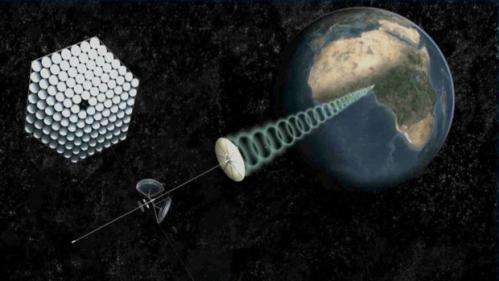
(PhysOrg.com) -- Scientists from around the world have completed a study that says harvesting the sun's energy in space can turn out to be a cost effective way of delivering the worlds needs for power in as little as 30 years. As important, the report says that orbiting power plants capable of collecting energy from the sun and beaming it to earth are technically feasible within a decade or so based on technologies now in the laboratory.
These are findings in a report from the International Academy of Astronautics, headquartered in Paris.
What their time references refer to are that the very technology needed to satisfy global energy requirements may be available in only 10 to 20 years, and the project can show cost-effectiveness in about 30 years.
The IAA's three-year, ten-nation study, as the first broadly based international assessment of collecting solar energy in space, is considered significant. The study was conducted from 2008 to 2010 and was under peer review. John Mankins, the former head of concepts at NASA, led the study.
The concept centers on placing one, then several, then many, solar-powered satellites in orbit over the equator. Each would be several miles wide. The satellites would collect sunlight up to 24 hours a day
The power would be converted to electricity in space, then sent to where it was needed on earth by a microwave-transmitting antenna or by lasers, and then fed into a power grid.
Who would bear the cost of such an effort? The report recommends that both governments and the private sector should fund the research needed to further determine viability.
A pilot project to demonstrate the technology could proceed using low-cost expendable launch vehicles being developed for other space markets, said Mankins, according to Reuters. A moderate-scale demonstration would cost tens of billions of dollars less than previously projected as a result of not needing costly, reusable launch vehicles early on.
According to reports, reactions to the study strike a hopeful note that such a project will proceed.
Jeff Peacock, who heads Boeing's ground-based solar cell product line, said in theory it could double the amount of solar power collected, compared with the earth-bound technology equivalent. Col. Michael Smith, director of the Center for Strategy and Technology at Maxwell Air Force Base in Alabama, was quoted as saying that the idea has the potential to send safe, clean electrical energy worldwide "if we can make it work.
Advantages to space solar power compared to ground solar power are that it can occur without worry about adverse weather conditions and the costs of energy storage. Another thumbs-up reason given is that solar collection does not bring carbon pollution, addressing key concerns about a continuing reliance on fossil fuels that contribute to global pollution.
Nevertheless, the Reuters report says skeptics point out hurdles such as space debris, a lack of focused market studies and development costs.
More information: http://iaaweb.org/
© 2011 PhysOrg.com
-
European space company wants solar power plant in space
Jan 21, 2010 |
not rated yet |
0
-
Toward a 'green grid' for delivering solar and wind-based electricity
Apr 13, 2011 |
not rated yet |
0
-
U.S. announces solar energy initiative
Jun 28, 2006 |
not rated yet |
0
-
U.S. to support some solar power research
May 01, 2008 |
not rated yet |
0
-
Is solar power cheaper than nuclear power?
Aug 09, 2010 |
not rated yet |
0
-
Stars containing dark matter should look different from other stars
Feb 20, 2012 |
4.5 / 5 (17) |
11
-
Physicists discover evidence of rare hypernucleus, a component of strange matter
Feb 17, 2012 |
4.7 / 5 (38) |
22
-
Fast photon control brings quantum photonic technologies closer
Feb 13, 2012 |
5 / 5 (8) |
1
-
Engineers build first sub-10-nm carbon nanotube transistor
Feb 01, 2012 |
4.9 / 5 (36) |
32
-
Something old, something new: Evolution and the structural divergence of duplicate genes
Jan 31, 2012 |
4.6 / 5 (7) |
1
-
Calculating forces involved in seesaw motion
4 hours ago
-
Writing shear and moment equations for a simple beam problem?
5 hours ago
-
Furnace Shell Spray Cooling Design
21 hours ago
-
Ways to measure the speed of a golf ball?
Feb 21, 2012
-
Water Skin Effect in Plastic Pipe
Feb 21, 2012
-
Undergraduate Engineering Physics To Graduate Aerospace Engineering
Feb 21, 2012
- More from Physics Forums - General Engineering
More news stories
Stanford research team cracks animated NuCaptcha
(PhysOrg.com) -- The research team from Stanford University, led by Elie Bursztein, that previously had cracked regular CAPTCHAs and then audio CAPTCHAs, now has also successfully cracked the animated version called NuCapt ...
Tiny, implantable medical device can propel itself through bloodstream
Someday, your doctor may turn to you and say, "Take two surgeons and call me in the morning." If that day arrives, you may just have Ada Poon to thank.
17 hours ago |
5 / 5 (9) |
8
|
Italian engineer invents floating solar panels
Rays of the winter sun bounce off gleaming mirrors on the tiny lake of Colignola in Italy, where engineers have built a cost-effective prototype for floating, rotating solar panels.
Technology / Energy & Green Tech
21 hours ago |
4.7 / 5 (6) |
5
Microsoft hits Motorola, Google with EU complaint
Microsoft on Wednesday lodged a formal complaint with the European Union's competition regulator against Motorola Mobility and its soon-to-be owner Google, saying Motorola's aggressive enforcement of patent ...
17 hours ago |
2 / 5 (1) |
2
Calif. pledges better mobile privacy disclosures
(AP) -- Mobile applications seeking to collect personal information will have to forewarn users as part of an agreement reached in California.
9 hours ago |
not rated yet |
0
Researchers build first physical 'metatronic' circuit
(PhysOrg.com) -- The technological world of the 21st century owes a tremendous amount to advances in electrical engineering, specifically, the ability to finely control the flow of electrical charges using ...
Spitzer finds solid buckyballs in space
(PhysOrg.com) -- Astronomers using data from NASA's Spitzer Space Telescope have, for the first time, discovered buckyballs in a solid form in space. Prior to this discovery, the microscopic carbon spheres ...
Faster than light neutrinos? More like faulty wiring
You can shelf your designs for a warp drive engine (for now) and put the DeLorean back in the garage; it turns out neutrinos may not have broken any cosmic speed limits after all.
Physicists surprised by disappearing and reappearing superconductivity in iron selenium chalcogenides
Superconductivity is a rare physical state in which matter is able to conduct electricity -- maintain a flow of electrons -- without any resistance. This phenomenon can only be found in certain materials at low temperatures, ...
Going up: Japan builder eyes space elevator
A Japanese construction firm claimed Wednesday it could execute an out-of-this-world plan to put tourists in space within 40 years by building an elevator that stretches a quarter of the way to the moon.
Flesh-eating bacteria inspire superglue
(PhysOrg.com) -- A bio-inspired superglue has been developed by Oxford University researchers that cant be matched for sticking molecules together and not letting go.
Nov 15, 2011
Rank: 4.3 / 5 (13)
This is partially true. There is such a thing as space weather. Solar flares have forced sattelites to shut down in the past - and these systems would be very prone to those effects. Then there is the issue of storage: Depending on where you beam the energy down you will likely need some transport (as you want those beams to come down far from human habitation). Microwaves are affected by cirrus clouds to some extent.
The exhausts of current rocket technologies are extremely harmful to the ozone layer. Putting massive power production in orbit would mean many launches. This needs to be taken into account
Nov 15, 2011
Rank: 4.2 / 5 (20)
Nov 15, 2011
Rank: 3 / 5 (2)
Nov 15, 2011
Rank: not rated yet
It should prove very interesting.
Nov 15, 2011
Rank: 3.4 / 5 (13)
It is reliable and the efficiency would be somewhere between 80 and 90%. But you need really large antennas (in space the thing would need to have an antenna 1 km wide, on the ground we'd need something 10 km in diameter)
Something we should also not forget: Taking energy from space means we are sending more energy to Earth than Earth would take up on its own (in effect increasing the size of earth as with respect to solar radiation).
All energy we create/send will eventually become heat. This will somewhat offset the gain in terms of global warming. Here utilizing solar energy that impacts Earth anyways is superior (wind, Earth based solar, hydro)
Nov 15, 2011
Rank: 4.4 / 5 (9)
I find that suspiciously optimistic. A microwave magnetron for example is only 65% efficient, and the recieving antenna and rectification can't be 99% efficient.
Nov 15, 2011
Rank: 5 / 5 (1)
Nov 15, 2011
Rank: 4.8 / 5 (6)
I was referring to the beaming process, only (i.e. losses between sending an receiving antennas - which would manifest as heat in the Earth's atmosphere).
You are perfectly correct that the entire system efficiency will be substantially lower (especially if we use lasers - then the efficiency will go right down the drain because making laser light is a very inefficient process)
I did the calcs base on the ISS solar panels a few years ago on another forum. Getting 10% of Earth power needs from solar came out to about 400 trillion dollars (with about 4 trillion annual upkeep and replacement of degrading structures) and a 20 times overkill of the ozone layer from rocket exhausts. But that was based on PV, not mirror collectors.
Nov 15, 2011
Rank: 1 / 5 (1)
lol, yeah one hit from a piece of space debris could leave a large scar on Earths surface.
Nov 15, 2011
Rank: 1.5 / 5 (8)
Is global warming only a concern if it is caused by carbon dioxide? Because the article did not present any concerns about global warming.
Nov 15, 2011
Rank: 5 / 5 (1)
Nov 15, 2011
Rank: 5 / 5 (1)
Wiki says world use in 2008 = 142,000 TW/h
That can't be beamed to the surface safely.
Nov 15, 2011
Rank: 5 / 5 (7)
Global warming caused by any heating of Earths surface is negligible if the excess heat can escape. The problem is CO2 which blocks this escape.
Nov 15, 2011
Rank: 5 / 5 (5)
..yes, until they were shredded by micro-meteorites and dust.
, no ?
Nov 15, 2011
Rank: 5 / 5 (1)
True. but since we're not getting rid of the CO2 we already have the problem is larger with orbital solar than it is with Earth based solar.
Though this is probably really only a niggle. The added 'surface area' of the Earth due to space based collectors would be very small as a percentage of surface area of the Earth.
The losses of the microwave beam in the atmosphere might be more of a problem as it's starting to heat up stuff at very high altitudes - and we really don't know what kind of effects that will have on weather patterns. (If the HAARP project is anything to go by - though at a slightly differnt frequency - then it's not entirely without ffect)
Nov 15, 2011
Rank: 3.2 / 5 (18)
Nov 15, 2011
Rank: 5 / 5 (7)
Nov 15, 2011
Rank: 5 / 5 (6)
That would make too much sense O:
I am jaded perhaps, but I don't think many people are willing to commit to altering how they are used to living.
Nov 15, 2011
Rank: 5 / 5 (11)
You want to bring common sense into this? Are you crazy?
Nov 15, 2011
Rank: 4.3 / 5 (3)
Nov 15, 2011
Rank: 4.2 / 5 (6)
In a word, no.
Population growth remains unchecked and energy demand is expected to skyrocket for the foreseeable future (one could make the case that in an increasingly technical civilization, energy demand will grow on a constant basis). Governments have shown very little ability to keep either in check.
Nov 15, 2011
Rank: 4 / 5 (5)
There are much better ways to cater the energy needs of a growing global population even with today's energy tech, let alone with rapid developments in harvesting here on the ground and amazing properties of materials we are only beginning to understand.
Nov 15, 2011
Rank: 3.5 / 5 (2)
Anyway, I always had mixed feelings about solar-in-space. Even assuming that it has double or triple the efficiency, wouldn't it make more sense to just put double or triple the same amount of solar panels but on Earth?
Nov 15, 2011
Rank: 4 / 5 (4)
Nov 15, 2011
Rank: 4.6 / 5 (9)
Yes it would. Mostly because having a number of solar panels in orbit is hundreds of times more expensive than having the same number here on the ground (including some means for storing excess energy production for night time/bad weather conditions).
But I could actually see a use for largish space based solar power plants: Providing power (and possibly impulse via solar sails) to other sattelites.
Wouldn't it be great if sattelites didn't have to pack their own batteries, reactors or photovoltaics but simply a microwave antenna which they point at the nearest solar power plant?
Could bring launch weight, size, and cost of new sattelites down substantially while increasing the lifetime of sattelites at the same time.
Nov 15, 2011
Rank: 5 / 5 (4)
Solar constant at the top of the atmosphere is about 1.3-1.4kW per square meter.
Solar constant at ground level (desert) is about 1kW per square meter or about 800W in northern latitudes (midday).
Given that, on the ground, you have no energy production during the night and lesser energy production during morning/evening I'd estimate that the effectiveness at ground level is about a quarter that of something of the same size in orbit.
And let's not forget maintenance issues. Anything that breaks in space stays broken (or anything that fails upon launch is a total loss). On Earth repairs and maintenance are more intensive, but also
a) a LOT cheaper
b) feasible
Spectrum is different in orbit, too. Of those 1.4kW more is high energy radiation than whatreaches the ground - which is harder to use.
Nov 15, 2011
Rank: 4.5 / 5 (4)
Although it would be a bit risky to have so many critical satellites dependent on just one. If that one were to go down (or be shot down)...
Nov 15, 2011
Rank: 4.5 / 5 (2)
Nov 15, 2011
Rank: 1.8 / 5 (5)
Nov 15, 2011
Rank: 1.8 / 5 (5)
But it is not.
We now have to struggle with the greenhouse effect, so every extra lumen we bring from space to the surface becomes an extra energy input to the atmosphere.
Make no mistake:
I like this idea. It could be very usefull on Mars or on the Moon, but here on Earth we'll have to find a way to reduce sunlight income (with a giant space sunshade?) BEFORE thinking bringing more heat to the whole sustem.
Nov 15, 2011
Rank: not rated yet
Nov 15, 2011
Rank: 4 / 5 (3)
Nov 15, 2011
Rank: 2.4 / 5 (8)
Nukes would be passe in comparison.
Oh, I think that I just answered my own question. Darn.
Do it right (pair it with lasers?) and you'd be able to vaporize individuals.
Nixon would have LOVED it (talk about people on your "enemies list" just evaporating)....
Come-on: Before someone else beats us to it and while we still have a semblance of an economy (eh - credit card) left that "might" be able to "pay" (eh - Borrow) for it.
Talk about be careful what you say or "god" will strike you down....
Nov 15, 2011
Rank: 5 / 5 (3)
Rectennas are about 80% efficient, but you are right, there will be losses at the transmission end.
The big problem with the power satellite scheme is the cost (and energy expenditure and pollution) of getting all this junk into orbit.
This will never happen until they can get large scale manufacturing facilities on the moon.
Nov 15, 2011
Rank: 5 / 5 (3)
Nov 15, 2011
Rank: 3.4 / 5 (5)
And we had better solve the energy crisis WAY before then. If we wait till we get a big factory and settlement up there then we're screwed.
There's a couple of interanational treaties forbidding that kind oif shenannigans and...oh...right...this is the US we're talking about. Isn't that the country that holds, by an enormous margin, the record for most broken treaties since it's founding? My bad. Go ahead. Build space lasers. Do.
Nov 15, 2011
Rank: 2.3 / 5 (3)
Nov 15, 2011
Rank: 1 / 5 (1)
Nov 15, 2011
Rank: 4 / 5 (7)
But the most important point here is that is opens new horizons, electricity powered spacecraft, if magnetic or microwave propulsion becomes prominent we could colonize the entire solar system while we habitate in luxury.
Not to mention provide a living, work food and a place to sleep for possibly a trillion humans, WITHOUT compromising the glorious planet which seeded us. We could turn earth into a wild life reserve and spend our time exploring the wonders of the universe.
But it's going to take support and grunt work now to even survive the many coming apocalypses, superviruses, resource shortages, wars, famines and all the other shit that happens when we don't work together and work smart!
Nov 15, 2011
Rank: 5 / 5 (4)
In space, getting rid of excess heat is major problem (no convection losses - just radiation losses which are little). And since these objects will be in the sun all the time they will get a lot of heat. Note that the lifetime of space telescopes is limited by when their _coolant_ runs out.
Most isn't enough. One good one and you're out a all your multi trillion dollar power plants. With NO way to hide them from it.
For magnetic propulsion you must have a field to work against. This would only work very close to Earth (and there only poorly).
Microwave/laser propulsion is a one way trip. And the boost is only for an extremely short duration. Not nearly enough for interplanetary flight.
Nov 15, 2011
Rank: 5 / 5 (2)
Which treaties are you referring to re: forbidding that kind of shenanigans? Do you mean space weapons specifically?
As to your ludicrous comment re: treaties broken by the U.S., don't want to confuse you with any facts that might cloud your exuberant rant, but you are only fabricating a story. A fantasy as it were. Nicely done. Let me guess, you're going to quote the Native American treaties?
Nov 15, 2011
Rank: 1 / 5 (1)
Nov 15, 2011
Rank: 5 / 5 (1)
BTW the EM beam from space can be made harmless and be collected by wire-thin antenna arrays.
Nov 15, 2011
Rank: 5 / 5 (2)
Not if masers were used.
Nov 15, 2011
Rank: 1 / 5 (2)
Nov 16, 2011
Rank: 2.3 / 5 (3)
Nov 16, 2011
Rank: 3 / 5 (2)
Nov 16, 2011
Rank: 1 / 5 (2)
Outer Space Treaty
http://en.wikiped...e_Treaty
As for broken treaties (or simply not signed ones that should be blindingly obvious to any being that calls itself even remotely human)
http://www.vote.org/treaties
Nov 16, 2011
Rank: 4.5 / 5 (2)
Nov 16, 2011
Rank: not rated yet
Nov 16, 2011
Rank: 5 / 5 (1)
Oh, come on, they'll be using Windows 10 by then. I'm sure it will be perfectly safe. hehe
Nov 16, 2011
Rank: 4.8 / 5 (4)
antialias, I commend you for the intelligence and rationality you commonly show in your posts. Your analyses are well thought out, and you have very relevant information to share.
On this one, however, it seems that you may be letting your personal opinion sway you. First, I looked around quite a bit and was unable to find anyone who had ever compiled a definitive listing of every treaty ever recorded between two governments, and a corresponding list of when the treaty was dissolved and under what circumstances.
So, first, it's very difficult to say that the U.S. has broken more treaties that anyone else. Second, it's partially subjective anyway. For each treaty, you'd have to analyze the circumstances and determine if one, both, or multiple parties pulled out. Finally, it's inappropriate to include "treaties the U.S. should sign" in your list.
Nov 16, 2011
Rank: 3 / 5 (2)
Nov 16, 2011
Rank: 4.6 / 5 (5)
1) ISS is low orbit (400km). This stuff would be high orbit (geosynch, which means 36000km). No constant human presence possible with current tech at those altitudes (would be enormously expensive).
2) Rigidity would have to be just as much as on the ISS (which is substantial and not much different than on Earth). The launch weight for the ISS panels is several tons a piece (and they are SMALL compared to what you would need here)
3) Lasers diverge. Over such a distance they diverge subtsantially. Creating a high power laser beam is a very inefficient process. We're talking 0.01% to 0.1% of the energy put into a laser apparatus actually comes out as laser light. The rest is wasted (which just made the power plant 1000 to 10000 times bigger than one on Earth for the same output).
4) Non repairability would be the only way to go. Fire and forget.
Nov 16, 2011
Rank: 1 / 5 (1)
Remember the old saying - "If it sounds too good to be true - it usually is..."
Nov 17, 2011
Rank: 3.5 / 5 (2)
On the other hand, if the system is REALLY big, we possibly can position it in a way to act as a sun shield too, reducing the effect of beaming extra energy to the Earth. Depending on the design and material, the collectors could be spun to provide rigidity without weight penalties, and the underside of the collectors would be in shadow, enabling the use of minimal cryogenic cooling for superconductors in the machinery.
Still the biggest show breaker would be the annual meteor showers. Their swath are big enough to hit Earth that I doubt there is anywhere near Earth that is safe from them. The system must be able to survive and function with this regular bombardments.
Nov 19, 2011
Rank: 5 / 5 (1)
Just having raw materials in storage up on the moon opens up wild new frontiers.
If you have mining and refining equip on the moon all you have to do it send up a series of small factories to turn the semi-processed materials into components.
You could get to the point where everything is ready up there and you send some humans up to assemble anything that can't be easily done remotely. From there the moon is much easier to launch power satellites from, not to mention you could beam back the sun energy to the moon instead of earth.
I hardly think cooling would be a problem with a solar satellite, the panels would not be thermally connected to the power distribution. I thought telescopes needed to be cooled because the lens needed to be a consistent even temp
Nov 19, 2011
Rank: 5 / 5 (1)
It's a different order of magnitude. Once the fossil fuels are burnt they have expended their useful energy; but they add to the earth's radiative forcing for a very long time.
The current 2.5 W/m^2 anthropogenic GHG forcing is equivalent to adding ~45 kW per capita of heat to earths atmosphere continously, night and day.
The average power consumption(primary energy, i.e. including the ~2/3 that is rejected as waste heat) of the world is ~2.3 kW per capita. Even the US is only ~10 kW/capita.
Beaming even 10 kW/capita to the Earth from space(which allows for ~2/3 of beamed energy to be lost, as with current primary energy consumption) would not be a serious problem.
Power satellites would heat the Earth very unevenly; where the receivers and consumers(mostly cities) are. Greenhouse gasses are global; this would be mostly local heating.
Nov 19, 2011
Rank: 2.5 / 5 (2)
However on the flip side, eventually it could be a planetary defense, concentrate lasers from all satellites and aim at asteroid; probably won't blow it up, but should be enough to deflect it off course.
Nov 20, 2011
Rank: 5 / 5 (3)
I wonder how much junk will be floating around our planet in 100 years.... Has anyone done projections based on accumulation rates since we started going to space ?
Nov 20, 2011
Rank: 1 / 5 (1)
Nov 20, 2011
Rank: 3.7 / 5 (3)
2. Orbiting at 24,000 miles, they will not crash to earth for millions (?) of years, hence, no threat.
3. Microwave transmission is safe and effective, and proven. These proposals would not be useful as weapons.
4. Orbital debris is a serious problem, but mostly from LEO, not GEO. Check NASA's website on this. http://orbitaldeb...asa.gov/
5. Damage from micrometeoroids etc is a concern, so the above questions on maintenace are valid. Best guess is that the satellites would have to be maintained from a lunar base.
No need to hyperventilate or exaggerate the issues, just try Google once in a while. There is a lot of good information out there.
Nov 20, 2011
Rank: 5 / 5 (3)
I thought projects like this were already in the works?
http://www.livesc...ace.html
http://inhabitat....0-homes/
Nov 20, 2011
Rank: 4 / 5 (3)
I'm not sure that can be stated with certainty. The determining factor is how much energy we need for use - and how much losses are generated within the atmosphere along the entire chain until that X amount of useful TWatts are produced.
Gut feeling tells me that using coal/oil/gas is worse. But my gut feeling also tells me that putting up regenerative powerplants (wind, wave, solar) on Earth is much better in that respect.
And how good are these advances? We stills send out astronauts to the Hubble telescope to swap out rectangular blocks (a very basic task comparing the maintenance issues that can arise in high orbit). We are talking about whether we can do it NOW. If we can do it in 100 years then orbital power plants aren't the solution to today's problems.
Nov 20, 2011
Rank: 4.7 / 5 (3)
Nov 20, 2011
Rank: 5 / 5 (2)
http://www.google...kZZtXIAA
Nov 20, 2011
Rank: 5 / 5 (2)
Nov 20, 2011
Rank: 5 / 5 (1)
Rural drive-in movie theaters are bound to make a comeback!
Nov 20, 2011
Rank: 3 / 5 (2)
Nov 20, 2011
Rank: 5 / 5 (1)
Nov 20, 2011
Rank: not rated yet
Nov 20, 2011
Rank: 5 / 5 (2)
Exactly my point. If we put our chips on technology yet to be developed (robotics that can handle that kind of complexity, orbital delivery and maintenance systems for multi gigatonne payloads, etc.) we'll be here in 50 years and not see one of these contraptions.
Not saying that its impossible or won't be done some time in the future - but it's not doable in the timeline we have for affecting anything down here
- weaning us off oil
- fight global warming
- getting rid of nuclear
But we DO have the technologies for doing it down here for a fraction of the cost. Less 'SciFi'-glitzy...but definitely more realistic and with all sorts of added benefits (less centralization, availability of incorporating developing countries, ... )
Nov 20, 2011
Rank: 3 / 5 (1)
Haven't you heard the good news? Rossi finished that task.
Nov 21, 2011
Rank: 5 / 5 (1)
Nov 21, 2011
Rank: 5 / 5 (2)
Military projects are often begun on the confidence that tech developments along the way will make it possible. Think tanks make projections like this all the time. It behooves the military to begin developing applications NOW as opposed to waiting for someone else to beat them to it.
RPV tech exists now. Construction of massive space structures has been proven. Note the timeline between the wright brothers and Dresden. Remote assembly of structures DESIGNED to be constructed that way, will be MUCH easier, faster, and cheaper than humans in space suits trying to turn screws
Nov 21, 2011
Rank: 5 / 5 (1)
Nov 21, 2011
Rank: 2.5 / 5 (2)
And you know how long that took from first conception to actually getting the thing up there? First ideas were being chucked around in the early 1960's. Concrete concepts being developed in the early 80's. And THEY didn't need to invent entirely new rocket systems (if we use the current rocket technologies/fuels then CO2/global warming will look like a picknick compared to what the amount of needed launches would do to our atmosphere)
And that was in a time when countries had resources and money to spare (the 90's were an unprecedented boom phase).
But you have looked at the timeline and the cost figures? If you haven't you should. Then extrapolate (even with economics of scale) to something a mile wide in HIGH orbit(!)
Then to MANY such somethings.
Doable and sensible are not the same thing.
Nov 21, 2011
Rank: 5 / 5 (1)
At the other end of the spectrum the manhattan project was committed to, and accomplished with breathtaking speed, on little more than theory.
Consider the timeline between the model T and the interstate highway system.
Nov 21, 2011
Rank: 4.5 / 5 (2)
Which have no environmental impact. Rocket fuels do (they are major ozone-killers among other things. The only reason why this has not affected the ozone layer much is because the flights are so few and far between)
What the hell does this have to do with anything in this article or discussion?
There are certain limits here which we cannot ignore. It takes X amount of energy to get something of mass Y into high orbit. That sort of energy has to come from reaction mass (i.e. rocket exhausts).
And no, you cannot make these stations very flimsy because they have to be reoriented to point at the sun. So either you pack them with a lot of nozzles and fuel (which means a limited lifetime or very expensive/dangerous refueling trips) or make them rigid to use solar sail methods.
Nov 21, 2011
Rank: 4 / 5 (1)
The whole concept is a study in "what-if"', not "what-when".
If we lived in a "Star Trek" world where money was no object, we'd be trying a LOT of these kinds of projects. However - we don't...
Nov 21, 2011
Rank: not rated yet
If we lived in a "Star Trek" world where money was no object, we'd be trying all kinds of these projects. However - we don't...
Nov 21, 2011
Rank: 5 / 5 (2)
Tensile structures supporting composite fabric can be VERY light yet very rigid.
Nov 21, 2011
Rank: 5 / 5 (1)
http://www.spaceenergy.com/
"This follows Solarens recently signed deal for the first-ever power purchase agreement to deliver 200 megawatts of solar energy from space with Californias Pacific Gas & Electric."
http://newenergya...r-power/
http://www.solarenspace.com/
Research and testing of similar structures is ongoing:
http://en.wikiped...lar_sail
Nov 21, 2011
Rank: 5 / 5 (2)
Nov 21, 2011
Rank: 3 / 5 (2)
http://en.wikiped...nt_Types
No. That's Sci Fi.
How will hydro plants, solar power plants and windfarms be obsolete? Especially when they are orders of magnitude cheaper, available to everyone (even low tech countries), decentralized, unable to be sabotaged,...
Hmm..look at this timelaps of the ISS. Looks like the panels are rotating a bit faster than once a year.
http://www.youtub...o7w_RiI4
Then why aren't they used on ANY sattelite? Seems like NASA would eat that up as a means of saving weight.
Nov 21, 2011
Rank: 4.5 / 5 (2)
http://www.kurzwe...-by-nasa
Nov 21, 2011
Rank: 2 / 5 (1)
Nov 21, 2011
Rank: 5 / 5 (2)
http://www.davidd...ope.html
-with many more to follow-
Nov 22, 2011
Rank: 4.5 / 5 (2)
So no maintenance. Great. But either you rotate your antenna all the time or your panels.
No, not in the poorer areas. Not in Africa or the like. You need a lot of wood for one person. This is not sustainable. Problematic in cities, too.
They do already run all of those (why shouldn't they be able to? Power is power.)
And who owns the sattelite? Who owns the power? Certainly not Cameroon. Better for them (or anyone else) to have their own, cheap power plants.
China has shown they can blow up sattelites in orbit. So can Russia or the US. "He who can destroy a thing controls a thing".
As for the panels: The Webb's telescope mirrors are quite rigid. As are its solar panels (which are on the bottom).
http://www.jwst.n...er5a.jpg
The only thing flimsy is the 'heat' shield.
Nov 22, 2011
Rank: 5 / 5 (1)
Cont>>
Nov 22, 2011
Rank: 5 / 5 (2)
High orbit shuttling of spare parts and robotics for complicated maintenance is SciFi for now.
They can do it like anyone else can do it over here: Buy X amount of Megawatt per year from the energy provider as alternative energy. The provider is then obligated to put X amount of Megawatts from alternative energy sources into the grid.
It is not necessary to put the amount of energy into the grid at the same time that it is used at the factory. Simple.
Cameroon could get it from their own power plants. Space based solar is certainly not going to be theirs.
But Cameroon is a perfect example (from the wikipedia site on energy in cameroon)
Nov 22, 2011
Rank: 5 / 5 (1)
Tensile structures can be extremely strong and rigid for their weight. Space elevators will be tensile structures. Materials tech currently limits their use and related tech such as inflatables in the harsh environs of space, but not for long. Their inherent economy will make them predominant in the near future.
http://www.bigspa...res.com/
Nov 22, 2011
Rank: 5 / 5 (2)
And Cameroonian hydro power, or any hydro power, is magnitudes above what can be produced with solar and wind. And siltation and environmental disruption make hydro a very poor investment compared to space-based solar, as one example.
Of course there is no reason Cameroon couldn't commission the construction of their own space plants, like California? Or at least lease rights from others, like California. This arrangement is typical among civilized nations yes?