Kilobots - tiny, collaborative robots - are leaving the nest (w/ video)
November 21, 2011
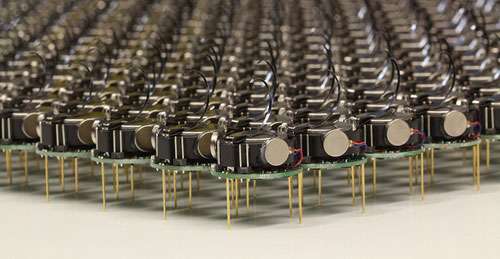
The Kilobots are an inexpensive system for testing synchronized and collaborative behavior in a very large swarm of robots. Photo courtesy of Michael Rubenstein
(PhysOrg.com) -- The Kilobots are coming. Computer scientists and engineers at Harvard University have developed and licensed technology that will make it easy to test collective algorithms on hundreds, or even thousands, of tiny robots.
Called Kilobots, the quarter-sized bug-like devices scuttle around on three toothpick-like legs, interacting and coordinating their own behavior as a team. A June 2011 Harvard Technical Report demonstrated a collective of 25 machines implementing swarming behaviors such as foraging, formation control, and synchronization.
Once up and running, the machines are fully autonomous, meaning there is no need for a human to control their actions.
This video is not supported by your browser at this time.
The communicative critters were created by members of the Self-Organizing Systems Research Group led by Radhika Nagpal, the Thomas D. Cabot Associate Professor of Computer Science at the Harvard School of Engineering and Applied Sciences (SEAS) and a Core Faculty Member at the Wyss Institute for Biologically Inspired Engineering at Harvard. Her team also includes Michael Rubenstein, a postdoctoral fellow at SEAS; and Christian Ahler, a fellow of SEAS and the Wyss Institute.Thanks to a technology licensing deal with the K-Team Corporation, a Swiss manufacturer of high-quality mobile robots, researchers and robotics enthusiasts alike can now take command of their own swarm.
One key to achieving high-value applications for multi-robot systems in the future is the development of sophisticated algorithms that can coordinate the actions of tens to thousands of robots.
"The Kilobot will provide researchers with an important new tool for understanding how to design and build large, distributed, functional systems," says Michael Mitzenmacher, Area Dean for Computer Science at SEAS.
"Plus," he adds, "tiny robots are really cool!"
The name "Kilobot" does not refer to anything nefarious; rather, it describes the researchers' goal of quickly and inexpensively creating a collective of a thousand bots.
This video is not supported by your browser at this time.
Inspired by nature, such swarms resemble social insects, such as ants and bees, that can efficiently search for and find food sources in large, complex environments, collectively transport large objects, and coordinate the building of nests and other structures.Due to reasons of time, cost, and simplicity, the algorithms being developed today in research labs are only validated in computer simulation or using a few dozen robots at most.
In contrast, the design by Nagpal's team allows a single user to easily oversee the operation of a large Kilobot collective, including programming, powering on, and charging all robots, all of which would be difficult (if not impossible) using existing robotic systems.
So, what can you do with a thousand tiny little bots?
Robot swarms might one day tunnel through rubble to find survivors, monitor the environment and remove contaminants, and self-assemble to form support structures in collapsed buildings.
They could also be deployed to autonomously perform construction in dangerous environments, to assist with pollination of crops, or to conduct search and rescue operations.
For now, the Kilobots are designed to provide scientists with a physical testbed for advancing the understanding of collective behavior and realizing its potential to deliver solutions for a wide range of challenges.
-
Kilobots bring us one step closer to a robot swarm
Jun 17, 2011 |
not rated yet |
0
-
All for one, 'R-one' for all (w/ video)
Oct 11, 2011 |
not rated yet |
0
-
Honey bee search strategy: Robot swarms to search Mars caves
Mar 22, 2011 |
not rated yet |
0
-
Smart swarms of bacteria inspire robotics researchers
Nov 17, 2011 |
not rated yet |
0
-
Robots play soccer, make breakfast at the RoboCup German Open 2011 (w/ video)
Apr 07, 2011 |
not rated yet |
0
-
Stars containing dark matter should look different from other stars
Feb 20, 2012 |
4.5 / 5 (17) |
11
-
Physicists discover evidence of rare hypernucleus, a component of strange matter
Feb 17, 2012 |
4.7 / 5 (38) |
22
-
Fast photon control brings quantum photonic technologies closer
Feb 13, 2012 |
5 / 5 (8) |
1
-
Engineers build first sub-10-nm carbon nanotube transistor
Feb 01, 2012 |
4.9 / 5 (36) |
32
-
Something old, something new: Evolution and the structural divergence of duplicate genes
Jan 31, 2012 |
4.6 / 5 (7) |
1
-
Calculating forces involved in seesaw motion
4 hours ago
-
Writing shear and moment equations for a simple beam problem?
5 hours ago
-
Furnace Shell Spray Cooling Design
21 hours ago
-
Ways to measure the speed of a golf ball?
Feb 21, 2012
-
Water Skin Effect in Plastic Pipe
Feb 21, 2012
-
Undergraduate Engineering Physics To Graduate Aerospace Engineering
Feb 21, 2012
- More from Physics Forums - General Engineering
More news stories
PlayStation Vita game gadgets debut outside Asia
Sony's slick PlayStation Vita handheld videogame gadget hit major markets around the world on Wednesday as the Japanese entertainment titan bucked a trend towards play on smartphones.
Electronics / Consumer & Gadgets
11 hours ago |
not rated yet |
0
Energy-recycling computer technology from UM goes global through AMD
An energy-recycling computer circuit born at the University of Michigan will enable a new generation of power efficient laptop PCs and servers.
18 hours ago |
5 / 5 (1) |
0
Review: Vita sets new standard for portable games
(AP) -- The PlayStation Vita won't replace your smartphone. For starters, it isn't a telephone (although it will eventually let you use Skype). And it's too big to fit in your pants pocket, unless you're wearing ...
Electronics / Consumer & Gadgets
Feb 21, 2012 |
3.7 / 5 (3) |
2
Engineering research brings seven adult-sized humanoid robots together for first time in US
Seven adult-sized humanoid robots took the stage during Drexel University's celebration of National Engineers Week, in a first-of-its-kind assembly of robotic technology. A showcase event on Feb. 20 introduced all seven of ...
Feb 21, 2012 |
not rated yet |
2
British firm develops 'cheapest wireless tablet'
A British technology company claims to have developed the world's least expensive computer tablet for wireless Internet access.
Electronics / Consumer & Gadgets
Feb 19, 2012 |
4.6 / 5 (10) |
2
Researchers build first physical 'metatronic' circuit
(PhysOrg.com) -- The technological world of the 21st century owes a tremendous amount to advances in electrical engineering, specifically, the ability to finely control the flow of electrical charges using ...
Spitzer finds solid buckyballs in space
(PhysOrg.com) -- Astronomers using data from NASA's Spitzer Space Telescope have, for the first time, discovered buckyballs in a solid form in space. Prior to this discovery, the microscopic carbon spheres ...
Faster than light neutrinos? More like faulty wiring
You can shelf your designs for a warp drive engine (for now) and put the DeLorean back in the garage; it turns out neutrinos may not have broken any cosmic speed limits after all.
Physicists surprised by disappearing and reappearing superconductivity in iron selenium chalcogenides
Superconductivity is a rare physical state in which matter is able to conduct electricity -- maintain a flow of electrons -- without any resistance. This phenomenon can only be found in certain materials at low temperatures, ...
Stanford research team cracks animated NuCaptcha
(PhysOrg.com) -- The research team from Stanford University, led by Elie Bursztein, that previously had cracked regular CAPTCHAs and then audio CAPTCHAs, now has also successfully cracked the animated version called NuCapt ...
Going up: Japan builder eyes space elevator
A Japanese construction firm claimed Wednesday it could execute an out-of-this-world plan to put tourists in space within 40 years by building an elevator that stretches a quarter of the way to the moon.
Nov 21, 2011
Rank: 5 / 5 (5)
Nov 21, 2011
Rank: 5 / 5 (1)
http://www.microm...ter.com/
instead of making herkyjerky stiltbots from scratch.., I would think if one is trying to test robot swarms, having higher mobility would be key.
Nov 21, 2011
Rank: 5 / 5 (2)
Nov 21, 2011
Rank: 1 / 5 (7)
Nov 21, 2011
Rank: 5 / 5 (1)
Nov 21, 2011
Rank: 5 / 5 (2)
Nov 21, 2011
Rank: 5 / 5 (1)
Nov 21, 2011
Rank: 3.7 / 5 (3)
Emergent behaviors from cellular automata run as computer simulations have been explored extensively over many years. The complexity of such behaviors from very simple rules never fails to amaze.
Nov 21, 2011
Rank: not rated yet
Wish I could find the link...
Nov 22, 2011
Rank: not rated yet
Nov 22, 2011
Rank: 5 / 5 (2)
Nov 22, 2011
Rank: 5 / 5 (2)
Nov 22, 2011
Rank: 5 / 5 (2)
True, lol. And, of all they're categories for "post removal", I can't quite figure out how they can make that determination. Seems like there's LOTS of pointless verbiage. But they don't take it all off.
Nov 23, 2011
Rank: 5 / 5 (1)
Nov 26, 2011
Rank: not rated yet