Gone fishing? We have for 42,000 years
November 25, 2011
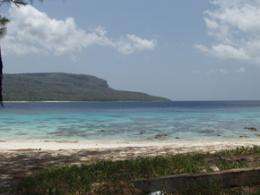
Many caves and rockshelter - such as Jerimalai - are located in the uplifted Pleistocene limestone terraces at the east end of East Timor.
(PhysOrg.com) -- An archaeologist from The Australian National University has uncovered the worlds oldest evidence of deep sea fishing for big fish, showing that 42,000 years ago our regional ancestors had mastered one of our nations favourite pastimes.
Professor Sue OConnor of the College of Asia and the Pacific at ANU, also found the worlds earliest recorded fish hook in her excavations at a site in East Timor. The results of this work are published in the latest issue of Science.
The finds from the Jerimalai cave site demonstrate that 42,000 years ago our regional ancestors had high-level maritime skills, and by implication the technology needed to make the ocean crossings to reach Australia.
The site that we studied featured more than 38,000 fish bones from 2,843 individual fish dating back 42,000 years, said Professor OConnor.
What the site in East Timor has shown us is that early modern humans in Island Southeast Asia had amazingly advanced maritime skills. They were expert at catching the types of fish that would be challenging even today fish like tuna. Its a very exciting find.
Professor OConnor also uncovered the worlds oldest fish hook, which dates from a later period.
We found a fish hook, made from a shell, which dates to between 23,000 and 16,000 years ago. This is, we believe, the earliest known example of a fish hook and shows that our ancestors were skilled crafts people as well as fishers. The hooks dont seem suitable for pelagic fishing, but it is possible that other types of hooks were being made at the same time.
Whats still unknown is how these ancient people were able to catch these fast-moving deep-ocean fish.
Its not clear what method the occupants of Jerimalai used to capture the pelagic fish or even the shallow water species. But tuna can be caught in purse seines or leader nets, or by using hooks and trolling. Simple fish aggregating devices such as tethered logs can also be used to attract them. So they may have been caught using hooks or nets. Either way it seems certain that these people were using quite sophisticated technology and watercraft to fish offshore, said Professor OConnor.
She added that this may shed light on how Australias first inhabitants arrived on the continent.
We have known for a long time that Australias ancient ancestors must have been able to travel hundreds of kilometres by sea because they reached Australia by at least 50,000 years ago. We also know that they used boats because Australia was separated from Southeast Asia by ocean throughout the human time span. When we look at the watercraft that Indigenous Australians used at the time of European contact, however, they are all very simple, like rafts and canoes. So how people got here at such an early date has always been puzzling. These new finds from Jerimalai cave go a long way to solving the puzzle, said Professor OConnor.
Provided by Australian National University
-
Study reveals secret sex life of fish
Feb 22, 2006 |
not rated yet |
0
-
Tuna nearly fished to extinction
Sep 15, 2005 |
not rated yet |
0
-
New fishing hook reduces shark catch
Jun 08, 2011 |
not rated yet |
0
-
Fishy behaviour
Oct 04, 2011 |
not rated yet |
0
-
Eleven-foot 'giant herring' found off Sweden
May 12, 2010 |
not rated yet |
0
-
Stars containing dark matter should look different from other stars
Feb 20, 2012 |
4.5 / 5 (17) |
11
-
Physicists discover evidence of rare hypernucleus, a component of strange matter
Feb 17, 2012 |
4.7 / 5 (38) |
22
-
Fast photon control brings quantum photonic technologies closer
Feb 13, 2012 |
5 / 5 (8) |
1
-
Engineers build first sub-10-nm carbon nanotube transistor
Feb 01, 2012 |
4.9 / 5 (36) |
32
-
Something old, something new: Evolution and the structural divergence of duplicate genes
Jan 31, 2012 |
4.6 / 5 (7) |
1
-
Eye biology videos
4 hours ago
-
Flowering Plant Revived After 30,000 Years in Permafrost
Feb 21, 2012
-
Toba volcano eruptions - 1.000 - 10,000 breeding pairsunb
Feb 20, 2012
-
How is a specific gene removed from DNA
Feb 20, 2012
-
Reproduction and Human evolution
Feb 19, 2012
-
Viruses: Living or Non-living organisms
Feb 19, 2012
- More from Physics Forums - Biology
More news stories
Global influence of U.S. Constitution on the decline, study reveals
The U.S. Constitution's global influence is on the decline, finds a new study by David S. Law, JD, PhD, professor of law at Washington University in St. Louis.
Other Sciences / Economics & Business
18 hours ago |
4.5 / 5 (2) |
8
Immigration chief seeks to reassure Silicon Valley
(AP) -- The Obama administration's top immigration official said Wednesday he wants to keep more foreign-born high-tech entrepreneurs in the U.S. But to make that happen, he said he needs those entrepreneurs to turn their ...
9 hours ago |
5 / 5 (2) |
0
What is the value of a green card? Researcher calculates increase in income
Just what does it mean to get a green card? To some applicants, about $1,000 each month.
Other Sciences / Economics & Business
17 hours ago |
not rated yet |
2
Increasingly, children's books are where the wild things aren't: study
Was your favorite childhood book crawling with wild animals and set in places like jungles or deep forests? Or did it take place inside a house or in a city, with few if any untamed creatures in sight?
Other Sciences / Social Sciences
11 hours ago |
4.8 / 5 (4) |
0
Making the bones speak
In a narrow, modest laboratory in Michigan State Universitys Giltner Hall, students pore over African skeletons from the Middle Ages in an effort to make the bones speak.
Other Sciences / Archaeology & Fossils
18 hours ago |
not rated yet |
0
Researchers build first physical 'metatronic' circuit
(PhysOrg.com) -- The technological world of the 21st century owes a tremendous amount to advances in electrical engineering, specifically, the ability to finely control the flow of electrical charges using ...
Spitzer finds solid buckyballs in space
(PhysOrg.com) -- Astronomers using data from NASA's Spitzer Space Telescope have, for the first time, discovered buckyballs in a solid form in space. Prior to this discovery, the microscopic carbon spheres ...
Faster than light neutrinos? More like faulty wiring
You can shelf your designs for a warp drive engine (for now) and put the DeLorean back in the garage; it turns out neutrinos may not have broken any cosmic speed limits after all.
Physicists surprised by disappearing and reappearing superconductivity in iron selenium chalcogenides
Superconductivity is a rare physical state in which matter is able to conduct electricity -- maintain a flow of electrons -- without any resistance. This phenomenon can only be found in certain materials at low temperatures, ...
Stanford research team cracks animated NuCaptcha
(PhysOrg.com) -- The research team from Stanford University, led by Elie Bursztein, that previously had cracked regular CAPTCHAs and then audio CAPTCHAs, now has also successfully cracked the animated version called NuCapt ...
Going up: Japan builder eyes space elevator
A Japanese construction firm claimed Wednesday it could execute an out-of-this-world plan to put tourists in space within 40 years by building an elevator that stretches a quarter of the way to the moon.
Nov 25, 2011
Rank: 1 / 5 (6)
What exactly does this mean? If there were people there and we can see their remains or remains of their actions, then is this not part of history?
Nov 25, 2011
Rank: 5 / 5 (4)
Every 'oldest' fossil or artifact found, is definitely not the oldest that lived/was made. I'd be surprised if people weren't fishing with hooks more than twice as long ago as those fish-bones are old.
Nov 25, 2011
Rank: 4 / 5 (1)
that follows the massive eruption of Mount Toba - most of the ash was blown north -
it was a powerful incentive to take to the boats and head south - and indicative that people around there could build boats which could take them safely across a sea which although not that wide was very deep with strong currents, and inhabited by sharks, crocodiles and poisonous jelly fish -
Nov 25, 2011
Rank: 5 / 5 (1)
Long-distance travel by raft or canoe is largely a matter of navigation. That in turn was knowledge of currents, tides and wind which was common in populations on islands and along coasts.
Nov 25, 2011
Rank: 5 / 5 (4)
It certainly seems that long when you've been out there for half an hour.