Studying bat skulls, evolutionary biologists discover how species evolve
November 23, 2011
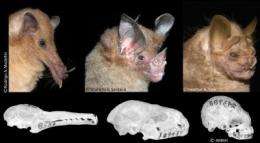
The skulls and faces of a nectar-eating bat (left) an insect-eating bat (middle) and a fruit bat (right). The short skulls of fruit bats allow them to bite harder than nectar or insect-eating bats. Credit: Elizabeth Dumont, UMass Amherst
A new study involving bat skulls, bite force measurements and scat samples collected by an international team of evolutionary biologists is helping to solve a nagging question of evolution: Why some groups of animals develop scores of different species over time while others evolve only a few. Their findings appear in the current issue of Proceedings of the Royal Society B: Biological Sciences.
To answer this question, Elizabeth Dumont at the University of Massachusetts Amherst and Liliana Dávalos of Stony Brook University together with colleagues at UCLA and the Leibniz Institute for Zoo and Wildlife Research, Berlin, compiled large amounts of data on the diet, bite force and skull shape in a family of New World bats, and took advantage of new statistical techniques to date and document changes in the rate of evolution of these traits and the number of species over time.
They investigated why there are so many more species of New World Leaf-Nosed bats, nearly 200, while their closest relatives produced only 10 species over the same period of time. Most bats are insect feeders, while the New World Leaf-Nosed bats eat nectar, fruit, frogs, lizards and even blood.
This video is not supported by your browser at this time.
One hypothesis is that the evolution of a trait, such as head shape, that gives access to new resources can lead to the rapid evolution of many new species. As Dumont and Dávalos explain, connecting changes in body structure to an ecological opportunity requires showing that a significant increase in the number of species occurred in tandem with the appearance of new anatomical traits, and that those traits are associated with enhanced resource use."If the availability of fruit provided the ecological opportunity that, in the presence of anatomical innovations that allowed eating the fruit, led to a significant increase in the birth of new species, then skull morphology should predict both diet and bite force" they said. They found support for these predictions by analyzing thousands of evolutionary trees of more than 150 species, measuring over 600 individual bat skulls of 85 species, testing bite force in over 500 individual bats from 39 species in the field and examining thousands of scat samples to identify the bats' diets.
They found that the emergence of a new skull shape in New World Leaf-Nosed bats about 15 million years ago led to an explosion of many new bat species. The new shape was a low, broad skull that allowed even small bats to produce the strong bite needed to eat hard fruits. The rate of birth of new species jumped as this new shape evolved, and this group of bats quickly increased the proportion of fruit in their diet. Change in shape slowed once this new skull had evolved.
It can be difficult for evolutionary biologists to demonstrate that traits related to anatomical changes, also called "morphological innovations" such as a new skull shape, give certain groups a survival advantage when new food sources, such as hard fruits, become available.
"This study conducted during the International Year of the Bat offers a clear example of how the evolution of new traits, in this case a skull with a new shape, allowed animals to use new resources and eventually, to rapidly evolve into many new species," Dumont says. "We found that when a new ecological niche opened up with an opportunity for bats that could eat hard fruits, they shifted their diet significantly, which in turn led to the evolution of new species."
Provided by University of Massachusetts at Amherst
-
Biologists use GPS to 'map' bats teeth to explore evolutionary adaptations to diet
Feb 16, 2011 |
not rated yet |
0
-
Drunk Bats Manage To Pass Sobriety Tests
Feb 18, 2010 |
not rated yet |
0
-
Engineers, Biologists Join to Explore Bat-Biting Mechanics
Jan 30, 2006 |
not rated yet |
0
-
Gray bats may be making a comeback
Jan 30, 2006 |
not rated yet |
0
-
Evolution of skull and mandible shape in cats
Jul 30, 2008 |
not rated yet |
0
-
Stars containing dark matter should look different from other stars
Feb 20, 2012 |
4.5 / 5 (17) |
11
-
Physicists discover evidence of rare hypernucleus, a component of strange matter
Feb 17, 2012 |
4.7 / 5 (38) |
22
-
Fast photon control brings quantum photonic technologies closer
Feb 13, 2012 |
5 / 5 (8) |
1
-
Engineers build first sub-10-nm carbon nanotube transistor
Feb 01, 2012 |
4.9 / 5 (36) |
32
-
Something old, something new: Evolution and the structural divergence of duplicate genes
Jan 31, 2012 |
4.6 / 5 (7) |
1
-
Eye biology videos
4 hours ago
-
Flowering Plant Revived After 30,000 Years in Permafrost
Feb 21, 2012
-
Toba volcano eruptions - 1.000 - 10,000 breeding pairsunb
Feb 20, 2012
-
How is a specific gene removed from DNA
Feb 20, 2012
-
Reproduction and Human evolution
Feb 19, 2012
-
Viruses: Living or Non-living organisms
Feb 19, 2012
- More from Physics Forums - Biology
More news stories
Surprising diversity at a synapse hints at complex diversity of neural circuitry
A new study reveals a dazzling degree of biological diversity in an unexpected place a single neural connection in the body wall of flies.
10 hours ago |
5 / 5 (4) |
0
|
Men might not 'become extinct' after all: Theory of the 'rotting' Y chromosome dealt a fatal blow
If you were to discover that a fundamental component of human biology has survived virtually intact for the past 25 million years, you'd be quite confident in saying that it is here to stay.
13 hours ago |
5 / 5 (6) |
1
|
New family of legless amphibians found in India
Since before the age of dinosaurs it has burrowed unbothered beneath the monsoon-soaked soils of remote northeast India - unknown to science and mistaken by villagers as a deadly, miniature snake.
21 hours ago |
5 / 5 (8) |
3
Climate change affects bird migration timing in North America
Bird migration timing across North America has been affected by climate change, according to a study published Feb. 22 in the open access journal PLoS ONE.
9 hours ago |
4.5 / 5 (2) |
2
New iridescent lizard species found in Cambodia
A new species of lizard with striking iridescent rainbow skin, a long tail and very short legs has been discovered in the rainforest in northeast Cambodia, conservationists announced Wednesday.
10 hours ago |
not rated yet |
0
Researchers build first physical 'metatronic' circuit
(PhysOrg.com) -- The technological world of the 21st century owes a tremendous amount to advances in electrical engineering, specifically, the ability to finely control the flow of electrical charges using ...
Spitzer finds solid buckyballs in space
(PhysOrg.com) -- Astronomers using data from NASA's Spitzer Space Telescope have, for the first time, discovered buckyballs in a solid form in space. Prior to this discovery, the microscopic carbon spheres ...
Faster than light neutrinos? More like faulty wiring
You can shelf your designs for a warp drive engine (for now) and put the DeLorean back in the garage; it turns out neutrinos may not have broken any cosmic speed limits after all.
Physicists surprised by disappearing and reappearing superconductivity in iron selenium chalcogenides
Superconductivity is a rare physical state in which matter is able to conduct electricity -- maintain a flow of electrons -- without any resistance. This phenomenon can only be found in certain materials at low temperatures, ...
CT colonography shown to be comparable to standard colonoscopy
Computerized tomographic (CT) colonography (CTC), also known as virtual colonoscopy, is comparable to standard colonoscopy in its ability to accurately detect cancer and precancerous polyps in people ages 65 and older, according ...
Stanford research team cracks animated NuCaptcha
(PhysOrg.com) -- The research team from Stanford University, led by Elie Bursztein, that previously had cracked regular CAPTCHAs and then audio CAPTCHAs, now has also successfully cracked the animated version called NuCapt ...