High court troubled by warrantless GPS tracking (Update)
November 8, 2011 By MARK SHERMAN , Associated Press
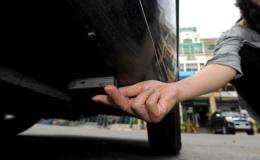
The US Supreme Court is considering whether police can use a GPS device to track a suspect without a warrant

Enlarge

The US Supreme Court delved Tuesday into the issue of privacy amid 21st century technology, hearing arguments on whether police can use a GPS device attached to a vehicle to track a suspect without a search warrant.

The Supreme Court invoked visions of an all-seeing Big Brother and satellites watching us from above. Then things got personal Tuesday when the justices were told police could slap GPS devices on their cars and track their movements, without asking a judge for advance approval.

The occasion for all the talk about intrusive police actions was a hearing in a case about whether the police must get a search warrant before using GPS technology to track criminal suspects. The outcome could have implications for other high-tech surveillance methods as well.

The justices expressed deep reservations about warrantless GPS tracking. But there also was no clear view about how or whether to regulate police use of the devices.

The justices were taken aback when the lawyer representing the government said police officers could install GPS devices on the justices' cars and track their movements without a warrant. To get a warrant, investigators need to convince a judge that there is reason to believe a suspect is involved in criminal activity.

"So your answer is yes, you could tomorrow decide that you put a GPS device on every one of our cars, follow us for a month; no problem under the Constitution?" Chief Justice John Roberts said.

Not only that, government lawyer Michael Dreeben replied, but FBI agents wouldn't need a warrant either if they wanted to rummage through the justices' trash, use a low-tech beeper to track them or tail them around-the-clock with a team of agents. Dreeben said the court has previously ruled that people have no reasonable expectation of privacy in those circumstances.

Justice Samuel Alito captured the essence of the court's concern when he said, "With computers around, it's now so simple to amass an enormous amount of information. How do we deal with this? Just say nothing has changed?"

Justice Stephen Breyer alluded to George Orwell's novel "1984" when he said surveillance in the past depended on human beings and their sometimes flawed memories. But computers don't have that problem, he said.

"The question that I think people are driving at, at least as I understand it and certainly share the concern, is that if you win this case then there is nothing to prevent the police or the government from monitoring 24 hours a day the public movement of every citizen of the United States," Breyer said.

Roberts drew a comparison with artwork to explain his perception of the power of GPS surveillance. "You're talking about the difference between seeing a little tile and a mosaic," Roberts said.

But Dreeben said it would be better for lawmakers rather than judges to set limits. Dreeben said the concerns expressed Tuesday were similar to those in the earlier high court case. Thirty years ago, Dreeben said, "Beeper technology seemed extraordinarily advanced."

The court shouldn't make special rules for GPS devices just because they allow the police to be more efficient in capturing and analyzing data, Dreeben said.

GPS devices are especially useful in early stages of an investigation, when they can eliminate the use of time-consuming stakeouts as officers seek to gather evidence, he said.

The issue arose after the federal appeals court in Washington threw out the drug conspiracy conviction of nightclub owner Antoine Jones. FBI agents and local police did not have a valid search warrant when they installed a GPS device on Jones' car and collected travel information for a month.

The GPS device helped authorities link Jones to a suburban house used to stash money and drugs. He was sentenced to life in prison before the appeals court overturned the conviction. The appellate judges said the authorities should have had a warrant and pointed to the length of the surveillance as a factor in their decision.

For all the unease the justices voiced in questions to Dreeben, they seemed equally torn in questions to Stephen Leckar, Jones' lawyer, about how to impose limits on the police.

Justice Ruth Bader Ginsburg asked whether the use of video surveillance cameras is so different from getting information from a GPS device on a car. In London, Justice Elena Kagan noted, cameras are everywhere.

"It's pretty scary," Leckar said.

Justice Antonin Scalia responded with evident sarcasm. "Well, it must be unconstitutional if it's scary," Scalia said.

More gently, Breyer pointed out that English authorities have used video footage to prevent terrorist attacks.

The point of the questioning was to get Leckar to offer a principled way to draw a line that would still allow police to do their jobs without compromising people's rights.

Leckar said perhaps police could use the GPS device to follow someone for one day or one trip, without first getting a warrant. But that didn't appear to satisfy much of the court, either.

An unusual array of interest groups backs Jones, including the Gun Owners of America, the Council on American-Islamic Relations, the American Civil Liberties Union and an association of truck drivers. The groups say GPS technology is much more powerful than the beeper technology police once employed in surveillance.

Other appeals courts have ruled that search warrants aren't necessary for GPS tracking.

The justices are considering two related issues, whether a warrant is needed before installing the device or using the GPS technology to track a vehicle. They could determine that the installation requires a warrant, leaving the knottier issues relating to tracking to another day.

A decision should come by spring.

The case is U.S. v. Jones, 10-1259.


From now on, you can follow Physorg.com on Google+ too!

©2011 The Associated Press. All rights reserved. This material may not be published, broadcast, rewritten or redistributed.

4.9 /5 (13 votes)  

Filter


Move the slider to adjust rank threshold, so that you can hide some of the comments.


Display comments: newest first

Nerdyguy
Nov 08, 2011

Rank: 5 / 5 (5)
"The justices were taken aback when the lawyer representing the government said police officers could install GPS devices on the justices' cars and track their movements without a warrant."

Why would they be surprised? They've consistently ruled in favor of increasingly intrusive and totalitarian administrations for many decades. Our freedoms have been chipped away a little at a time, and now they're "taken aback"? Makes you wonder if any of those antiquarians actually has any idea how high tech is applied.
tadchem
Nov 08, 2011

Rank: 4 / 5 (3)
The justices should not have been surprised. They themselves ruled "there is no expectation of privacy on public roads". They are also subject to warrantless searches every time they board a commercial airplane...or are they somehow exempted from this as members of the Priveleged Class?
Kedas
Nov 08, 2011

Rank: not rated yet
No idea why they need to do that, they can perfectly track the phone position already.
Nik_2213
Nov 08, 2011

Rank: 5 / 5 (1)
"... they can perfectly track the phone position already."

IIRC, only if the phone is on or in 'standby' mode, when it is 'handshaking' with cell towers. Powered off, it is 'invisible'.
Nerdyguy
Nov 08, 2011

Rank: not rated yet
No idea why they need to do that, they can perfectly track the phone position already.


This is not in regards to cellphone GPS. It's about police slapping miniature gps devices on your bumper, your bike, your scooter, hell probably your kids skateboard. If it's out in the open, it's fair game.
Au-Pu
Nov 08, 2011

Rank: not rated yet
Physorg.
Surely you should be able to prevent the posting of material such as that from "fendo" above.
Osiris1
Nov 09, 2011

Rank: 1 / 5 (1)
Do not these justices seem a little foggy about the Constitution that they are sworn to uphold...for life!...or for Alzheimerhood! Of course the prosecutors in this would like to keep this going, as surveilling the judiciary is exactly what Stalin and Hitler did to the Presidium and the Reichstag as well as the judiciary in order to maintain unquestioned dictatorial control. Now Justice (whoever), you would not want your episode with our decoy agent 'Gloria' to become public now..DON'T YOU!! Maybe now, as the questioner of old Tailgunner Joe McCarthy said, in paraphrase: "The government will finally show a shred of decency!" And I would hope a real respect for freedom, the rule of law, and the use of the Constitution for good instead of a base for a word game to justify medieval tortures and murders. For as said in the "Internationale": Freedom is merely privilege extended unless enjoyed by one and all!
Ricochet
Nov 09, 2011

Rank: not rated yet
I think you got a bit off-track there, Osiris... Part of the problem is when people use the good 'ole Slippery Slope to attach any kind of surveillance technologies to things like "medieval tortures and murders," as you put it, to greatly exaggerate the implications of the use of such technology, warranted or not, in an investigation.
You attach fear to it and suddenly nobobdy wants to hear any more of it.
Decimatus
Nov 09, 2011

Rank: not rated yet
Regardless of GPS scanners, the technology to track you will only get more and more sophisticated.

One day, someone will invent a device or system similar to radar/airport scanners that allows the government to see anything and evertyhing in range, inside and out. Computers will manage everything and tell the government when you are being bad.

By itself, a crime prevention system like that could be good for society. I mean, we would immediately know who stole the missing kids, who raped the girl, where all the terrorists are located, etc.

However, a system like that can easily go from law enforcement device to instant totalitarian dictatorship. Totalitarian in the absolute strongest possible sense of the word.
Ricochet
Nov 09, 2011

Rank: not rated yet
One thing to remember when it comes to "monitoring the actions of every person in the country", much less the globe, is this simple question...

HOW many people is that, exactly?
Decimatus
Nov 09, 2011

Rank: not rated yet
One thing to remember when it comes to "monitoring the actions of every person in the country", much less the globe, is this simple question...

HOW many people is that, exactly?


Computing power makes/will make that irrelevant.

Did you know that NYC has a camera/computer system that scans the face of basically everyone in the city? If you leave a package on the street unattended, it knows and alerts authorities. They can type a simple command such as red shirt, and find everyone within camera shot wearing a red shirt.

Computers and surveilance will only get more powerful over time.

On one hand, it can give more freedom. Even if you do have a gun, they know if you use it on someone they have you. Immediate justice.

On the other hand, if they decide they don't want you to have a gun, there won't be a thing you can do to stop them.

Same for any other action they might decide to label as a crime. You won't be able to get away with it.
Ricochet
Nov 09, 2011

Rank: not rated yet
My point is that they won't use it unless they need it. It would take way too much drive space to keep track of EVERYONE, so don't worry about being tracked unless you have something to hide.
Nerdyguy
Nov 09, 2011

Rank: 5 / 5 (1)
My point is that they won't use it unless they need it. It would take way too much drive space to keep track of EVERYONE, so don't worry about being tracked unless you have something to hide.


Rather than "don't worry about being tracked unless you have something to hide", the America I believe in is a place where "no need for excessive police powers" would be the norm.

Or, at the least, please see the judge for a warrant if you feel you have reason to suspect me of a crime.

You know, that whole crazy notion of "innocent until proven guilty".
tkjtkj
Nov 09, 2011

Rank: not rated yet
One thing to remember when it comes to "monitoring the actions of every person in the country", much less the globe, is this simple question...

HOW many people is that, exactly?


It's soooo many that it'd take a computer to keep track of it all ... 7 billion people.. !
nxtr
Nov 12, 2011

Rank: 5 / 5 (2)
only criminals need fear crime prevention. Corruption or misuse is another thing but I would imagine the same tech will make it harder to cover your tracks if you misuse public tracking.
Ojorf
Nov 13, 2011

Rank: 5 / 5 (1)
so don't worry about being tracked unless you have something to hide.
I generally agree with you, but in addition I would like a live webcan above every politician's desk. :D
Skultch
Nov 20, 2011

Rank: not rated yet
only criminals need fear crime prevention. Corruption or misuse is another thing but I would imagine the same tech will make it harder to cover your tracks if you misuse public tracking.


Great point, but to play satan's lawyer; not if the guy who accepts the bid also oversees the installation of the system. You need human checks and balances for that, and that's where things get screwed up. It's manageable, but for small municipalities, I can see the ease of a corruption tracker workaround.
Rank 4.9 /5 (13 votes)
Related Stories
Relevant PhysicsForums posts

More news stories

Stanford research team cracks animated NuCaptcha

(PhysOrg.com) -- The research team from Stanford University, led by Elie Bursztein, that previously had cracked regular CAPTCHAs and then audio CAPTCHAs, now has also successfully cracked the animated version called NuCapt ...

Technology / Computer Sciences

created 18 hours ago | popularity 5 / 5 (3) | comments 6 | with audio podcast report

Tiny, implantable medical device can propel itself through bloodstream

Someday, your doctor may turn to you and say, "Take two surgeons and call me in the morning." If that day arrives, you may just have Ada Poon to thank.

Technology / Engineering

created 18 hours ago | popularity 5 / 5 (9) | comments 8 | with audio podcast

Italian engineer invents floating solar panels

Rays of the winter sun bounce off gleaming mirrors on the tiny lake of Colignola in Italy, where engineers have built a cost-effective prototype for floating, rotating solar panels.

Technology / Energy & Green Tech

created 22 hours ago | popularity 4.7 / 5 (6) | comments 5

Microsoft hits Motorola, Google with EU complaint

Microsoft on Wednesday lodged a formal complaint with the European Union's competition regulator against Motorola Mobility and its soon-to-be owner Google, saying Motorola's aggressive enforcement of patent ...

Technology / Business

created 17 hours ago | popularity 2 / 5 (1) | comments 2

Calif. pledges better mobile privacy disclosures

(AP) -- Mobile applications seeking to collect personal information will have to forewarn users as part of an agreement reached in California.

Technology / Internet

created 10 hours ago | popularity not rated yet | comments 0


Researchers build first physical 'metatronic' circuit

(PhysOrg.com) -- The technological world of the 21st century owes a tremendous amount to advances in electrical engineering, specifically, the ability to finely control the flow of electrical charges using ...

Spitzer finds solid buckyballs in space

(PhysOrg.com) -- Astronomers using data from NASA's Spitzer Space Telescope have, for the first time, discovered buckyballs in a solid form in space. Prior to this discovery, the microscopic carbon spheres ...

Faster than light neutrinos? More like faulty wiring

You can shelf your designs for a warp drive engine (for now) and put the DeLorean back in the garage; it turns out neutrinos may not have broken any cosmic speed limits after all.

Physicists surprised by disappearing and reappearing superconductivity in iron selenium chalcogenides

Superconductivity is a rare physical state in which matter is able to conduct electricity -- maintain a flow of electrons -- without any resistance. This phenomenon can only be found in certain materials at low temperatures, ...

Going up: Japan builder eyes space elevator

A Japanese construction firm claimed Wednesday it could execute an out-of-this-world plan to put tourists in space within 40 years by building an elevator that stretches a quarter of the way to the moon.

Flesh-eating bacteria inspire superglue

(PhysOrg.com) -- A bio-inspired superglue has been developed by Oxford University researchers that can’t be matched for sticking molecules together and not letting go.