British oceanographers find new species in Indian Ocean hydrothermal vents
December 29, 2011 by Bob Yirka
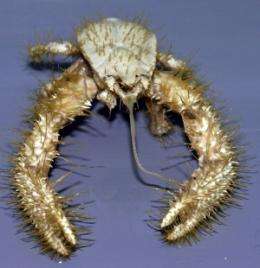
Yeti crab. Image: Andrew Thurber
(PhysOrg.com) -- A research team sailing on the vessel James Cook has been studying the unique habitat surrounding deep sea vents in the Indian Ocean far off the south-east coast of Africa. The vents, created by under-the-sea-floor volcanic activity, spew black cloudy liquid and create a hot hostile environment. One of them, known as the Dragon Vent, was the main focus of cameras fixed to an aquatic robot that captured the existence of some of the exotic animals that are able to live in the distinctive environment. One of those creatures, a type of yeti crab, may even be a species unknown to science.
The expedition, sponsored by Britains Natural Environment Research Council and led by Dr. Jon Copley, a marine biologist, set sail from South Africa early in November and concluded its voyage this past week. During the middle part of that trip, the team sent down a robot called Kiel 6000 which has both cameras and a means for collecting samples of marine life, to the vents to see what sorts of animals might be living down there. Other such ventures to other vents in the Indian Ocean, as well as in other oceans have shown that truly unique types of creatures have evolved that are able to flourish in such a strange part of the planet. Whats not clear, however, is how such creatures manage to move the vast distances between such vents, as the vents, just like volcanoes on land, tend to go dormant between periods of activity.
Other types of sea life found around vents include sea cucumbers, which are long and skinny and are related to sea stars and unique types of snails, shrimp and mussels.
The vents in this latest study, are part of the South West Indian Ridge, and were first noted in 2007 by a team of Chinese researchers. Vents, or fissures in the sea floor, in general were first found to exist back in 1977 and have attracted attention since that time due to the unique life forms that call such areas home, and the fact that such vents tend to create tall mineral spires that look like chimneys which also quite often contain precious metals. Its the existence of these metals though that could pose problems for the aquatic life as humans are apt to destroy the unique ecosystem in extracting them. The Dragon Vent, for example, is likely to be impacted soon as China has just recently been granted mineral exploration and extraction rights by the body of the United Nations responsible for doling out such permission.
© 2011 PhysOrg.com
-
Expedition heads for world's deepest undersea volcanoes
Mar 25, 2010 |
not rated yet |
0
-
More deep-sea vents discovered
Feb 14, 2011 |
not rated yet |
0
-
Fossil find gives hope for animal life in 'lost cities'
Jun 07, 2011 |
not rated yet |
0
-
Research group finds ancient deep sea mud volcano as possible site for origin of life
Oct 18, 2011 |
not rated yet |
0
-
New deep-sea hot springs discovered in the Atlantic
Oct 07, 2010 |
not rated yet |
0
-
Stars containing dark matter should look different from other stars
Feb 20, 2012 |
4.5 / 5 (17) |
11
-
Physicists discover evidence of rare hypernucleus, a component of strange matter
Feb 17, 2012 |
4.7 / 5 (38) |
22
-
Fast photon control brings quantum photonic technologies closer
Feb 13, 2012 |
5 / 5 (8) |
1
-
Engineers build first sub-10-nm carbon nanotube transistor
Feb 01, 2012 |
4.9 / 5 (36) |
32
-
Something old, something new: Evolution and the structural divergence of duplicate genes
Jan 31, 2012 |
4.6 / 5 (7) |
1
-
Eye biology videos
4 hours ago
-
Flowering Plant Revived After 30,000 Years in Permafrost
Feb 21, 2012
-
Toba volcano eruptions - 1.000 - 10,000 breeding pairsunb
Feb 20, 2012
-
How is a specific gene removed from DNA
Feb 20, 2012
-
Reproduction and Human evolution
Feb 19, 2012
-
Viruses: Living or Non-living organisms
Feb 19, 2012
- More from Physics Forums - Biology
More news stories
Surprising diversity at a synapse hints at complex diversity of neural circuitry
A new study reveals a dazzling degree of biological diversity in an unexpected place a single neural connection in the body wall of flies.
10 hours ago |
5 / 5 (4) |
0
|
Men might not 'become extinct' after all: Theory of the 'rotting' Y chromosome dealt a fatal blow
If you were to discover that a fundamental component of human biology has survived virtually intact for the past 25 million years, you'd be quite confident in saying that it is here to stay.
13 hours ago |
5 / 5 (6) |
1
|
New family of legless amphibians found in India
Since before the age of dinosaurs it has burrowed unbothered beneath the monsoon-soaked soils of remote northeast India - unknown to science and mistaken by villagers as a deadly, miniature snake.
21 hours ago |
5 / 5 (8) |
3
Climate change affects bird migration timing in North America
Bird migration timing across North America has been affected by climate change, according to a study published Feb. 22 in the open access journal PLoS ONE.
9 hours ago |
4.5 / 5 (2) |
2
New iridescent lizard species found in Cambodia
A new species of lizard with striking iridescent rainbow skin, a long tail and very short legs has been discovered in the rainforest in northeast Cambodia, conservationists announced Wednesday.
10 hours ago |
not rated yet |
0
Researchers build first physical 'metatronic' circuit
(PhysOrg.com) -- The technological world of the 21st century owes a tremendous amount to advances in electrical engineering, specifically, the ability to finely control the flow of electrical charges using ...
Spitzer finds solid buckyballs in space
(PhysOrg.com) -- Astronomers using data from NASA's Spitzer Space Telescope have, for the first time, discovered buckyballs in a solid form in space. Prior to this discovery, the microscopic carbon spheres ...
Faster than light neutrinos? More like faulty wiring
You can shelf your designs for a warp drive engine (for now) and put the DeLorean back in the garage; it turns out neutrinos may not have broken any cosmic speed limits after all.
Physicists surprised by disappearing and reappearing superconductivity in iron selenium chalcogenides
Superconductivity is a rare physical state in which matter is able to conduct electricity -- maintain a flow of electrons -- without any resistance. This phenomenon can only be found in certain materials at low temperatures, ...
CT colonography shown to be comparable to standard colonoscopy
Computerized tomographic (CT) colonography (CTC), also known as virtual colonoscopy, is comparable to standard colonoscopy in its ability to accurately detect cancer and precancerous polyps in people ages 65 and older, according ...
Stanford research team cracks animated NuCaptcha
(PhysOrg.com) -- The research team from Stanford University, led by Elie Bursztein, that previously had cracked regular CAPTCHAs and then audio CAPTCHAs, now has also successfully cracked the animated version called NuCapt ...
Dec 29, 2011
Rank: 5 / 5 (1)
Jan 01, 2012
Rank: not rated yet