DARPA's new spy satellite could provide real-time video from anywhere on Earth
December 21, 2011 By Nancy Atkinson, Universe Today
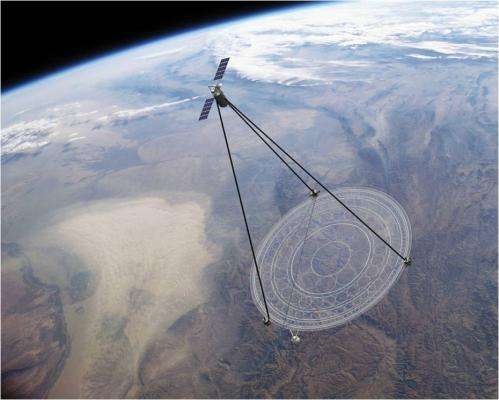
Artist concept of the Membrane Optical Imager for Real-Time Exploitation (MOIRE). Credit: DARPA
It sees you when youre sleeping and knows when youre awake could be the theme song for a new spy satellite being developed by DARPA. The Defense Advanced Research Projects Agencys latest proof-of-concept project is called the Membrane Optical Imager for Real-Time Exploitation (MOIRE), and would provide real-time images and video of any place on Earth at any time a capability that, so far, only exists in the realm of movies and science fiction. The details of this huge eye-in-the-sky look like something right out of science fiction, as well, and it would be interesting to determine if it could have applications for astronomy as well.
MOIRE would be a geosynchronous orbital system that uses a huge but lightweight membrane optic. A 20-meter-wide membrane eye would be etched with a diffractive pattern, according to DARPA, which would focus light on a sensor. Reportedly it will cost $500 million USD for each space-based telescope, and it would be able to image an area greater than 100 x 100 km with a video update rate of at least one frame a second.
DARPA says the program aims to demonstrate the ability to manufacture large membranes and large structures to hold the optics flat, and also demonstrate the secondary optical elements needed to turn a diffraction-based optic into a wide bandwidth imaging device.
The MOIRE program began in March 2010 is now in the first phase of development, where DARPA is testing the concepts viability. Phase 2 would entail system design, with Ball Aerospace doing the design and building to test a 16-foot (5 m) telescope, and an option for a Phase 3 which would include a demonstration of the system, launching a 32-foot (10 m) telescope for flight tests in orbit.
The 20 meter (66 ft) design is quite a bit larger than NASAs next-generation James Webb Space Telescope that has an aperture of 21 feet (6.5 m).
Public Intelligence reports that such a telescope should be able to spot missile launcher vehicles moving at speeds of up to 60 mph on the ground, according to a DARPA contract. That would also require the image resolution to see objects less than 10 feet (3 m) long within a single image pixel.
Can we order one for looking for extrasolar planets?
More information: Read more about the MOIRE on DARPAs website.
Source: Universe Today
-
DARPA unveils new telescope to protect satellites from space debris
Apr 25, 2011 |
not rated yet |
0
-
DARPA's compact high-power laser program completes key milestone
Jul 04, 2011 |
not rated yet |
0
-
Assembly stand completed for James Webb Telescope flight optics
Nov 17, 2011 |
not rated yet |
0
-
Webb telescope primary mirror segment completes cryogenic test
Oct 27, 2010 |
not rated yet |
0
-
First full set of Webb telescope flight mirrors begin final tests
Apr 12, 2011 |
not rated yet |
0
-
Stars containing dark matter should look different from other stars
Feb 20, 2012 |
4.5 / 5 (17) |
11
-
Physicists discover evidence of rare hypernucleus, a component of strange matter
Feb 17, 2012 |
4.7 / 5 (38) |
22
-
Fast photon control brings quantum photonic technologies closer
Feb 13, 2012 |
5 / 5 (8) |
1
-
Engineers build first sub-10-nm carbon nanotube transistor
Feb 01, 2012 |
4.9 / 5 (36) |
32
-
Something old, something new: Evolution and the structural divergence of duplicate genes
Jan 31, 2012 |
4.6 / 5 (7) |
1
-
Calculating the magnitude
2 hours ago
-
What is this spectrum I took?
12 hours ago
-
Orientation of Space
13 hours ago
-
Geologically Active Moon Now: NASA
20 hours ago
-
advice on building a science fair telescope
Feb 22, 2012
-
Rise of the Sun
Feb 22, 2012
- More from Physics Forums - General Astronomy
More news stories
Spitzer finds solid buckyballs in space
(PhysOrg.com) -- Astronomers using data from NASA's Spitzer Space Telescope have, for the first time, discovered buckyballs in a solid form in space. Prior to this discovery, the microscopic carbon spheres ...
14 hours ago |
4.7 / 5 (12) |
8
|
Going up: Japan builder eyes space elevator
A Japanese construction firm claimed Wednesday it could execute an out-of-this-world plan to put tourists in space within 40 years by building an elevator that stretches a quarter of the way to the moon.
Space & Earth / Space Exploration
21 hours ago |
3.5 / 5 (13) |
26
ENASA satellite finds Earth's clouds are getting lower
(PhysOrg.com) -- Earth's clouds got a little lower -- about one percent on average -- during the first decade of this century, finds a new NASA-funded university study based on NASA satellite data. The results ...
Space & Earth / Earth Sciences
18 hours ago |
5 / 5 (8) |
13
|
Fresh scandal embroils US climate science debate
A fresh scandal over climate change has erupted in the United States after leaked documents appeared to show a right-wing funded campaign to influence how climate science is taught in schools.
11 hours ago |
4.1 / 5 (9) |
8
World's oceans get an acid bath
Among the repercussions of global climate change, the effect of ocean acidification on marine life is one of the least-understood variables.
18 hours ago |
4.3 / 5 (6) |
4
|
Researchers build first physical 'metatronic' circuit
(PhysOrg.com) -- The technological world of the 21st century owes a tremendous amount to advances in electrical engineering, specifically, the ability to finely control the flow of electrical charges using ...
Faster than light neutrinos? More like faulty wiring
You can shelf your designs for a warp drive engine (for now) and put the DeLorean back in the garage; it turns out neutrinos may not have broken any cosmic speed limits after all.
Physicists surprised by disappearing and reappearing superconductivity in iron selenium chalcogenides
Superconductivity is a rare physical state in which matter is able to conduct electricity -- maintain a flow of electrons -- without any resistance. This phenomenon can only be found in certain materials at low temperatures, ...
Stanford research team cracks animated NuCaptcha
(PhysOrg.com) -- The research team from Stanford University, led by Elie Bursztein, that previously had cracked regular CAPTCHAs and then audio CAPTCHAs, now has also successfully cracked the animated version called NuCapt ...
Flesh-eating bacteria inspire superglue
(PhysOrg.com) -- A bio-inspired superglue has been developed by Oxford University researchers that cant be matched for sticking molecules together and not letting go.
Scientists create potent molecules aimed at treating muscular dystrophy
While RNA is an appealing drug target, small molecules that can actually affect its function have rarely been found. But now scientists from the Florida campus of The Scripps Research Institute have for the first time designed ...
Dec 21, 2011
Rank: 1.4 / 5 (11)
Is not reassuring when we know world leaders are communicating among themselves and cooperating to control the world:
http://www.physor...iss.html
Dec 21, 2011
Rank: 3.8 / 5 (6)
I should hope so. It's their job, Mr. Paranoid. Oh, and your link is evidence of nothing, other than scientific cooperation.
Dec 21, 2011
Rank: 4.8 / 5 (5)
Dec 21, 2011
Rank: 1 / 5 (10)
http://dl.dropbox...oots.pdf
Dec 21, 2011
Rank: 5 / 5 (5)
However, to imply that it sees whether you are awake, may be a bit far fetched for something that only barely can see objects less than three meters (10ft) long.
Dec 21, 2011
Rank: 4.4 / 5 (7)
Too bad it isn't an easy to fix your broken brain.
Stop spamming this site with your paranoia and 'theories' that have little basis in REAL science. There is a reason why you haven't been given the Nobel Prize... you are incorrect. Let it go already.
Dec 21, 2011
Rank: not rated yet
Dec 21, 2011
Rank: 5 / 5 (3)
Everybody 'report abuse' this guy, PLEASE
Dec 21, 2011
Rank: not rated yet
Dec 21, 2011
Rank: not rated yet
Dec 21, 2011
Rank: 1.6 / 5 (5)
http://news.yahoo...097.html
Dec 22, 2011
Rank: not rated yet
That was my first question also. I expected to see 5,000 of them and then they show this and say that!?
Dec 22, 2011
Rank: 5 / 5 (2)
Dec 22, 2011
Rank: 1 / 5 (5)
Was the simultaneous collapse of Western science and Western economies a remarkable coincidence?
http://chiefio.wo...er-2011/
Either way there is a Holiday Message of Hope in every atom, leaf and rock: The universe is in good hands!
http://dl.dropbox...Fear.pdf
So be of good cheer!
Dec 22, 2011
Rank: not rated yet
Dec 26, 2011
Rank: 3 / 5 (4)