Japan, Russia see chance to clone mammoth
December 4, 2011
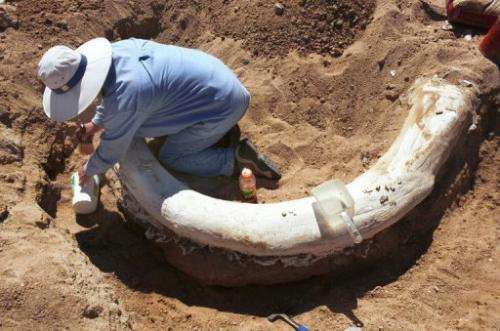
An archaeologist removes dirt from around a 50,000 year old mammoth tusk. Scientists from Japan and Russia believe it may be possible to clone a mammoth after finding well-preserved bone marrow in a thigh bone recovered from permafrost soil in Siberia, a report said Saturday.
Scientists from Japan and Russia believe it may be possible to clone a mammoth after finding well-preserved bone marrow in a thigh bone recovered from permafrost soil in Siberia, a report said Saturday.
Teams from the Sakha Republic's mammoth museum and Japan's Kinki University will launch fully-fledged joint research next year aiming to recreate the giant mammal, Japan's Kyodo News reported from Yakutsk, Russia.
By replacing the nuclei of egg cells from an elephant with those taken from the mammoth's marrow cells, embryos with mammoth DNA can be produced, Kyodo said, citing the researchers.
The scientists will then plant the embryos into elephant wombs for delivery, as the two species are close relatives, the report said.
Securing nuclei with an undamaged gene is essential for the nucleus transplantation technique, it said.
For scientists involved in the research since the late 1990s, finding nuclei with undamaged mammoth genes has been a challenge. Mammoths became extinct about 10,000 years ago.
But the discovery in August of the well-preserved thigh bone in Siberia has increased the chances of a successful cloning.
Global warming has thawed ground in eastern Russia that is usually almost permanently frozen, leading to the discoveries of a number of frozen mammoths, the report said.
(c) 2011 AFP
-
Scientists aim to bring mammoth back to life
Jan 16, 2011 |
not rated yet |
0
-
Russian 'Jurassic park' under development
Mar 30, 2006 |
not rated yet |
0
-
Woolly mammoth's secrets for shrugging off cold points toward new artificial blood for humans
Sep 14, 2011 |
not rated yet |
0
-
Baby mammoth preserved in frozen soil heads to Chicago
Oct 04, 2009 |
not rated yet |
0
-
A mammoth task -- sorting out mammoth evolution
May 30, 2011 |
not rated yet |
0
-
Stars containing dark matter should look different from other stars
Feb 20, 2012 |
4.5 / 5 (17) |
11
-
Physicists discover evidence of rare hypernucleus, a component of strange matter
Feb 17, 2012 |
4.7 / 5 (38) |
22
-
Fast photon control brings quantum photonic technologies closer
Feb 13, 2012 |
5 / 5 (8) |
1
-
Engineers build first sub-10-nm carbon nanotube transistor
Feb 01, 2012 |
4.9 / 5 (36) |
32
-
Something old, something new: Evolution and the structural divergence of duplicate genes
Jan 31, 2012 |
4.6 / 5 (7) |
1
-
Eye biology videos
4 hours ago
-
Flowering Plant Revived After 30,000 Years in Permafrost
Feb 21, 2012
-
Toba volcano eruptions - 1.000 - 10,000 breeding pairsunb
Feb 20, 2012
-
How is a specific gene removed from DNA
Feb 20, 2012
-
Reproduction and Human evolution
Feb 19, 2012
-
Viruses: Living or Non-living organisms
Feb 19, 2012
- More from Physics Forums - Biology
More news stories
Surprising diversity at a synapse hints at complex diversity of neural circuitry
A new study reveals a dazzling degree of biological diversity in an unexpected place a single neural connection in the body wall of flies.
11 hours ago |
5 / 5 (4) |
0
|
Men might not 'become extinct' after all: Theory of the 'rotting' Y chromosome dealt a fatal blow
If you were to discover that a fundamental component of human biology has survived virtually intact for the past 25 million years, you'd be quite confident in saying that it is here to stay.
14 hours ago |
5 / 5 (6) |
1
|
New family of legless amphibians found in India
Since before the age of dinosaurs it has burrowed unbothered beneath the monsoon-soaked soils of remote northeast India - unknown to science and mistaken by villagers as a deadly, miniature snake.
21 hours ago |
5 / 5 (9) |
3
Climate change affects bird migration timing in North America
Bird migration timing across North America has been affected by climate change, according to a study published Feb. 22 in the open access journal PLoS ONE.
10 hours ago |
4.5 / 5 (2) |
2
New iridescent lizard species found in Cambodia
A new species of lizard with striking iridescent rainbow skin, a long tail and very short legs has been discovered in the rainforest in northeast Cambodia, conservationists announced Wednesday.
10 hours ago |
not rated yet |
0
Researchers build first physical 'metatronic' circuit
(PhysOrg.com) -- The technological world of the 21st century owes a tremendous amount to advances in electrical engineering, specifically, the ability to finely control the flow of electrical charges using ...
Spitzer finds solid buckyballs in space
(PhysOrg.com) -- Astronomers using data from NASA's Spitzer Space Telescope have, for the first time, discovered buckyballs in a solid form in space. Prior to this discovery, the microscopic carbon spheres ...
Faster than light neutrinos? More like faulty wiring
You can shelf your designs for a warp drive engine (for now) and put the DeLorean back in the garage; it turns out neutrinos may not have broken any cosmic speed limits after all.
Physicists surprised by disappearing and reappearing superconductivity in iron selenium chalcogenides
Superconductivity is a rare physical state in which matter is able to conduct electricity -- maintain a flow of electrons -- without any resistance. This phenomenon can only be found in certain materials at low temperatures, ...
Stanford research team cracks animated NuCaptcha
(PhysOrg.com) -- The research team from Stanford University, led by Elie Bursztein, that previously had cracked regular CAPTCHAs and then audio CAPTCHAs, now has also successfully cracked the animated version called NuCapt ...
Going up: Japan builder eyes space elevator
A Japanese construction firm claimed Wednesday it could execute an out-of-this-world plan to put tourists in space within 40 years by building an elevator that stretches a quarter of the way to the moon.
Dec 04, 2011
Rank: 5 / 5 (15)
Dec 04, 2011
Rank: 2.3 / 5 (3)
Dec 04, 2011
Rank: 1.3 / 5 (14)
There was a reason why tha mammoths went extinct, let them rest in peace.
Dec 04, 2011
Rank: 1.8 / 5 (5)
Dec 04, 2011
Rank: 4.2 / 5 (5)
Dec 04, 2011
Rank: 5 / 5 (4)
Most unlikely nonetheless. Only the mammoth is possible to be seen again in my lifetime.
Imagine a mammoth ride through the taiga in the winter.... (SOME wodka included :-)
Dec 04, 2011
Rank: 1.2 / 5 (5)
Dec 04, 2011
Rank: 5 / 5 (7)
Also, I would pay to ride a mammoth.
well, a real mammoth, not scifreak86's mother-in-law.
Dec 04, 2011
Rank: 2.6 / 5 (5)
Dec 04, 2011
Rank: 3 / 5 (4)
Dec 04, 2011
Rank: 3 / 5 (4)
Dec 04, 2011
Rank: 1.3 / 5 (4)
Don't make it sound so noble. I don't think that logic holds up. It's for own enjoyment ultimately.
We just regret not seeing the big furry elephants since we (probably) killed them off 10k years ago.
Dec 04, 2011
Rank: 3 / 5 (4)
Tastes like chicken :)
Dec 04, 2011
Rank: not rated yet
They need to find some viable mammoth eggs to put the DNA in.
Dec 04, 2011
Rank: 4.2 / 5 (5)
Dec 04, 2011
Rank: 4 / 5 (6)
I bet some day we will be able to reverse-engineer a creature just from a good fossil specimen, together with what we will learn about genetics and the function of organisms and evolution. We will be able to discern from that skeleton what organs it held and what muscles were attached to it. From those we should be able to rewrite a large percent of the code which created them, which we could compare to their descendants and fill in even more. Etc.
Life is probably a very complex formula with suprisingly few variables.
Dec 04, 2011
Rank: 3.3 / 5 (6)
Dec 04, 2011
Rank: 4.2 / 5 (5)
A new science - reconstructive evolution. We could surmise the existence of animals we havent found yet due to the evidence that that form was necessary to bridge a certain gap.
We could create extremely detailed computer models of these animals in lieu of actually growing them. Cell for cell perhaps. As they're planning on doing with the human brain.
Dec 04, 2011
Rank: 5 / 5 (3)
http://www.foodba...eat.html
-A collector friend of mine had one of those tusks sitting on his coffee table.
Dec 04, 2011
Rank: 2.5 / 5 (6)
We could even resurrect the mammoth hunt as a human pastime activity.
Dec 04, 2011
Rank: 2.6 / 5 (5)
Dec 04, 2011
Rank: 3.8 / 5 (5)
The reason they went extinct is likely due to overhunting. This is the same reason nearly everything is going extinct these days.
It's because of people like this, that I hope that they DO resurrect the mammoth.
a) It will show that the species isn't lost forever.
b) It will give us a chance to see them alive, study them and study their lifestyle.
c) And, most importantly, it will make the naysayers unhappy.
Also, it would be awesome if they could also do this with other animals (i.e. Neanderthals, Wooly Rhino, Thylacine, Sabre Toothed Tigers). Dinosaurs are still much of a stretch, since we don't have any preserved Dinosaur tissue.
Dec 04, 2011
Rank: 2.6 / 5 (5)
Hold on a second...
There, I've cleaned the mess, my mind has exploded. Frozen mammoth meat, well I don't see why not! It would certainly make for enormous bragging rights, and could be a culinary experience for a gourmet who has tried all other meats. I just haven't thought about naturally frozen mammoth before!
Dec 04, 2011
Rank: 2.3 / 5 (6)
Dec 04, 2011
Rank: 3.8 / 5 (5)
Dec 05, 2011
Rank: 1 / 5 (5)
Dec 05, 2011
Rank: 3.5 / 5 (4)
How can there be any genetic diversity if all of them are clones of the same animal? Wouldn't all of the other clones have the exact DNA, hence the term clone?
Dec 05, 2011
Rank: 3 / 5 (3)
Really? That's all you got from that?
Dec 05, 2011
Rank: 1 / 5 (2)
genome, DNA engineering?
Dec 05, 2011
Rank: 1.7 / 5 (6)
Dec 05, 2011
Rank: 3 / 5 (4)
http://en.wikiped...fy31.jpg
That's my vote for the name of the first one:
" Aloysius "
Dec 05, 2011
Rank: 4.5 / 5 (4)
My guess is at best we will get a sick, short lived mammoth, if it develops at all :(. But doesn't hurt to try, cause you never know.
Dec 05, 2011
Rank: 5 / 5 (4)
Dec 05, 2011
Rank: not rated yet
Actually the Pyrenean Ibex was brought back for all of 7 minutes.
Dec 05, 2011
Rank: 5 / 5 (2)
FREEZING INSTANTANEOUS
"A writer in Knowledge for 1892, tells of the many discoveries of mammoth flesh in fresh condition and mentions that the natives of Siberia as well as their dogs have eaten of the flesh-another striking proof of its freshness. But perhaps the most remarkable testimony of this sort is the fact that an actual banquet has been served from the flesh of this supposedly extinct animal"
There is another similar from the 1920 where a reporter tried mammoth meat and claimed what he had was horrible and uneatable because of a freezer-burn type taste.
I think we need some fresh stuff.
Dec 05, 2011
Rank: 3.7 / 5 (3)
Dec 05, 2011
Rank: 5 / 5 (1)
Dec 05, 2011
Rank: 5 / 5 (5)
Both the lack of genetic diversity and the mitochondrial RNA are valid points in any case.
Dec 05, 2011
Rank: 4.3 / 5 (3)
Some cloned sheep and cattle are living nearly full lives now. It seems that they have been making progress. Just because we have trouble now, doesn't mean we won't perfect it later, or even become moderately successful.
As for genetic diversity, I bet the elephant is close enough genetically to cross breed and create a hybrid animal that is analagous to the mammoth but has enough diversity to survive as a population.
i think the biggest obstacle is the fact that you'll have to severely upgrade the slaughter houses to handle animals that big.
Dec 05, 2011
Rank: 1 / 5 (3)
Why the hell would you think that?
Extinction is as natural as death, would you work to oppose death as well?
If you answer yes you haven't fully considered the ramifications of either.
Dec 05, 2011
Rank: 4.2 / 5 (5)
Uhh... you do realize that the world is equally strange for everything when they are born right? The newly born organism has no idea that all others of it's kind existed a long time ago... it would not feel out of place like a time traveler would... it is a new life born now, just like anything else.
Dec 05, 2011
Rank: 0.9 / 5 (54)
Why would one not? I'm assuming you think it is futile. Do you have a different reason?
Also Humans are an emergent property of the universe so anything we do is also "natural". Resurrecting extinct species would be a natural act, as ALL acts are.
Natural/unnatural is the most lazy, meaningless false dichotomy imaginable.
Dec 05, 2011
Rank: 3 / 5 (4)
Death is a prerequisite of 99.99999etc% of all life that has ever existed... death drives evolution. complex multicellular life would not exist without it.
I fully agree with this. I didn't mean to imply it would be unnatural to oppose death, just unwise
Dec 05, 2011
Rank: 0.9 / 5 (51)
^The original quote
I don't think it is a prerequisite of life. That seems anthropic to me. And before we get muddied in definitions immortality IS NOT invulnerability. I'm not saying technology will defeat death, I'm saying technology can defeat aging.
You can view aging as a genetic disease that all humans (and most organisms) share. Bacteria don't age in the same sense we do. They just kind of grow and bud off. As far as multicellular life, there is the immortal jellyfish http://en.wikiped...utricula .
I view it as a genetic disease in light of humanity (and a few other organisms) species-wide genetic inability to produce vitamin C. Aging just happens to be more complex and selected for for more reasons.
Maybe death is required to develop complex, intelligent life. We're already there though. We have the presence of mind to change it
Dec 05, 2011
Rank: 2.7 / 5 (3)
Otherwise I agree with you, but must point out that our lifespans were likely selected for like anything else... once you've reproduced and raised your offspring to maturity you don't really contribute anything more to the fitness of the species.
Dec 05, 2011
Rank: 4.3 / 5 (3)
If you clone a whole herd, assumably from different corpses, how would they know how to act together?
At best you will have an animatronic version of a mammoth.
Dec 05, 2011
Rank: 5 / 5 (1)
That's a little extreme, isn't it?
Dec 05, 2011
Rank: 3 / 5 (4)
I took it as him trying to show off about his knowledge of weapons or something... it was an odd comment in any case.
Dec 05, 2011
Rank: 3.7 / 5 (6)
Dec 06, 2011
Rank: 3 / 5 (2)
I took the comment about the compound bows, etc, as a sort of tongue in cheek reference as to how 'hunting for mammoths like our ancestors' wouldn't really resemble the way that our ancestors did it.
If you actually know anything at an introductory level about those weapons, then you would realize that he's trying to make it sound extreme on purpose - not to demonstrate knowledge...It's a mix of mostly common high end elements, and a few made up components.
Dec 06, 2011
Rank: 0.9 / 5 (50)
It very well could be that they had a learned culture that is lost, never to be recovered. I remember reading something similar about a type of extremely endangered tiger. They aren't worrying about it going extinct, but they are worried about it's learned behaviors going extinct.
I'd say the mammoth would probably be in a similar situation. Integrating them into elephant "culture" may be the only option.
Dec 06, 2011
Rank: 5 / 5 (2)
Correction - those are all real elements. The point is though that we use all this technology and materials science to get 'back to the basics'
Dec 07, 2011
Rank: 5 / 5 (2)
You're probably right, but that wasn't how I saw it. I saw it as a hypothetical plan to brutally murder mammoths. lol
Dec 07, 2011
Rank: 5 / 5 (2)
Dec 08, 2011
Rank: 5 / 5 (2)
Dec 08, 2011
Rank: 2 / 5 (2)
I see - the Russians found a bone, so they want to use it as an opportunity for getting the priority and as a source grant money by now, the actual results are secondary. We should learn first how to clone an elephant reliably before wasting the only sample we have for adventurous experiments. Just my few cents, these Russian primitives will not listen anybody anyway. http://www2.macle...erosene/
Dec 08, 2011
Rank: not rated yet
Dec 08, 2011
Rank: 5 / 5 (1)
https://www.googl...=cloning endangered species&gs_upl=0l0l0l3967lllllllllll0&aqi=g4s1
-Still not working o well.
Dec 09, 2011
Rank: 1 / 5 (1)
Dec 09, 2011
Rank: 1 / 5 (1)
Jan 04, 2012
Rank: 1 / 5 (1)