Multi-purpose photonic chip paves the way to programmable quantum processors

December 11, 2011
Artist’s impression of the quantum photonic chip, showing the waveguide circuit (in white), and the voltage-controlled phase shifters (metal contacts on the surface). Photon pairs become entangled as they pass through the circuit.
The fundamental resource that drives a quantum computer is entanglementthe connection between two distant particles which Einstein famously called 'spooky action at a distance'. The Bristol researchers have, for the first time, shown that this remarkable phenomenon can be generated, manipulated and measured entirely on a tiny silica chip. They have also used the same chip to measure mixturean often unwanted effect from the environment, but a phenomenon which can now be controlled and used to characterize quantum circuits, as well as being of fundamental interest to physicists.
"In order to build a quantum computer, we not only need to be able to control complex phenomena such as entanglement and mixture, but we need to be able to do this on a chip, so that we can scalably and practically duplicate many such miniature circuitsin much the same way as the modern computers we have today," says Professor Jeremy O'Brien, Director of the Centre for Quantum Photonics. "Our device enables this and we believe it is a major step forward towards optical quantum computing."
The chip, which performs several experiments that would each ordinarily be carried out on an optical bench the size of a large dining table, is 70 mm by 3 mm. It consists of a network of tiny channels which guide, manipulate and interact single photonsparticles of light. Using eight reconfigurable electrodes embedded in the circuit, photon pairs can be manipulated and entangled, producing any possible entangled state of two photons or any mixed state of one photon.
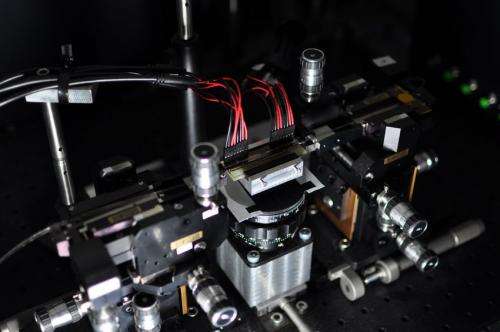
The reconfigurable quantum photonic chip and two alignment stages. Photon pairs are coupled into the chip through optical fibres, which require precise alignment.
"It isn't ideal if your quantum computer can only perform a single specific task", explains Peter Shadbolt, lead author of the study, which is published in the journal Nature Photonics. "We would prefer to have a reconfigurable device which can perform a broad variety of tasks, much like our desktop PCs todaythis reconfigurable ability is what we have now demonstrated. This device is approximately ten times more complex than previous experiments using this technology. It's exciting because we can perform many different experiments in a very straightforward way, using a single reconfigurable chip."The researchers, who have been developing quantum photonic chips for the past six years, are now working on scaling up the complexity of this device, and see this technology as the building block for the quantum computers of the future.
Dr Terry Rudolph from Imperial College in London, UK, believes this work is a significant advance. He said: "Being able to generate, manipulate and measure entanglement on a chip is an awesome achievement. Not only is it a key step towards the many quantum technologies such as optical quantum computingwhich are going to revolutionize our lives, it gives us much more opportunity to explore and play with some of the very weird quantum phenomena we still struggle to wrap our minds around. They have made it so easy to dial up in seconds an experiment that used to take us months, that I'm wondering if even I can run my own experiment now!"
More information: 'Generating, manipulating and measuring entanglement and mixture with a reconfigurable photonic circuit' by P. J. Shadbolt, M. R. Verde, A. Peruzzo, A. Politi, A. Laing, M. Lobino, J. C. F. Matthews, M. G. Thompson and J. L. O'Brien in Nature Photonics
-
Prototype 'optics table on a chip' places microwave photon in two colors at once
Jul 07, 2011 |
not rated yet |
0
-
Optical circuit enables new approach to quantum technologies
Jun 24, 2011 |
not rated yet |
0
-
Manipulating light on a chip for quantum technologies
Jun 05, 2009 |
not rated yet |
0
-
Optical chip enables new approach to quantum computing
Sep 16, 2010 |
not rated yet |
0
-
Quantum electronics: Two photons and chips
Jan 20, 2006 |
not rated yet |
0
-
Stars containing dark matter should look different from other stars
Feb 20, 2012 |
4.5 / 5 (17) |
11
-
Physicists discover evidence of rare hypernucleus, a component of strange matter
Feb 17, 2012 |
4.7 / 5 (38) |
22
-
Fast photon control brings quantum photonic technologies closer
Feb 13, 2012 |
5 / 5 (8) |
1
-
Engineers build first sub-10-nm carbon nanotube transistor
Feb 01, 2012 |
4.9 / 5 (36) |
32
-
Something old, something new: Evolution and the structural divergence of duplicate genes
Jan 31, 2012 |
4.6 / 5 (7) |
1
-
linear wave equation vs. linear system
1 hour ago
-
adhesive force and surface tension
1 hour ago
-
Newbie here.
3 hours ago
-
Rainbows in space?
3 hours ago
-
taking mechanical physics next fall
5 hours ago
-
Help: maximum force of an object when given impulse and time on a graph
8 hours ago
- More from Physics Forums - General Physics
More news stories
Researchers build first physical 'metatronic' circuit
(PhysOrg.com) -- The technological world of the 21st century owes a tremendous amount to advances in electrical engineering, specifically, the ability to finely control the flow of electrical charges using ...
10 hours ago |
4.7 / 5 (17) |
5
|
Faster than light neutrinos? More like faulty wiring
You can shelf your designs for a warp drive engine (for now) and put the DeLorean back in the garage; it turns out neutrinos may not have broken any cosmic speed limits after all.
9 hours ago |
4.2 / 5 (22) |
23
|
Physicists surprised by disappearing and reappearing superconductivity in iron selenium chalcogenides
Superconductivity is a rare physical state in which matter is able to conduct electricity -- maintain a flow of electrons -- without any resistance. This phenomenon can only be found in certain materials at low temperatures, ...
13 hours ago |
5 / 5 (5) |
2
|
Less is more: Study of tiny droplets could have big impact on industrial applications
(PhysOrg.com) -- Under a microscope, a tiny droplet slides between two fine hairs like a roller coaster on a set of rails until poof it suddenly spreads along them, a droplet no more.
10 hours ago |
3.7 / 5 (3) |
0
|
Study reveals switching mechanism in promising computer memory device
(PhysOrg.com) -- Sometimes knowing that a new technology works is not enough. You also must know why it works to get marketplace acceptance. New information from the National Institute of Standards and Technology ...
17 hours ago |
4 / 5 (4) |
0
|
Spitzer finds solid buckyballs in space
(PhysOrg.com) -- Astronomers using data from NASA's Spitzer Space Telescope have, for the first time, discovered buckyballs in a solid form in space. Prior to this discovery, the microscopic carbon spheres ...
Stanford research team cracks animated NuCaptcha
(PhysOrg.com) -- The research team from Stanford University, led by Elie Bursztein, that previously had cracked regular CAPTCHAs and then audio CAPTCHAs, now has also successfully cracked the animated version called NuCapt ...
CT colonography shown to be comparable to standard colonoscopy
Computerized tomographic (CT) colonography (CTC), also known as virtual colonoscopy, is comparable to standard colonoscopy in its ability to accurately detect cancer and precancerous polyps in people ages 65 and older, according ...
Going up: Japan builder eyes space elevator
A Japanese construction firm claimed Wednesday it could execute an out-of-this-world plan to put tourists in space within 40 years by building an elevator that stretches a quarter of the way to the moon.
Scientists create potent molecules aimed at treating muscular dystrophy
While RNA is an appealing drug target, small molecules that can actually affect its function have rarely been found. But now scientists from the Florida campus of The Scripps Research Institute have for the first time designed ...
Flesh-eating bacteria inspire superglue
(PhysOrg.com) -- A bio-inspired superglue has been developed by Oxford University researchers that cant be matched for sticking molecules together and not letting go.

Dec 11, 2011
Rank: 2.3 / 5 (3)
Interesting.
Why not create an "add-on" card to add quantum functionality to existing computers?
If that's the size of the circuit, then you could make a card about the size of a Video Card and fit roughly 100 of these devices in the same space (assuming you lined both sides of the card with them.)
Of course, the "precise alignment" thing could be a problem for an ordinary PC add-on card.
Some quantum algorithms really only need a few qubits, so who knows. Maybe that'd be more than enough?
Dec 11, 2011
Rank: 2.3 / 5 (6)
Dec 11, 2011
Rank: 1 / 5 (2)
Dec 11, 2011
Rank: not rated yet
If it is at ambient, this is only one step on the road to real quantum computers, for one thing, ten times the complexity is only a baby step since you would need hundreds of these devices for a functional QC. Funny, that used to mean Quality Control:)
Dec 11, 2011
Rank: 2.4 / 5 (7)
Thank God for Socialism.
"Yes yes another quantum computing breakthrough here and another graphene breakthrough there but WHEN can i buy a laptop with a quantum or graphene processor already!!!" - Capitalism Fails
Dec 12, 2011
Rank: not rated yet
Quantum computers are happening fast. They're going to speed up figuring out everything from nanotech to a.i. We're going to find out who's naughty or nice; i'm going to enjoy the near future!
Hope you've been questioning your assumptions and following the truth!
Dec 12, 2011
Rank: not rated yet
Dec 12, 2011
Rank: not rated yet
Dec 12, 2011
Rank: not rated yet
The experiment is room temperature which is very neat, I think the major drawback is the "configurable" components rely on heat transfer which is an inherently slow process ... none the less a very neat experiment in the right direction.
Dec 12, 2011
Rank: not rated yet
I can't remember the exact formula, but it is a finite improvement.
Honestly, for most mundane applications it's only a few orders of magnitude improvement.
For something really big, like modeling the universe, or running an A.I. or whatever, it could be millions or billions of times better with the right algorithm.
Also, some problems which can theoretically be solved on a quantum computer cannot be solved on a classical computer at all, so in those cases there is no comparison.
Like anything else in computers, it depends on the data set and complexity of the model you are doing...
Dec 12, 2011
Rank: not rated yet
en.wikipedia.org/wiki/Quantum_computer
Translation:
If you had an 8 digit password, the quantum algorithm could solve a worst case scenario in 16 iterations, while the best possible classical algorithm would require at least 256 iterations for a worst case scenario.
This doesn't mean a QC is "16 times better".
It just means a QC is 16 times better, assuming Grover's Algorithm, and in the case of N=8.
If N = 2, then the QC is barely even better.
If N = 100, then the QC is better by a factor of 2^50, which would be about a quadrillion times better.
If N = 1000, which it might be in a weather model or a cosmology model, the QC is better by a factor of 2^500, which is 3*10^150: 3 followed by 150 zeros...
Dec 12, 2011
Rank: not rated yet
Real world applications usually have sequential data input and outputs, human interactions, interactions between different computer systems, etc.
The best you can hope for is that software developers would be able to program a library of "quantum functions" which some classical functions would make use of, or pass input and output to and from one another.
Highly nested algorithms like classical computers use in games, operating systems, business software, etc, will not translate easily to quantum algorithms. ALTHOUGH, you will probably be able to replace SOME functions with quantum functions, certainly not all.
So you might have a quantum sort in your business software, or a quantum pathfinding algorithm for a video game ai, etc.
Just dont expect Windows, or any operating system, to be a million times better. It won't be.
Dec 12, 2011
Rank: 5 / 5 (1)
Dec 13, 2011
Rank: not rated yet