Underwater neutrino detector will be second-largest structure ever built

December 21, 2011 by Jason Major, Universe Today
Underwater neutrino detector will be second-largest structure ever built

Enlarge

Artist's rendering of the KM3NeT array. Credit: Marco Kraan/Property KM3NeT Consortium

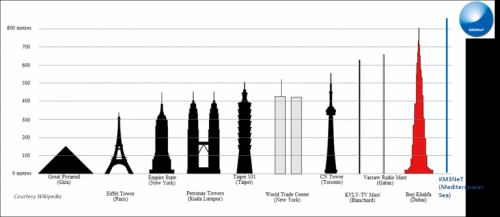
The hunt for elusive neutrinos will soon get its largest and most powerful tool yet: the enormous KM3NeT telescope, currently under development by a consortium of 40 institutions from ten European countries. Once completed KM3NeT will be the second-largest structure ever made by humans, after the Great Wall of China, and taller than the Burj Khalifa in Dubai… but submerged beneath 3,200 feet of ocean!

KM3NeT – so named because it will encompass an area of several cubic kilometers – will be composed of lengths of cable holding optical modules on the ends of long arms. These modules will stare at the sea floor beneath the Mediterranean in an attempt to detect the impacts of neutrinos traveling down from deep space.

Successfully spotting neutrinos – subatomic particles that don’t interact with “normal” matter very much at all, nor have magnetic charges – will help researchers to determine which direction they originated from. That in turn will help them pinpoint distant sources of powerful radiation, like quasars and gamma-ray bursts. Only neutrinos could make it this far and this long after such events since they can pass basically unimpeded across vast cosmic distances.

Underwater neutrino detector will be second-largest structure ever built
Enlarge

Each Digital Optical Module (DOM) is a standalone sensor module with 31 3-inch PMTs in a 17-inch glass sphere.

“The only high energy particles that can come from very distant sources are neutrinos,” said Giorgio Riccobene, a physicist and staff researcher at the National Institute for Nuclear Physics. ”So by looking at them, we can probe the far and violent universe.”

In effect, by looking down beneath the sea KM3NeT will allow scientists to peer outward into the Universe, deep into space as well as far back in time.
Underwater neutrino detector will be second-largest structure ever built
Enlarge

Height of the KM3NeT telescope structure compared to well-known buildings.

The optical modules dispersed along the KM3NeT array will be able to identify the light given off by muons when neutrinos pass into the sea floor. The entire structure would have thousands of the modules (which resemble large versions of the hovering training spheres used by Luke Skywalker in Star Wars.)

In addition to searching for neutrinos passing through Earth, KM3NeT will also look toward the galactic center and search for the presence of there, which would help confirm the purported existence of dark matter.

More information: Read more about the KM3NeT project here.

Source: Universe Today

4.9 /5 (14 votes)  

Filter


Move the slider to adjust rank threshold, so that you can hide some of the comments.


Display comments: newest first

mohamad_nabaa
Dec 21, 2011

Rank: 1.8 / 5 (5)
why is it submerged,and how will neutrinos be detected by optical modules?
rawa1
Dec 21, 2011

Rank: 4.7 / 5 (14)
why is it submerged,and how will neutrinos be detected by optical modules?
The neutrinos can be detected only with reaction with high amount of matter, because they're interacting only very weakly with it. When the neutrino collides with atom nuclei, it generates fast electrons or muons, which are moving with nearly the speed of light in vacuum. These fast moving charged particles are slowed down during their travel through marine water into speed of light in water, which is substantially lower. The difference of energy is radiated in form of Cherenkov radiation, a weak blue radiation which can be detected with photodetectors. The marine water is cheap, bulky and transparent enough for these purpose.

http://hyperphysi...nkov.gif
rawa1
Dec 21, 2011

Rank: 4.7 / 5 (12)
This type of neutrino detector is actually very similar to the famous "Ice Cube" detector, which is already successfully running inside of Antarctic ice. The Antarctic ice is more transparent and shielded from artificial sources of light - but the Medditerian sea is way more accessible from apparent reasons and the undersea detector can be maintained more easily.

http://www.dailym...ace.html
mohamad_nabaa
Dec 21, 2011

Rank: 5 / 5 (3)
World of Physics, truly is Amazing and pioneering
Pyle
Dec 21, 2011

Rank: 5 / 5 (6)
Nice one Zephir. Another obvious point answering the question

why is it submerged,


It be dark down there. Same as with the Ice Cube detector. If you were watching for the "spark" from the neutrino collisions with the ground it would be overwhelmed with light from other sources (the sun, moon, Venus, lights, etc.) Down in the deep there are many fewer sources to filter out and they are looking for a very specific signature of the interaction of the neutrinos.
Nanobanano
Dec 21, 2011

Rank: 1.3 / 5 (19)
I think they've gone mad, actually.

If they can spend this kind of money on a neutrino detector, why not spend a similar amount on fixing the world's more immediate problems, like energy, food, the economy, etc?

What's next after this project is completed like 50 years from now?

will they make 1000 more of them all over the atlantic, Indian, and pacific basins as well?

They looking for the Anunaki or something?
El_Nose
Dec 21, 2011

Rank: 3.5 / 5 (2)
why the mediteranean --- its earthquake prone
Pyle
Dec 21, 2011

Rank: 5 / 5 (12)
QC: There are ALWAYS going to be "better" ways to spend money. This project, per the link at the bottom of the article, is slated to spend a third that of the tower in Dubai. I think your time is better spent railing against the phallic superstructure rather than attacking a research project designed to improve our understanding of the building blocks and fundamental properties of the universe we live in.

Update on my "it be dark" comment. Someone mentioned over at UT is takes several kilometers of sea water to filter out the muon activity from cosmic rays. Much more relevant than the reflection of the sun off of Venus mentioned in my lame comment.
rawa1
Dec 21, 2011

Rank: 1.1 / 5 (13)
If they can spend this kind of money on a neutrino detector, why not spend a similar amount on fixing the world's more immediate problems, like energy, food, the economy, etc?
Because physicists are separated from the rest of society and they do care only about projects and ideas, which are solving their problems - not the problems of the rest of society. The twenty years standing ignorance of cold fusion demonstrates it most clearly, but this is not the only example at all.
Every social group which lacks the public feedback converges into this approach undeniably and we should solve it, if we don't want to suffer with serious slowing of progress.
There are ALWAYS going to be "better" ways to spend money.
Your answer just illustrates, the proponents of mainstream science have ABSOLUTELY NO CLUE about ways of prioritization of research. They're simply always asking all money, which they can get at given time. This is just another argument for more stringent public control.
rawa1
Dec 21, 2011

Rank: 1.4 / 5 (10)
Nice one Zephir. Another obvious point answering the question
I know. Everyone can see, the answers, which are following the existing way of knowledge are upvoted here (because they don't require thinking, so that every troll feels familiar with it) - whereas the answers, which bring something new are downvoted here (because the thinking is painfull for trolls, so they feel unsure with it).

http://www.physor...eas.html

In this way every public voting converges into censorship of new ideas and trivialization of the existing ones undeniably. So, if we really want to support the innovative thinking, we should change the way, in which the people in public forums are labelled with others.
rawa1
Dec 21, 2011

Rank: 1 / 5 (3)
This is just another argument for more stringent public control.
The above requirement may sound like the attempt for malicious ostracising of poor scientists - who are indeed just doing their job in their very best all the time... - but in its consequence it will bring more money into research and science instead. For example, if we would insist on preferential research of cold fusion before twenty years, we shouldn't cut many research programs by now just because of financial crisis. The physicists would have their research and the rest of people would have their cheap energy by now.

It's as simple as it is - or not?
malapropism
Dec 21, 2011

Rank: not rated yet
How do they prevent the optical detectors getting gunged up with crap drifting down from the surface of the sea, or colonised by sea life, and obscured?
antialias_physorg
Dec 21, 2011

Rank: 5 / 5 (12)
If they can spend this kind of money on a neutrino detector, why not spend a similar amount on fixing the world's more immediate problems

To put this in perspective:
You can build 6 of these detectors for the cost of one F35 fighter jet.

Now I want you to say 'waste' six times for each F35 to be bought. After you have said 4338 times 'waste' you may say 'waste' ONCE for this detector. Deal?

Your priorities and perceptions of reality are WAY out of kilter.
Cube
Dec 21, 2011

Rank: 3.7 / 5 (3)
The twenty years standing ignorance of cold fusion demonstrates it most clearly, but this is not the only example at all.


Actually the NAVY has had a full cold fusion research team for 20 years now. The results have been absolutely confirmed and peer reviewed (this is using the Pd deuterium system of Ponz and Fleischman, not Rossi's Ni-H)

It is actually impossible to deny cold fusion after you watch the full talk given last year by the SPAWAR team. That said the NAVY recently shut down the research group, though all the researchers have been sent to another research facility to continue their work.

http://www.youtub...hJCcNBBc

Whether or not Rossi's e-cat does what he says remains to be seen, but no one who call themselves a scientist can deny cold fusion is real. It has been peer reviewed and repeatedly demonstrated. If you have a problem with Rossi fine, but cold fusion is definitely science. [/end off topic rant]
Cube
Dec 21, 2011

Rank: 5 / 5 (2)
more on topic, the structures described here will be large, but they wont cost nearly as much as an above ground building. They're big but the're mostly cable. It'll cost far less than the LHC and that behemoth in Dubai, that's for sure.
Telekinetic
Dec 21, 2011

Rank: 5 / 5 (5)
How do they prevent the optical detectors getting gunged up with crap drifting down from the surface of the sea, or colonised by sea life, and obscured?


MerMAIDS.
bewertow
Dec 22, 2011

Rank: 4.4 / 5 (9)
I think they've gone mad, actually.

If they can spend this kind of money on a neutrino detector, why not spend a similar amount on fixing the world's more immediate problems, like energy, food, the economy, etc?

What's next after this project is completed like 50 years from now?

will they make 1000 more of them all over the atlantic, Indian, and pacific basins as well?

They looking for the Anunaki or something?


What are you doing on a science website if you hate science? How about you STFU and go watch some Fox News for your daily dose of stupidity.
rawa1
Dec 22, 2011

Rank: 1.5 / 5 (8)
What are you doing on a science website if you hate science?
Actually, the only thing which I love more than science is the application of science.

Personally, I do perceive nothing attractive on the situation, when the human civilization will end in nuclear wars for the rest of fossil fuels because of ignorance of cold fusion and another findings, whereas the Earth will be full of detectors, telescopes and particle accelerators. We will extinct smart - but for what, exactly?

It will just indicate, some group of people got too much money and power, but low responsibility.
rawa1
Dec 22, 2011

Rank: 1 / 5 (9)
You can build 6 of these detectors for the cost of one F35 fighter jet.
It's indeed true, but if the physicists wouldn't hinder the cold fusion research, we could save even this F35 fighter. In this sense just the physicists are co-responsible for the high price of F35 fighters, because of fossil fuel crisis.

And there are many other things, which actually do limit the usefulness of scientific research in objective way. If the civilization will extinct poor, its knowledge would be useless. The implementation of each scientific finding requires wide infrastructure of engineers and technicians. The players of strategic games like the Civilization or Age Of Empires know quire well, it has no meaning to spend all resources into research, which is advancing the current level of society evolution too much. We will forget such a results sooner, before they could be applied. In some cases, the knowledge could even become harmless for civilization, which is not prepared for its usage.
rawa1
Dec 22, 2011

Rank: 1 / 5 (8)
The people who ignore more substantial research on behalf of this dispensable one are illiterate, not me. I can just see the things in wider connections than these experts, who just care about their research.
http://money.cnn....ndex.htm
http://www.nypost...QJHmT5QO
Without sufficient energy source we wouldn't have both the neutrino detectors, both the usage for them (which is even worse). This is why the proponents of mainstream science are getting so upset just with the cold fusion - it illustrates clearly, how dispensable they're actually are and how deeply they're responsible for the current situation. It's no secret for me.
mohamad_nabaa
Dec 22, 2011

Rank: 5 / 5 (4)
how is it about money and energy now? isnt this page about science? the same science that can enhance humanity as it always did?!
Anda
Dec 26, 2011

Rank: 5 / 5 (1)
Rawa1 is not illiterate:

"The players of strategic games like the Civilization or Age Of Empires know quire well, it has no meaning to spend all resources into research"

Lots of things in this aether brain...
Rank 4.9 /5 (14 votes)
Related Stories
Relevant PhysicsForums posts
  • which college offer Light and modern physics in summer?
    created59 minutes ago
  • linear wave equation vs. linear system
    created2 hours ago
  • adhesive force and surface tension
    created2 hours ago
  • Newbie here.
    created4 hours ago
  • Rainbows in space?
    created4 hours ago
  • taking mechanical physics next fall
    created5 hours ago
  • More from Physics Forums - General Physics

More news stories

Researchers build first physical 'metatronic' circuit

(PhysOrg.com) -- The technological world of the 21st century owes a tremendous amount to advances in electrical engineering, specifically, the ability to finely control the flow of electrical charges using ...

Physics / General Physics

created 10 hours ago | popularity 4.7 / 5 (17) | comments 5 | with audio podcast

Faster than light neutrinos? More like faulty wiring

You can shelf your designs for a warp drive engine (for now) and put the DeLorean back in the garage; it turns out neutrinos may not have broken any cosmic speed limits after all.

Physics / General Physics

created 9 hours ago | popularity 4.2 / 5 (22) | comments 23 | with audio podcast

Physicists surprised by disappearing and reappearing superconductivity in iron selenium chalcogenides

Superconductivity is a rare physical state in which matter is able to conduct electricity -- maintain a flow of electrons -- without any resistance. This phenomenon can only be found in certain materials at low temperatures, ...

Physics / Superconductivity

created 13 hours ago | popularity 5 / 5 (5) | comments 2 | with audio podcast

Less is more: Study of tiny droplets could have big impact on industrial applications

(PhysOrg.com) -- Under a microscope, a tiny droplet slides between two fine hairs like a roller coaster on a set of rails until — poof — it suddenly spreads along them, a droplet no more.

Physics / General Physics

created 10 hours ago | popularity 3.7 / 5 (3) | comments 0 | with audio podcast

Study reveals switching mechanism in promising computer memory device

(PhysOrg.com) -- Sometimes knowing that a new technology works is not enough. You also must know why it works to get marketplace acceptance. New information from the National Institute of Standards and Technology ...

Physics / General Physics

created 17 hours ago | popularity 4 / 5 (4) | comments 0 | with audio podcast


Spitzer finds solid buckyballs in space

(PhysOrg.com) -- Astronomers using data from NASA's Spitzer Space Telescope have, for the first time, discovered buckyballs in a solid form in space. Prior to this discovery, the microscopic carbon spheres ...

Stanford research team cracks animated NuCaptcha

(PhysOrg.com) -- The research team from Stanford University, led by Elie Bursztein, that previously had cracked regular CAPTCHAs and then audio CAPTCHAs, now has also successfully cracked the animated version called NuCapt ...

CT colonography shown to be comparable to standard colonoscopy

Computerized tomographic (CT) colonography (CTC), also known as virtual colonoscopy, is comparable to standard colonoscopy in its ability to accurately detect cancer and precancerous polyps in people ages 65 and older, according ...

Going up: Japan builder eyes space elevator

A Japanese construction firm claimed Wednesday it could execute an out-of-this-world plan to put tourists in space within 40 years by building an elevator that stretches a quarter of the way to the moon.

Scientists create potent molecules aimed at treating muscular dystrophy

While RNA is an appealing drug target, small molecules that can actually affect its function have rarely been found. But now scientists from the Florida campus of The Scripps Research Institute have for the first time designed ...

Flesh-eating bacteria inspire superglue

(PhysOrg.com) -- A bio-inspired superglue has been developed by Oxford University researchers that can’t be matched for sticking molecules together and not letting go.