Is Vesta the 'smallest terrestrial planet?'
December 12, 2011 By Dauna Coulter
Is vesta the "smallest terrestrial planet?"

Enlarge

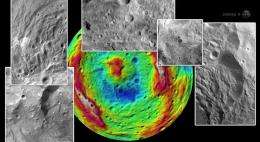
Like Earth and other terrestrial planets, Vesta has ancient basaltic lava flows on the surface and a large iron core. It also has tectonic features, troughs, ridges, cliffs, hills and a giant mountain. False colors in this montage denote topography, where the colors indicate heights ranging from -22 km to +19 km above a reference ellipsoid.

NASA's Dawn spacecraft spent the last four years voyaging to asteroid Vesta – and may have found a planet.

Vesta was discovered over two hundred years ago but, until Dawn, has been seen only as an indistinct blur and considered little more than a large, rocky body. Now the spacecraft's instruments are revealing the true complexity of this ancient world.

"We're seeing enormous mountains, valleys, hills, cliffs, troughs, ridges, craters of all sizes, and plains," says Chris Russell, Dawn principal investigator from UCLA. "Vesta is not a simple ball of rock. This is a world with a rich geochemical history. It has quite a story to tell!"

In fact, the asteroid is so complex that Russell and members of his team are calling it the "smallest terrestrial planet."

Vesta has an iron core, notes Russell, and its surface features indicate that the asteroid is "differentiated" like the terrestrial planets Earth, Mercury, Mars, and Venus.

Differentiation is what happens when the interior of an active planet gets hot enough to melt, separating its materials into layers. The light material floats to the top while the heavy elements, such as iron and nickel, sink to the center of the planet.

Researchers believe this process also happened to Vesta.

This video is not supported by your browser at this time.

The story begins about 4.57 billion years ago, when the planets of the Solar System started forming from the primordial solar nebula. As Jupiter gathered itself together, its powerful gravity stirred up the material in the asteroid belt so objects there could no longer coalesce. Vesta was in the process of growing into a full-fledged planet when Jupiter interrupted the process.

Although Vesta’s growth was stunted, it is still differentiated like a true planet.

"We believe that the Solar System received an extra slug of radioactive aluminum and iron from a nearby supernova explosion at the time Vesta was forming," explains Russell. "These materials decay and give off heat. As the asteroid was gathering material up into a big ball of rock, it was also trapping the heat inside itself."

As Vesta’s core melted, lighter materials rose to the surface, forming volcanoes and mountains and lava flows.

"We think Vesta had volcanoes and flowing lava at one time, although we've not yet found any ancient volcanoes there," says Russell. "We're still looking. Vesta's plains seem similar to Hawaii's surface, which is basaltic lava solidified after flowing onto the surface.

Vesta has so much in common with the terrestrial planets, should it be formally reclassified from "" to "dwarf planet"?

"That's up to the International Astronomical Union, but at least on the inside, Vesta is doing all the things a planet does."

If anyone asks Russell, he knows how he would vote.

Source: Science@NASA

4.5 /5 (13 votes)  

Filter


Move the slider to adjust rank threshold, so that you can hide some of the comments.


Display comments: newest first

SoylentGrin
Dec 12, 2011

Rank: 3.6 / 5 (8)
I was in favor of reclassifying Pluto, because if it's a planet, we'd have to rewrite the texts every time we found a Kuiper Belt object like it. But based on the new rules, Vesta definitely seems to qualify, even more than Pluto.
Guess we gotta rewrite the texts one more time.
rawa1
Dec 12, 2011

Rank: 3 / 5 (3)
It indicates, how powerful the radioactive heating of planetoids is. We could live comfortably there inside of tunnels just a few miles beneath the surface. BTW It is estimated that about 5% of all meteorite falls on Earth originated from Vesta.
Ethelred
Dec 12, 2011

Rank: 4.2 / 5 (5)
Vesta does not qualify any more than Pluto does with the present definition. It has not cleared its orbit.

Zephir, that radioactive heating was due to short half life isotopes. They all completely decayed a long time ago. Uranium 238 is the main remaining isotope and it takes a much bigger body to have enough to keep the center molten. Even Mars is now gone cold in the center.

Ethelred
jsa09
Dec 12, 2011

Rank: 3.7 / 5 (3)
Hey Ethelred, SoylentGrin was saying that Vesta qualifies as a dwarf planet even better than Pluto does. Dwarf planets don't have to clear their orbits. At least that is the way I read his/her comments.

I was in favor of reclassifying Pluto, because if it's a planet, we'd have to rewrite the texts every time we found a Kuiper Belt object like it.

... in favour of clasifying Pluto as dwarf planet.
But based on the new rules, Vesta definitely seems to qualify, even more than Pluto.


... as dwarf planet
Guess we gotta rewrite the texts one more time.

Osiris1
Dec 12, 2011

Rank: 2.3 / 5 (6)
Guess if we want our planet back, Pluto, we will have to ask Congress to pass a law defining Pluto as a planet, and make its attempted redefinition as anything else a felony. There are a lot of Pluto supporters out there. And tradition says it is a planet. WE all learned the rhymes to remember the NINE planets, and resent the dimunition of our system.
marraco
Dec 13, 2011

Rank: 3.7 / 5 (3)
Just another childish attempt to make Pluto a planet again.
Sinister1811
Dec 13, 2011

Rank: 4 / 5 (3)
"We love Pluto, therefore it should be a planet".

That's their only argument. And it's a stupid one. Personally, I prefer the NEW label "Dwarf Planet", since it's more accurate.

Reasons Pluto shouldn't be a major planet:
1. It's one of the smallest objects in the solar system (even the moon is larger by comparison).
2. There are other bodies in the solar system like it (some of them are even larger, for example; Eris), and none of them are considered "planets". So what makes Pluto so special?
Sinister1811
Dec 13, 2011

Rank: 5 / 5 (1)
Vesta could be classified as a fourth Dwarf Planet, though. I wouldn't see any problem with that. There'd be Ceres, Vesta, Pluto and Eris (probably not in that order).
Ethelred
Dec 13, 2011

Rank: 5 / 5 (2)
Hey Ethelred, SoylentGrin was saying that Vesta qualifies as a dwarf plane
OK, I didn't read it that way. Since Vesta is fairly spherical I thought of it as a dwarf planet along with Ceres. So that is why I saw it differently.

However I don't see how it qualifies more than Pluto as that has a moon and is much more massive.

Ethelred
Rank 4.5 /5 (13 votes)
Related Stories
Relevant PhysicsForums posts
  • Calculating the magnitude
    created2 hours ago
  • What is this spectrum I took?
    created12 hours ago
  • Orientation of Space
    created13 hours ago
  • Geologically Active Moon Now: NASA
    created20 hours ago
  • advice on building a science fair telescope
    createdFeb 22, 2012
  • Rise of the Sun
    createdFeb 22, 2012
  • More from Physics Forums - General Astronomy

More news stories

Spitzer finds solid buckyballs in space

(PhysOrg.com) -- Astronomers using data from NASA's Spitzer Space Telescope have, for the first time, discovered buckyballs in a solid form in space. Prior to this discovery, the microscopic carbon spheres ...

Space & Earth / Astronomy

created 14 hours ago | popularity 4.7 / 5 (12) | comments 8 | with audio podcast

Going up: Japan builder eyes space elevator

A Japanese construction firm claimed Wednesday it could execute an out-of-this-world plan to put tourists in space within 40 years by building an elevator that stretches a quarter of the way to the moon.

Space & Earth / Space Exploration

created 21 hours ago | popularity 3.5 / 5 (13) | comments 26

ENASA satellite finds Earth's clouds are getting lower

(PhysOrg.com) -- Earth's clouds got a little lower -- about one percent on average -- during the first decade of this century, finds a new NASA-funded university study based on NASA satellite data. The results ...

Space & Earth / Earth Sciences

created 18 hours ago | popularity 5 / 5 (8) | comments 13 | with audio podcast

Fresh scandal embroils US climate science debate

A fresh scandal over climate change has erupted in the United States after leaked documents appeared to show a right-wing funded campaign to influence how climate science is taught in schools.

Space & Earth / Environment

created 11 hours ago | popularity 4.1 / 5 (9) | comments 8

World's oceans get an acid bath

Among the repercussions of global climate change, the effect of ocean acidification on marine life is one of the least-understood variables.

Space & Earth / Environment

created 18 hours ago | popularity 4.3 / 5 (6) | comments 4 | with audio podcast


Researchers build first physical 'metatronic' circuit

(PhysOrg.com) -- The technological world of the 21st century owes a tremendous amount to advances in electrical engineering, specifically, the ability to finely control the flow of electrical charges using ...

Faster than light neutrinos? More like faulty wiring

You can shelf your designs for a warp drive engine (for now) and put the DeLorean back in the garage; it turns out neutrinos may not have broken any cosmic speed limits after all.

Physicists surprised by disappearing and reappearing superconductivity in iron selenium chalcogenides

Superconductivity is a rare physical state in which matter is able to conduct electricity -- maintain a flow of electrons -- without any resistance. This phenomenon can only be found in certain materials at low temperatures, ...

Stanford research team cracks animated NuCaptcha

(PhysOrg.com) -- The research team from Stanford University, led by Elie Bursztein, that previously had cracked regular CAPTCHAs and then audio CAPTCHAs, now has also successfully cracked the animated version called NuCapt ...

Flesh-eating bacteria inspire superglue

(PhysOrg.com) -- A bio-inspired superglue has been developed by Oxford University researchers that can’t be matched for sticking molecules together and not letting go.

Scientists create potent molecules aimed at treating muscular dystrophy

While RNA is an appealing drug target, small molecules that can actually affect its function have rarely been found. But now scientists from the Florida campus of The Scripps Research Institute have for the first time designed ...