Australians make Antarctic history
January 27, 2012
Justin Jones and James Castrission have made Antarctic history

Enlarge

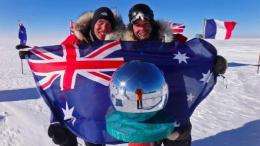
A handout photo taken and released by You Can on December 31, shows Australians Justin Jones (L), 28, and James Castrission, 29, displaying the Australian flag at the South Pole sphere which marked the half-way point of their 2,270 km unaided expedition from the edge of Antarctica to the South Pole and back.

Two Australian adventurers have made Antarctic history by becoming the first team to travel unaided to the South Pole and back, surviving three months of "extreme hardship", they said on Friday.

James Castrission, a 29-year-old accountant, and Justin Jones, 28 and a scientist, skied 2,270 kilometres (1,400 miles) to complete the arduous trek, overcoming fatigue, injuries and hallucinations from and food.

"It's an absolutely fantastic feeling, I can't describe the elation I am feeling right now," said Castrission after reaching home base late Thursday.

"It has been nearly three months of extreme hardship and at times simply surviving this adventure has been our goal.

"It's great to finish this trek on Australia Day (January 26) too and we can't wait to step onto the tarmac at Sydney Airport next week."

The pair reached the Pole on December 31 and en route passed the previous longest polar skiing trip without airdrops or sails. That record was set in 2009 when Norwegian Cecilie Skog and American Ryan Waters covered 1,800 kilometres.

Both men beefed up by about 20 kilograms (45 pounds) each in preparation for the gruelling trip, during which they towed 160 kilograms of gear.

They were eating the calorie equivalent of 15 beef burgers a day until caused delays in reaching the , forcing them to ration their .

They ended up losing 55 kilograms in weight between them.

"Despite the blisters, ulcers, soreness and fatigue I feel fantastic," said Jones.

"This trek has been the most mentally and physically demanding thing I have ever done but it feels worth it.

"I know the enormity of what we have achieved probably won't sink in until we are back home, however I'm now just looking forward to a nice hot meal and sleeping in a comfortable bed."

Over the past 89 days they endured heavy snowfall and winds of up to 70 kilometres per hour while the has been minus 25 Celsius (minus 13 Fahrenheit).

The men are now awaiting a flight out of Antarctica, which will take them to Chile to undergo medical examinations before returning to Australia next week.

They are familiar with extremes, have previously battled giant seas, sickness, sharks and food shortages during a 62-day world record crossing of the Tasman Sea in a kayak in 2007-2008 -- a 3,300-kilometre journey.

(c) 2012 AFP


Rank 5 /5 (1 vote)
Related Stories
Relevant PhysicsForums posts
  • Is the Earth really going to die
    created14 hours ago
  • Do some geologists actually act a lot like Randy Marsh?
    createdFeb 11, 2012
  • Discrepancy between oxygen and carbon-dioxide levels
    createdFeb 09, 2012
  • where gems are found in the world
    createdFeb 09, 2012
  • Wind Waves in Reservoir ~ Wind run-up and Wind set-up
    createdFeb 08, 2012
  • Balance of oxygen in the atmosphere
    createdFeb 01, 2012
  • More from Physics Forums - Earth

More news stories

Spitzer finds solid buckyballs in space

(PhysOrg.com) -- Astronomers using data from NASA's Spitzer Space Telescope have, for the first time, discovered buckyballs in a solid form in space. Prior to this discovery, the microscopic carbon spheres ...

Space & Earth / Astronomy

created 14 hours ago | popularity 4.7 / 5 (12) | comments 8 | with audio podcast

Going up: Japan builder eyes space elevator

A Japanese construction firm claimed Wednesday it could execute an out-of-this-world plan to put tourists in space within 40 years by building an elevator that stretches a quarter of the way to the moon.

Space & Earth / Space Exploration

created 21 hours ago | popularity 3.5 / 5 (13) | comments 26

ENASA satellite finds Earth's clouds are getting lower

(PhysOrg.com) -- Earth's clouds got a little lower -- about one percent on average -- during the first decade of this century, finds a new NASA-funded university study based on NASA satellite data. The results ...

Space & Earth / Earth Sciences

created 18 hours ago | popularity 5 / 5 (8) | comments 13 | with audio podcast

Fresh scandal embroils US climate science debate

A fresh scandal over climate change has erupted in the United States after leaked documents appeared to show a right-wing funded campaign to influence how climate science is taught in schools.

Space & Earth / Environment

created 10 hours ago | popularity 4.1 / 5 (9) | comments 8

World's oceans get an acid bath

Among the repercussions of global climate change, the effect of ocean acidification on marine life is one of the least-understood variables.

Space & Earth / Environment

created 17 hours ago | popularity 4.3 / 5 (6) | comments 4 | with audio podcast


Researchers build first physical 'metatronic' circuit

(PhysOrg.com) -- The technological world of the 21st century owes a tremendous amount to advances in electrical engineering, specifically, the ability to finely control the flow of electrical charges using ...

Faster than light neutrinos? More like faulty wiring

You can shelf your designs for a warp drive engine (for now) and put the DeLorean back in the garage; it turns out neutrinos may not have broken any cosmic speed limits after all.

Physicists surprised by disappearing and reappearing superconductivity in iron selenium chalcogenides

Superconductivity is a rare physical state in which matter is able to conduct electricity -- maintain a flow of electrons -- without any resistance. This phenomenon can only be found in certain materials at low temperatures, ...

CT colonography shown to be comparable to standard colonoscopy

Computerized tomographic (CT) colonography (CTC), also known as virtual colonoscopy, is comparable to standard colonoscopy in its ability to accurately detect cancer and precancerous polyps in people ages 65 and older, according ...

Stanford research team cracks animated NuCaptcha

(PhysOrg.com) -- The research team from Stanford University, led by Elie Bursztein, that previously had cracked regular CAPTCHAs and then audio CAPTCHAs, now has also successfully cracked the animated version called NuCapt ...

Study: Virtual colonoscopy effective screening tool for adults over 65

Computed tomography (CT) colonography can be used as a primary screening tool for colorectal cancer in adults over the age of 65, according to a new study published online in the journal Radiology.