Bilayer graphene works as an insulator
January 24, 2012
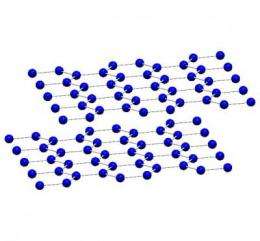
The image shows a bilayer graphene schematic. The blue beads represent carbon atoms. Credit: Lau lab, UC Riverside
A research team led by physicists at the University of California, Riverside has identified a property of "bilayer graphene" (BLG) that the researchers say is analogous to finding the Higgs boson in particle physics.
Graphene, nature's thinnest elastic material, is a one-atom thick sheet of carbon atoms arranged in a hexagonal lattice. Because of graphene's planar and chicken wire-like structure, sheets of it lend themselves well to stacking.
BLG is formed when two graphene sheets are stacked in a special manner. Like graphene, BLG has high current-carrying capacity, also known as high electron conductivity. The high current-carrying capacity results from the extremely high velocities that electrons can acquire in a graphene sheet.
The physicists report online Jan. 22 in Nature Nanotechnology that in investigating BLG's properties they found that when the number of electrons on the BLG sheet is close to 0, the material becomes insulating (that is, it resists flow of electrical current) a finding that has implications for the use of graphene as an electronic material in the semiconductor and electronics industries.
"BLG becomes insulating because its electrons spontaneously organize themselves when their number is small," said Chun Ning (Jeanie) Lau, an associate professor of physics and astronomy and the lead author of the research paper. "Instead of moving around randomly, the electrons move in an orderly fashion. This is called 'spontaneous symmetry breaking' in physics, and is a very important concept since it is the same principle that 'endows' mass for particles in high energy physics."
Lau explained that a typical conductor has a huge number of electrons, which move around randomly, rather like a party with ten thousand guests with no assigned seats at dining tables. If the party only has four guests, however, then the guests will have to interact with each other and sit down at a table. Similarly, when BLG has only a few electrons the interactions cause the electrons to behave in an orderly manner.
New quantum particle
Allan MacDonald, the Sid W. Richardson Foundation Regents Chair in the Department of Physics at The University of Texas at Austin and a coauthor on the research paper, noted that team has measured the mass of a new type of massive quantum particle that can be found only inside BLG crystals.
"The physics which gives these particles their mass is closely analogous to the physics which makes the mass of a proton inside an atomic nucleus very much larger than the mass of the quarks from which it is formed," he said. "Our team's particle is made of electrons, however, not quarks."
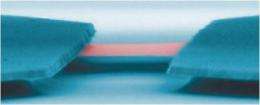
Photo shows a scanning electron microscope image of a graphene sheet (red) suspended between two electrodes. The length of the graphene sheet shown is about 1/100 of the width of a human hair. Credit: Lau lab, UC Riverside
MacDonald explained that the experiment the research team conducted was motivated by theoretical work which anticipated that new particles would emerge from the electron sea of a BLG crystal."Now that the eagerly anticipated particles have been found, future experiments will help settle an ongoing theoretical debate on their properties," he said.
Practical applications
An important finding of the research team is that the intrinsic "energy gap" in BLG grows with increasing magnetic field.
In solid state physics, an energy gap (or band gap) refers to an energy range in a solid where no electron states can exist. Generally, the size of the energy gap of a material determines whether it is a metal (no gap), semiconductor (small gap) or insulator (large gap). The presence of an energy gap in silicon is critical to the semiconductor industry since, for digital applications, engineers need to turn the device 'on' or conductive, and 'off' or insulating.
Single layer graphene (SLG) is gapless, however, and cannot be completely turned off because regardless of the number of electrons on SLG, it always remains metallic and a conductor.
"This is terribly disadvantageous from an electronics point of view," said Lau, a member of UC Riverside's Center for Nanoscale Science and Engineering. "BLG, on the other hand, can in fact be turned off. Our research is in the initial phase, and, presently, the band gap is still too small for practical applications. What is tremendously exciting though is that this work suggests a promising route trilayer graphene and tetralayer graphene, which are likely to have much larger energy gaps that can be used for digital and infrared technologies. We already have begun working with these materials."
More information: http://www.nature. … 011.251.html
Provided by University of California - Riverside (news : web)
-
How graphene's electrical properties can be tuned
Sep 26, 2011 |
not rated yet |
0
-
Two graphene layers may be better than one
Apr 27, 2011 |
not rated yet |
0
-
Bilayer graphene is another step toward graphene electronics
Aug 11, 2011 |
not rated yet |
0
-
The secrets of tunneling through energy barriers
Nov 07, 2011 |
not rated yet |
0
-
Graphene may gain an 'on-off switch,' adding semiconductor to long list of material's achievements
Jun 17, 2011 |
not rated yet |
0
-
Stars containing dark matter should look different from other stars
Feb 20, 2012 |
4.5 / 5 (17) |
11
-
Physicists discover evidence of rare hypernucleus, a component of strange matter
Feb 17, 2012 |
4.7 / 5 (38) |
22
-
Fast photon control brings quantum photonic technologies closer
Feb 13, 2012 |
5 / 5 (8) |
1
-
Engineers build first sub-10-nm carbon nanotube transistor
Feb 01, 2012 |
4.9 / 5 (36) |
32
-
Something old, something new: Evolution and the structural divergence of duplicate genes
Jan 31, 2012 |
4.6 / 5 (7) |
1
-
Strength reduction factors for welded edge joints
3 hours ago
-
Specific heat of Al
Feb 21, 2012
-
Strongest steel?
Feb 19, 2012
-
stabilizing Zirconia
Feb 18, 2012
-
How to calculate strength of welds (welded joints)?
Feb 17, 2012
-
Polycarbonate fracture toughness????
Feb 16, 2012
- More from Physics Forums - Materials & Chemical Engineering
More news stories
New nanotechnology converts heat into power when it's needed most
Never get stranded with a dead cell phone again. A promising new technology called Power Felt, a thermoelectric device that converts body heat into an electrical current, soon could create enough juice to make another call ...
17 hours ago |
4 / 5 (8) |
6
|
Researchers discover how different nanomaterial surfaces affect proteins
A new study led by nanotechnology and biotechnology experts at Rensselaer Polytechnic Institute is providing important details on how proteins in our bodies interact with nanomaterials. In their new study, published in the ...
Nanotechnology / Bio & Medicine
10 hours ago |
5 / 5 (2) |
1
|
Graphene is thinnest known anti-corrosion coating
New research has established the "miracle material" called graphene as the world's thinnest known coating for protecting metals against corrosion. Their study on this potential new use of graphene appears ...
Nanotechnology / Nanomaterials
13 hours ago |
4.6 / 5 (7) |
2
|
New technique produces free-standing piezoelectric ferroelectric nanostructures from PZT material
(PhysOrg.com) -- Researchers have developed a soft template infiltration technique for fabricating free-standing piezoelectrically active ferroelectric nanotubes and other nanostructures from PZT ...
17 hours ago |
5 / 5 (5) |
4
|
A new twist on nanowires
Nanowires — microscopic fibers that can be “grown” in the lab — are a hot research topic today, with a variety of potential applications including light-emitting diodes (LEDs) and sensors. ...
19 hours ago |
4.8 / 5 (4) |
0
|
Researchers build first physical 'metatronic' circuit
(PhysOrg.com) -- The technological world of the 21st century owes a tremendous amount to advances in electrical engineering, specifically, the ability to finely control the flow of electrical charges using ...
Spitzer finds solid buckyballs in space
(PhysOrg.com) -- Astronomers using data from NASA's Spitzer Space Telescope have, for the first time, discovered buckyballs in a solid form in space. Prior to this discovery, the microscopic carbon spheres ...
Faster than light neutrinos? More like faulty wiring
You can shelf your designs for a warp drive engine (for now) and put the DeLorean back in the garage; it turns out neutrinos may not have broken any cosmic speed limits after all.
Physicists surprised by disappearing and reappearing superconductivity in iron selenium chalcogenides
Superconductivity is a rare physical state in which matter is able to conduct electricity -- maintain a flow of electrons -- without any resistance. This phenomenon can only be found in certain materials at low temperatures, ...
CT colonography shown to be comparable to standard colonoscopy
Computerized tomographic (CT) colonography (CTC), also known as virtual colonoscopy, is comparable to standard colonoscopy in its ability to accurately detect cancer and precancerous polyps in people ages 65 and older, according ...
Stanford research team cracks animated NuCaptcha
(PhysOrg.com) -- The research team from Stanford University, led by Elie Bursztein, that previously had cracked regular CAPTCHAs and then audio CAPTCHAs, now has also successfully cracked the animated version called NuCapt ...

Jan 24, 2012
Rank: not rated yet
Jan 25, 2012
Rank: not rated yet
Graphene layers, perhaps spaced apart by SF6 molecules or some such, would make an excellent ultra-thin superinsulator.
Jan 28, 2012
Rank: not rated yet
Jan 28, 2012
Rank: not rated yet
http://www.nature...2-f1.jpg
Feb 11, 2012
Rank: not rated yet
My thesis is that Art Winfree's "law" of coupled oscillators applies broadly to physics. Examples: phase transitions, superconductivity low-temp and high, and countless other examples, including this graphene result. All of physics is quantum oscillations and derivations thereof, and that is the stuff of Art's law.
Feb 12, 2012
Rank: not rated yet
Turning to the graphene article above, portions of the article miss the mark. The electrons self-organize not essentially because their "numbers are small." They self-organize because they are part of atoms that are themselves organized, in graphene, in a simple, repetitive, two dimensional system. When two graphene sheets are stacked, they stack in an exceptionally orderly fashion. That makes it easy for their electrons to self-organize--position, proximity, and orientation are all just right.
The article omits an important detail. What exactly is the pattern of organization? Winfree's law identifies the exact patterns that will arise.
Feb 12, 2012
Rank: not rated yet