Blue marble 2012: Amazing high definition image of Earth
January 26, 2012 By Nancy Atkinson, Universe Today
Blue marble 2012: Amazing high definition image of earth

Enlarge

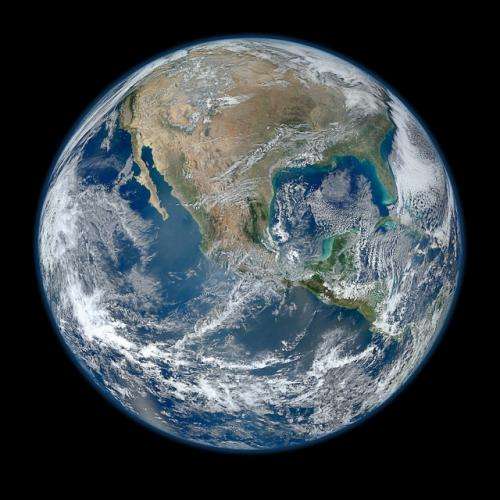
A 'Blue Marble' image of the Earth taken from the VIIRS instrument aboard NASA's most recently launched Earth-observing satellite - Suomi NPP. This composite image uses a number of swaths of the Earth's surface taken on January 4, 2012. Credit: NASA/NOAA/GSFC/Suomi NPP/VIIRS/Norman Kuring.

A new high-definition version of the ‘Blue Marble’ has been taken from the newest Earth observation satellite. The just-renamed Suomi NPP satellite took numerous images on January 4, 2012 and this composite image was created from several “swaths” of Earth. It is a stunningly beautiful look at our home planet, with the largest versions of the image showing about 1.6 km (1 mile) per pixel. This Sun-synchronous Earth-orbiting satellite is 824 kilometers (512 miles) above Earth, and it gets a complete view of our planet every day. It is the first of a new generation of satellites that will observe many facets of how our Earth may be changing.

Originally launched as the National Polar-orbiting Operational Environmental Satellite System Preparatory Project (NPP), it was just renamed ‘Suomi NPP’ on to honor a pioneer in the use of satellites, the late Verner E. Suomi.

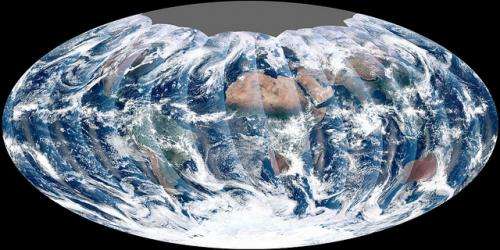
See below for an image showing these “swaths” from global images taken on November 24, 2011.
Blue marble 2012: Amazing high definition image of earth
Enlarge

The Suomi NPP satellite gets a complete view of our planet every day. This image uses 20 orbital ‘swaths’ from November 24, 2011, and is the first complete global image from the VIIRS instrument. Credit: NASA Earth Observatory.

These images were taken with the The Visible/Infrared Imager Radiometer Suite or VIIRS instrument aboard Suomi NPP.

VIIRS images the surface in long wedges measuring 3,000 kilometers (1,900 miles) across. The swaths from each successive orbit overlap one another, so that at the end of the day, the sensor has a complete view of the globe. The Arctic is missing because it is too dark to view in visible light during the winter.

The NPP satellite was placed in a Sun-synchronous orbit, so its path takes the satellite over the equator at the same local (ground) time in every orbit. This orbit allows the satellite to maintain the same angle between the and the Sun so that all images have similar lighting. This consistent angle is important because it allows scientists to compare images from year to year without worrying about extreme changes in shadows and lighting.

Suomi NPP is carrying five instruments on board, and the biggest and most important instrument is VIIRS.

Unfortunately, an anomaly has been discovered in the instrument. During the checkout phase after it launched in October 2011, engineers detected a larger than expected decrease in sensor sensitivity in four of VIIRS’s near-infrared and visible channels.

An analysis revealed an anomalous material on the surface of the mirror, and further investigation on the ground discovered a non-standard process that occurred during the mirror coating as a potential source of tungsten oxide contamination on the VIIRS mirrors. Tungsten oxides could cause the surface of the mirror to darken.

This evidence suggests that the cause of the contamination is limited to the VIIRS instrument, and is not a concern for other NPP instruments. Officials from NPP said that while this problem is likely irreversible, the darkening of the VIIRS mirror caused by the contamination is expected to reach a plateau and remain at that level for the life of the mission. Although testing on this issue is continuing, NPP mission managers expect this plateau to still provide sufficient margins to allow VIIRS to meet its design requirements.

Still, the images have been spectacular so far from Suomi NPP and we look forward to more high definition views of our Blue Marble.

See the complete set of images from this spacecraft on their Flickr site.

Source: Universe Today

4.4 /5 (23 votes)  

Filter


Move the slider to adjust rank threshold, so that you can hide some of the comments.


Display comments: newest first

deatopmg
Jan 26, 2012

Rank: 2 / 5 (3)
so what is the resolution? (k)M/pixel?
pretty pictures but how are they useful, other than PR, vs. the myriad of other photo's of earth?
kafantaris
Jan 26, 2012

Rank: 5 / 5 (5)
Our earth is stunning, absolutely beautiful.
Let us pause for a moment and look at this detailed photo to appreciate the vast and dynamic treasure we have inherited.
Surely we can find a way to solve our problems as the one people that we are.
Surely we can get along enough to save our home, and the home of children and grandchildren.
nkalanaga
Jan 26, 2012

Rank: 5 / 5 (2)
Deatopmq: "It is a stunningly beautiful look at our home planet, with the largest versions of the image showing about 1.6 km (1 mile) per pixel."
evropej
Jan 26, 2012

Rank: 4.8 / 5 (4)
I can never figure out why physorg always has the smallest resolution images possible. Its like it's the 1980's and 14K baud modems were around on AOL dialup. Post some images which can fill most monitors at least, which would be worth looking at. I can't tell you how many times I click on the image to view image just to find that the full image is the same size as the article. Ok, off the soapbox.
fmfbrestel
Jan 26, 2012

Rank: 4.3 / 5 (3)
pretty pictures but how are they useful, other than PR, vs. the myriad of other photo's of earth?


maybe read the article before bitching, hu?

"This orbit allows the satellite to maintain the same angle between the Earth and the Sun so that all images have similar lighting. This consistent angle is important because it allows scientists to compare images from year to year without worrying about extreme changes in shadows and lighting."

Although, I dont know... maybe quoting two whole sentences is too much for you to read.
Graeme
Jan 26, 2012

Rank: not rated yet
And one good feature is that it available for free use under a creative commons attribution license. The flickr image is up to 3360 pixels wide for those that want bigger, but really this should still be available in much higher resolution.
ccr5Delta32
Jan 27, 2012

Rank: 5 / 5 (3)
They could have put a link like this one 8000x8000 pixels
http://www.nasa.g...full.jpg

Sinister1811
Jan 27, 2012

Rank: not rated yet
That's an awesome picture. It's amazing what they can do with imaging these days. I'd love to see a whole planet image with that resolution.
Cynical1
Jan 27, 2012

Rank: not rated yet
Back in the 70's, Jim Capaldi wrote and sang a song called "Livin on a Marble" - And there it is...
rawa1
Jan 27, 2012

Rank: 1 / 5 (1)
The satellite image of North America at the picture above or Africa here just illustrates, how dry our planet actually is already. The decline of forests and spreading of deserts illustrates the climatic change clearly: most of planet surface actually lack the green vegetation.

http://www.worldm...c_sm.jpg
rawa1
Jan 27, 2012

Rank: 1 / 5 (1)
What the huge areas of grey sea at the Easter Pacific are supposed to mean? Are they formed with atmospheric dust of just a water pollution?

http://www.nasa.g...-710.jpg
xen_uno
Jan 27, 2012

Rank: not rated yet
The top spherical pic makes the continental US appear to be 6000 to 7000 miles coast to coast (vs the 3000 is actually is). I find it odd this totally inaccurate (and rather ugly) picture is shown without mention of the significant distortion.
rsangole
Jan 27, 2012

Rank: 5 / 5 (1)
I can never figure out why physorg always has the smallest resolution images possible. Its like it's the 1980's and 14K baud modems were around on AOL dialup. Post some images which can fill most monitors at least, which would be worth looking at. I can't tell you how many times I click on the image to view image just to find that the full image is the same size as the article. Ok, off the soapbox.


Came here to second this! If anyone from physorg is reading, take note!!
Deathclock
Jan 27, 2012

Rank: 5 / 5 (2)
What the huge areas of grey sea at the Easter Pacific are supposed to mean? Are they formed with atmospheric dust of just a water pollution?

http://www.nasa.g...-710.jpg


Those are called clouds. If you look up in the sky you might see some...
Rank 4.4 /5 (23 votes)
Tags

Relevant PhysicsForums posts
  • Calculating the magnitude
    created2 hours ago
  • What is this spectrum I took?
    created12 hours ago
  • Orientation of Space
    created13 hours ago
  • Geologically Active Moon Now: NASA
    created20 hours ago
  • advice on building a science fair telescope
    createdFeb 22, 2012
  • Rise of the Sun
    createdFeb 22, 2012
  • More from Physics Forums - General Astronomy

More news stories

Spitzer finds solid buckyballs in space

(PhysOrg.com) -- Astronomers using data from NASA's Spitzer Space Telescope have, for the first time, discovered buckyballs in a solid form in space. Prior to this discovery, the microscopic carbon spheres ...

Space & Earth / Astronomy

created 14 hours ago | popularity 4.7 / 5 (12) | comments 8 | with audio podcast

Going up: Japan builder eyes space elevator

A Japanese construction firm claimed Wednesday it could execute an out-of-this-world plan to put tourists in space within 40 years by building an elevator that stretches a quarter of the way to the moon.

Space & Earth / Space Exploration

created 21 hours ago | popularity 3.5 / 5 (13) | comments 26

ENASA satellite finds Earth's clouds are getting lower

(PhysOrg.com) -- Earth's clouds got a little lower -- about one percent on average -- during the first decade of this century, finds a new NASA-funded university study based on NASA satellite data. The results ...

Space & Earth / Earth Sciences

created 18 hours ago | popularity 5 / 5 (8) | comments 13 | with audio podcast

Fresh scandal embroils US climate science debate

A fresh scandal over climate change has erupted in the United States after leaked documents appeared to show a right-wing funded campaign to influence how climate science is taught in schools.

Space & Earth / Environment

created 11 hours ago | popularity 4.1 / 5 (9) | comments 8

World's oceans get an acid bath

Among the repercussions of global climate change, the effect of ocean acidification on marine life is one of the least-understood variables.

Space & Earth / Environment

created 18 hours ago | popularity 4.3 / 5 (6) | comments 4 | with audio podcast


Researchers build first physical 'metatronic' circuit

(PhysOrg.com) -- The technological world of the 21st century owes a tremendous amount to advances in electrical engineering, specifically, the ability to finely control the flow of electrical charges using ...

Faster than light neutrinos? More like faulty wiring

You can shelf your designs for a warp drive engine (for now) and put the DeLorean back in the garage; it turns out neutrinos may not have broken any cosmic speed limits after all.

Physicists surprised by disappearing and reappearing superconductivity in iron selenium chalcogenides

Superconductivity is a rare physical state in which matter is able to conduct electricity -- maintain a flow of electrons -- without any resistance. This phenomenon can only be found in certain materials at low temperatures, ...

Stanford research team cracks animated NuCaptcha

(PhysOrg.com) -- The research team from Stanford University, led by Elie Bursztein, that previously had cracked regular CAPTCHAs and then audio CAPTCHAs, now has also successfully cracked the animated version called NuCapt ...

Flesh-eating bacteria inspire superglue

(PhysOrg.com) -- A bio-inspired superglue has been developed by Oxford University researchers that can’t be matched for sticking molecules together and not letting go.

Scientists create potent molecules aimed at treating muscular dystrophy

While RNA is an appealing drug target, small molecules that can actually affect its function have rarely been found. But now scientists from the Florida campus of The Scripps Research Institute have for the first time designed ...